
- Home
- About Us
- Contact Us
- Biography
- MedBound Hub
- InternshipInternship
- Daily Pulse
- Medicine
- Physical Therapy
- InterviewInterview
- Pharmacy
- Biotechnology
- College/InstituteCollege/Institute
- Dentistry
- Blog
- Wellness & Nutrition
- Nursing
- Opinion

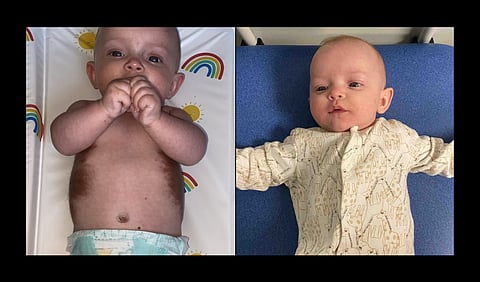
A 10-month-old baby, Macey-Mai, in Plymouth, England, has been diagnosed with cancer after developing complications from a rare birthmark known as giant congenital melanocytic nevus (GCMN). The diagnosis was confirmed in March 2026 following medical evaluation of multiple lesions that had recently changed in appearance.
Doctors remain cautious as early malignant transformation in GCMN, though rare, can indicate aggressive disease progression.
The child was born in May 2025 with a large, dark birthmark covering a significant portion of her back, along with numerous smaller spots across her body. These markings are characteristic of GCMN, a rare skin condition present at birth.
Following the diagnosis, Macey's mother, Katelyn Clarke, has initiated a fundraising campaign to support ongoing medical care.
According to report by SWNS, Macey-Mai’s condition is considered extremely rare not only because of the size of the nevus but also due to the unusually early malignant transformation, which is typically expected later in life rather than during infancy.
The family is seeking treatment at Great Ormond Street Hospital, a leading pediatric center, where Macey-Mai may receive further specialist evaluation and care.
Clarke has been providing updates on GoFundMe, stating that as Macey-Mai’s lesions continue to enlarge, doctors are concerned about possible cancer spread. Further surgery and additional treatment may be required.
She told SWNS,
It’s extremely hard to navigate being a parent of three but also being a parent of a baby with such a rare condition.
Katelyn Clarke
The family has also used the campaign to raise awareness about the condition and its potential complications.
According to reports, the infant developed several raised and painful lesions within the main birthmark. Some of these lesions began to bleed and increase in size over a short period.
Macey-Mai has a large congenital melanocytic nevus covering her entire back, along with more than 100 smaller lesions across her abdomen, scalp, arms, and legs. Clarke told Southwest News Service that she was “completely shocked” upon noticing the dark markings.
In August 2025, doctors removed the suspicious growths and conducted a biopsy. Clarke waited several months for the results, during which Macey-Mai’s lesions were managed with antibiotics. Doctors also advised her to closely observe the lesions for any changes in size, as such changes could indicate possible cancer development.
She explained,
Every single day I have got to take photos, to sit there and look at every single inch of her. Any changes, even the smallest changes can warrant the worst.
Katelyn Clarke
Unfortunately, in March 2026, the test results confirmed that at least one of the lesions had become malignant, indicating the development of skin cancer. The child is now undergoing further medical evaluation and treatment planning.
As reported in the Sun, she explained,
I have never cried like that before, my heart’s been broken since we received the news that one of the lumps was malignant. It has been very hard to comprehend. I knew that with this condition you would probably face malignancy at some point but they said that’s when you are an adult. They never say that you can be born with it so it’s devastating to know that it’s already the case.
Katelyn Clarke
Katelyn reported that her pregnancy was uneventful, with no abnormalities detected on ultrasound scans. She delivered the baby naturally on May 7, 2025, at University Hospitals Plymouth, with a birth weight of 5 pounds 15 ounces.
GCMN is a rare dermatological condition caused by an abnormal proliferation of melanocytes, the cells responsible for skin pigmentation. It occurs in fewer than 1 in 20,000 newborns.
These birthmarks are typically present at birth and may enlarge as the child grows. They can vary in size and number and may develop hair or changes in texture over time.
While most cases remain benign, GCMN is medically significant because it carries an increased risk of melanoma, a form of skin cancer. The lifetime risk is estimated to be between 5% and 10%, although cancer developing in infancy is uncommon.
In some severe cases, GCMN may also be associated with neurological complications such as neurocutaneous melanosis, a rare condition involving melanocyte proliferation in the central nervous system, which further complicates management and prognosis.
Rapid growth
Bleeding
Ulceration
Color change
As Macey-Mai nears her first birthday, Clarke said the occasion feels bittersweet due to her ongoing health challenges, but she hopes to make it the “best birthday ever” for her daughter.
We will never know if it is going to be the last.
Katelyn Clarke
Regular follow-up and timely intervention remain essential in managing patients with large congenital nevi, particularly when changes suggest possible malignancy.
MedlinePlus. “Giant Congenital Melanocytic Nevus.” https://medlineplus.gov/genetics/condition/giant-congenital-melanocytic-nevus/
DermNet NZ. “Congenital Melanocytic Naevi.” https://dermnetnz.org/topics/congenital-melanocytic-naevi
Viana, A. C. L., et al. “Giant Congenital Melanocytic Nevus.” Anais Brasileiros de Dermatologia (2013). https://pmc.ncbi.nlm.nih.gov/articles/PMC3900335/
(Rh/SS)
