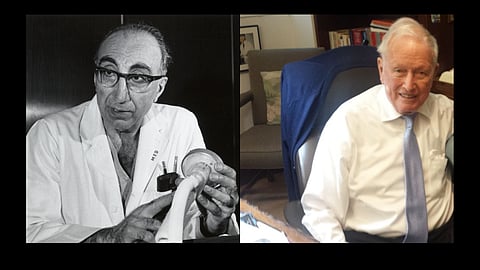
The first total artificial heart implantation in a human was performed in 1969 by Denton Cooley.
The device, developed in the lab of Michael DeBakey, was used without prior approval, sparking controversy.
The artificial heart supported the patient for about 64 hours before a donor heart transplant was attempted.
The case triggered a major medical ethics debate and led to investigations and professional censure.
The incident led to a decades-long DeBakey–Cooley feud and influenced modern research oversight and clinical regulations.
On April 4, 1969, inside an operating room at St. Luke’s Hospital in Houston, Dr. Denton Cooley implanted a device that had never before been used in a human. The patient, Haskell Karp, was in terminal heart failure. With no donor heart immediately available, Cooley and his team used a total artificial heart as a temporary measure.
The device had been developed in the laboratory of Dr. Michael DeBakey at Baylor College of Medicine with support from the National Heart Institute. Its use in humans had not been approved, and Dr. DeBakey was not informed of the procedure at the time.¹
The surgery was publicly announced soon after it was performed and received widespread media attention. A public appeal for a donor heart was made while the patient was supported on the device.⁴
The procedure became the first implantation of a total artificial heart in a human. It also triggered a conflict that would influence surgical ethics, research governance, and professional relationships for decades.
During the 1950s, Dr. DeBakey and Dr. Cooley worked together at Baylor College of Medicine and Methodist Hospital, forming one of the most productive collaborations in cardiovascular surgery. Their work contributed to major advances in vascular repair, aneurysm surgery, and cardiac procedures.
Dr. DeBakey played a central role in research, device development, and institutional leadership. He was also involved in establishing systems such as mobile army surgical hospitals and shaping the Veterans Affairs medical system.¹
Dr. Cooley became known for his operative speed, precision, and high surgical volume. He performed a large number of open-heart procedures annually and trained many surgeons who later became leaders in the field.⁵
Together, they helped position Houston as a major center for cardiovascular innovation.
See also: Baby Fae and the 1984 Baboon-to-Human Heart Transplant: A Turning Point in Xenotransplantation
By the late 1960s, cardiac surgery was undergoing rapid change. The first successful human heart transplant in 1967 intensified the need for mechanical support systems that could sustain patients awaiting donor organs.
The concept of a total artificial heart emerged as both a temporary and potential long-term solution. Devices developed during this period used synthetic materials and external consoles to maintain circulation.
The artificial heart developed in Dr. DeBakey’s laboratory, in collaboration with Dr. Domingo Liotta, consisted of a pneumatically driven system connected to an external pump. It had been tested in animal models, but results were limited and did not meet the threshold for approved human trials.¹³
Liotta had expressed concerns that progress on the artificial heart project was not advancing as quickly as expected within Dr. DeBakey’s program. This tension contributed to his decision to collaborate with Cooley on the implantation.⁷
On April 4, 1969, Dr. Cooley proceeded with implantation of the artificial heart at St. Luke’s Hospital. He was assisted by Dr. Domingo Liotta, who had been closely involved in the device’s development.
The device maintained the patient’s circulation for approximately 64 hours. During this period, a donor heart became available, and a transplant was performed. The patient survived for an additional 32 to 36 hours before death.¹⁴
During its use, the artificial heart demonstrated limitations similar to those observed in prior animal experiments, including evidence of organ dysfunction. These findings reinforced concerns about the device’s readiness for human application.⁴
This marked the first documented use of a total artificial heart in a human as a bridge to transplantation.
Dr. DeBakey learned of the procedure while attending a meeting and returned to Houston to investigate. He stated that the device had been removed from his laboratory without authorization and used in violation of federal research protocols.
Because the project was funded by the National Institutes of Health, the unauthorized use raised concerns about compliance and oversight. Investigations were initiated by Baylor College of Medicine and federal agencies.¹
The American College of Surgeons formally censured Cooley for his actions. He subsequently resigned from Baylor.¹⁴
The incident also highlighted tensions between surgical innovation and institutional accountability, particularly when federally funded research is involved.
See also: Australian Man Makes History with 100-Day Survival Using Artificial Heart
The disagreement between DeBakey and Cooley reflected a broader ethical dilemma that remains relevant today.
Cooley maintained that the patient faced imminent death and that the artificial heart was used as a last resort. He later stated that the procedure was justified as an emergency intervention.¹
DeBakey argued that the device lacked sufficient experimental validation and that bypassing established approval processes compromised both patient safety and scientific integrity. The observed organ dysfunction during the procedure further supported his concern that the technology required more rigorous testing before human use.⁴
This case became an early example of tensions that continue to shape modern medicine:
Physician autonomy versus institutional oversight
Emergency decision-making versus regulatory compliance
Innovation versus patient safety
Subsequent artificial heart trials were conducted under more structured regulatory frameworks, including oversight by ethics committees and the Food and Drug Administration.¹
After leaving Baylor, Cooley founded the Texas Heart Institute in 1962, which expanded significantly after the 1969 events. The institute became a major center for cardiovascular surgery and research.
DeBakey continued to lead surgical innovation at Baylor and Methodist Hospital. Both institutions developed internationally recognized programs, often attracting patients and trainees from around the world.
Despite their close physical proximity, the two surgeons led separate professional spheres, reinforcing a long-standing division within Houston’s medical community.
For nearly four decades, DeBakey and Cooley had minimal communication. Each continued to contribute to advancements in cardiovascular surgery and medical education.
Their perspectives on the conflict remained different. Cooley acknowledged the rivalry, while DeBakey often minimized its significance publicly, even while maintaining criticism of the 1969 procedure.¹
In 2007, DeBakey and Cooley met publicly at a professional event in Houston. At ages 99 and 87, they exchanged a handshake and shared a brief interaction.
The moment was symbolic and marked the end of one of the longest-standing disputes in modern medicine.¹
The reconciliation occurred shortly before the death of Michael DeBakey in 2008. Denton Cooley later died in 2016.
Although the underlying disagreements were not formally revisited, both surgeons expressed respect for each other’s contributions to cardiac surgery.
The 1969 artificial heart implantation had lasting implications beyond the immediate conflict.
It strengthened regulatory oversight in experimental surgery and contributed to clearer ethical guidelines for device trials. The case also influenced the development of stricter institutional review board systems and greater involvement of the Food and Drug Administration in approving experimental devices for human use.³
Artificial heart technology has since advanced significantly. Modern devices are used under regulated conditions as bridges to transplantation or as long-term support in selected patients.
Both DeBakey and Cooley remain central figures in cardiovascular surgery. Their work continues to influence surgical practice, training, and innovation.
Lawrence K. Altman, “The Feud,” The New York Times, November 27, 2007.
Columbia University, “Surgical Transgressions: Michael DeBakey, Denton Cooley, and the Controversial Artificial Heart.” https://scienceandsociety.columbia.edu/events/surgical-transgressions-michael-debakey-denton-cooley-and-controversial-artificial-heart
Frazier, O. H., et al. “The Total Artificial Heart: Past, Present, and Future.” Texas Heart Institute Journal. https://pmc.ncbi.nlm.nih.gov/articles/PMC3014126/
American College of Surgeons. “The Stolen Heart: The DeBakey-Cooley Controversy Beats On.” https://www.facs.org/for-medical-professionals/news-publications/news-and-articles/bulletin/2023/september-2023-volume-108-issue-9/stolen-heart-debakey-cooley-controversy-beats-on/
Transonic. “Dr. Denton Cooley and Cardiothoracic Surgery.” https://blog.transonic.com/cardiothoracic-surgery/cardiothoracic-surgery-dr.-denton-cooley
National Library of Medicine. https://resource.nlm.nih.gov/101743405X260
Nose, Y., et al. Historical perspectives on artificial heart development. https://pmc.ncbi.nlm.nih.gov/articles/PMC3377308/