
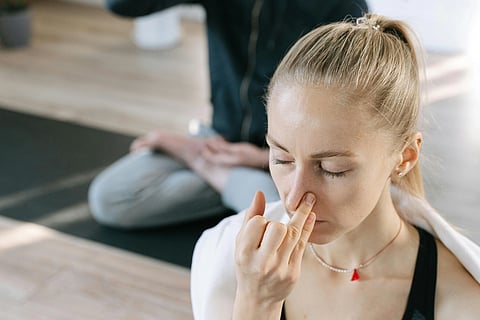
Woman practising pranayama, alternate nostril breathing performed seated indoors with a second person visible in the background, suggesting supervised practice
Pranayama practices recommended by the contributing specialists for patients with allergic rhinitis and asthma for respiratory strengthening and stress reduction. Specialists advise learning from a qualified yoga teacher, not from social media Photo by Ivan S from Pexels

Your Allergy Questions, Answered by a Pulmonologist and Dermatologist

Fourteen questions patients always want to ask, including which yoga practices actually help, what eczema looks like on Indian skin, and why your sinus infection antibiotics never work.
Published on

You have had the same “sinus infection” again and again. Each time, you are prescribed another course of antibiotics. The symptoms settle briefly, then return. Over time, the pattern becomes harder to ignore and easier to dismiss. If this sounds familiar, this article is for you.

MedBound Times put fourteen of the most common allergy questions to two specialists: Dr. Aishwarya C, MBBS, MD, Consultant Pulmonologist, Vagus Hospital, Bengaluru and Dr. A.P. Balaji, MBBS, MD, DVL, FRGUHS, Consultant Dermatologist, Bhairavi Skin, Hair, Laser & Cosmetology Clinic, Chennai, both practising yoga, both willing to say what most patients are never told.

Understanding your allergy

"I never had allergies before. Why now? And is there any chance they go away?"

Q

Dr. Abhinaya K: I see that many patients are demoralised by the word "chronic." When they ask if there is a cure for the allergies, what do u tell them?

A

Dr. Aishwarya C: The word ‘permanent’ makes most patients think that they are doomed. The reality is more specific and more hopeful.

Allergies are chronic immune responses and often persist, but the distinction between ‘permanent’ and ‘curable’ is more nuanced than most patients are told. Some childhood food allergies remit with age. Allergic rhinitis and asthma are less likely to disappear entirely, though long remissions are possible. Allergen immunotherapy (allergy shots or sublingual drops) is the only treatment that modifies the underlying immune response and can produce sustained remission even after stopping. That is the closest thing to a cure that current evidence supports.

For most patients, the realistic goal is well-controlled disease with minimal medication. That is entirely achievable and it is a fundamentally different picture from living with it forever.

Q

Dr. Abhinaya K: Often we see allergies in adults with no family history. Why are we seeing this happen in patients whose parents did not have this disease?

A

 Dr. Aishwarya C: What is inherited is not allergies directly, it is an immune tendency. That predisposition may never activate in one generation and express fully in the next, depending on the environment. Modern urban living, reduced microbial exposure in early childhood, increased antibiotic use, less contact with animals and natural environments, shifts immune development toward an allergic pattern. You may carry the same genetic predisposition as your parents but have grown up in a more allergenic environment. They had the same genes and a less allergenic one.

Q

Dr. Abhinaya K: Patients often complain that their "meds stopped working" or that symptoms are getting worse. How do you explain this?

A

Dr. Aishwarya C: Sensitisation (Immune system building a response to a specific allergen), can occur silently over months or years before any symptoms appear. By the time symptoms start, the threshold has already been crossed. Several things can shift that threshold: a viral respiratory illness, a change in living environment, pollen load from a particularly heavy season, or hormonal changes that modulate immune function.

The allergy did not start suddenly. The threshold was crossed.
Dr. Aishwarya C, MD Pulmonology - Vagus Hospital, Bengaluru
Q

Dr. Abhinaya K: A common clinical challenge we face is patients asking: 'Why do my symptoms keep coming back even when I take my medication?' From an immunological standpoint, why is symptomatic relief often just a temporary fix?

A

Dr. Aishwarya C: Medication only controls inflammation, thereby reducing symptoms, it does not eliminate the underlying immune hypersensitivity. The allergic reaction to a specific protein persists as long as the immune memory persists. Every time you are exposed to the allergen, the cascade re-activates. Antihistamines block the effect of histamine (inflammatory mediator causing symptoms such as sneezing, cough, runny nose). Nasal sprays reduce local mucosal inflammation. Both these medications only treat the effects of the disease. They do not change the fact that your immune system has learned to treat a harmless protein as a threat.

What your doctor wishes you knew

  • If your symptoms recur every year at the same time or in the same places, you almost certainly have allergic rhinitis,  not a recurring infection.

  • Medications that stop working after years of success usually means the allergy load has increased, not that the drug has failed.

  • A confirmed allergy diagnosis opens access to immunotherapy, the only treatment that can modify the immune response. Most patients are never told about it.

Allergic rhinitis affects a significant proportion of the Indian population, with prevalence estimates of around 20 to 30 percent

Infographic differences between common cold, sinusitis, and allergic rhinitis across eight markers including onset, mucus colour, fever, itchy eyes, and antibiotic response.
Cold, sinusitis, or allergic rhinitis - three conditions with overlapping symptoms but completely different causes and treatments. Reviewed by a Pulmonologist and Dermatologist.Illustration by MedBound Times. For educational purposes only

Also read: Polluting household fuels are linked to higher eczema and asthma risk in young children.

Natural Progression of Disease: Skin, Gut, and Mind

Q

Dr. Abhinaya K: We are increasingly recognizing the "skin-gut-mind" axis. Dr. Balaji, how do you explain the gut microbiome's (beneficial organisms in the gut) role in a patient presenting with an acute eczema flare?

A

Dr. A.P. Balaji: The gut is now called the second brain and it is directly connected to skin health and mental health. When gut health is appropriate, many allergies can be managed more effectively. I look beyond topical treatment (medication delivered by applying on skin) when a patient has recurring flares that do not respond predictably, or when there is a clear pattern after specific foods. Taking anti-inflammatory foods, dietary fibre, and probiotics under guidance matter.

Q

Dr. Abhinaya K: I’ve noticed a high correlation between eczema and anxiety in children. Is there a physiological link beyond the obvious discomfort of itching?

A

Dr. A.P. Balaji: You are not imagining it. More than 80% of diseases have a psychosomatic dimension (physical illness caused or worsened by mental factors like stress, anxiety, etc.), and eczema is a clear example of it. When the skin is inflamed and itching, stress hormones rise. When stress hormones rise, the skin barrier becomes more permeable and inflammation worsens. Itching skin drives an itching mind, and an itching mind drives itching skin.

Q

Dr. Abhinaya K: For the primary care physicians and pediatricians reading this, can we talk about the "Atopic March"? How critical is early intervention?

A

Dr. Aishwarya C: It’s critical. Roughly half of children with moderate eczema may develop asthma. Uncontrolled rhinitis is a major risk factor for asthma severity.

A

Dr. A.P. Balaji: It starts from birth. Treating the skin barrier aggressively in infancy (children under 1 year of age) can actually help prevent further progression, I would say. Waiting for respiratory symptoms to manifest is often waiting too long.

Q

Dr. Abhinaya K: In most medical textbooks eczema is represented as a bright red, clearly demarcated rash on a lighter skin. In Indian context, what does eczema actually look like on darker skin?

A

Dr. A.P. Balaji: In Indian patients, look for: intensely itchy, thickened, darkened patches and plaques, most commonly on the inner elbows, behind the knees, around the neck, and on the wrists. The thickening and darkening are the skin’s response to chronic scratching and inflammation. The redness reads as a darker, greyish or brownish discolouration.

Getting diagnosed and treated correctly

"I have taken antibiotics four times this year for a sinus infection. Nothing clears. Nobody has tested me for anything."

Infographic showing the seasonal allergy cycle in India. Spring tree pollen, Pre-monsoon thunderstorm asthma risk, Monsoon mould spores, Post-monsoon weed, Winter smog and indoor allergens.
Seasonal Aeroallergen & Environmental Irritant Calendar for India. Note the critical risk windows for Thunderstorm Asthma (May–June) and Pollution-linked exacerbations (December–January).Infographic by MedBound Times. Data Sources: All India Coordinated Project on Aeroallergens (AICPA); ICAR Pollen Calendar Data; Environmental Exposure Studies (2024-2026).
Q

Dr. Abhinaya: I see patients on their fourth or fifth course of antibiotics for "sinusitis." How do we differentiate this from chronic allergic rhinitis?

A

Dr. Aishwarya C: Most of these cases are not bacterial. Antibiotics have no mechanism to address allergic inflammation. If a "sinus infection" recurs annually or never fully clears, it’s almost certainly allergic rhinitis. I advise practitioners to skip the next round of antibiotics and order a skin-prick test or specific IgE blood test.

A

Dr. A.P. Balaji: Clearing the infection with antibiotics is treating the surface, not the source. Sinusitis in most of these cases is inflammation triggered by allergens or food sensitivities. We must identify them and address them at the root. Yoga, particularly pranayama and Jala Neti (cleansing the nasal passages with salt water using a copper Jala Neti pot), along with medications, plays a significant role in symptom control. Some patients may even completely come off medications.

Q

Dr. Abhinaya K: How will you explain when patients ask "How do I actually find out what is triggering my allergy?"

A

Dr. Aishwarya: You need a proper allergy work-up, there is no shortcut. A skin-prick test or specific IgE blood test identifies which allergens your immune system has sensitised to. But a positive test result is only the beginning. The clinical history, when your symptoms occur, where they are worst, what makes them better or worse, is equally important. Some patients have multiple sensitivities; some have sensitisation on a test that does not correspond to their actual symptoms. An allergist integrates both. Self-diagnosing based on symptoms alone leads patients in the wrong direction for years.

Managing Allergies in the long term

"I have three doctors, none talking to each other. I am trying yoga and nobody is guiding me properly. Where do I even start?"

Q

Dr. Abhinaya K: Can yoga actually help with allergies and eczema and which practices specifically?

A

Dr. A.P. Balaji: Stress is one of the most powerful eczema triggers. It is often underestimated and when cortisol spikes, the skin barrier becomes more permeable. Yoga’s effect on cortisol is real and measurable. I am specific about which practices because imprecise recommendations can cause harm.

  • Shambhavi Mahamudra:  breath, bandha, focused attention. Stress regulation and respiratory health.

  • Shakti Chalana Kriya: deeper nervous system regulation in chronic inflammatory conditions. 

  • Bhastrika Kriya: vigorous breathing that improves lung capacity. Asthma and chronic sinus issues. Must be supervised, contraindicated in some conditions. 

  • Jala Neti:  nasal saline irrigation. Directly reduces mucosal inflammation. One of the most effective adjuncts for chronic rhinitis in clinical practice. 

A

Dr. Aishwarya C: Daily pranayama practice: FeNO levels may drop, rescue inhaler use may reduce, symptom control between doses may improve in patients who maintain the practice.

All these practices must be learned under supervision from a trained yoga teacher as incorrect practices may cause damage to the system.
Q

Dr. Abhinaya K. Before we conclude, I empathize with patients telling me "I am seeing three different doctors for eczema, rhinitis, and asthma and none of them are talking to each other. What can I do?" How do you think this can be managed?

A

Dr. Aishwarya: Bring a single written summary of all your conditions, all your medications, and all your treating doctors to every appointment. Ask each doctor explicitly: ‘What do you know about my other conditions, and does that change your plan for me?’ Request that your reports be shared. If symptoms are inadequately controlled across all three conditions, that is the signal to see an allergist who can assess the full atopic picture together.

A patient with eczema, rhinitis, and asthma does not have three diseases. They have one dysregulated immune system expressing itself in three places.
Dr. A.P. Balaji, MD DVL, Bhairavi Skin Clinic
A

Dr. A.P. Balaji: The way I see it, the problem is not only that doctors are not coordinating, it is that the system treats disease in fragments when disease is whole. A patient with eczema, rhinitis, and asthma does not have three diseases. They have one dysregulated immune system expressing itself in three places. Coordination across systems of medicine matters. Ayurveda, Siddha, and allopathy each have legitimate and complementary tools for managing chronic allergic conditions. A patient whose allopathic treatment is inadequate may find that Ayurvedic or Siddha approaches address root inflammatory and digestive factors that modern dermatology does not prioritise. This is not a rejection of evidence-based medicine. It is an expansion of it.

ALLERGIES WORSE IN 2026? 3 ACTIONABLE STEPS: stay indoors during thunderstorms, choose allergy testing for seasonal symptoms, and treat infant eczema early to prevent the "Atopic March" to asthma.
3 Actionable Steps to Manage Allergic Rhinitis, Asthma, and Eczema, with Medical Guidance from Pulmonologist and DermatologistIllustrated by MedBound Times. For educational purposes only.
Summary

1. It's not just the season, the pollen has changed. Modern lifestyle and reduced microbial exposure in early childhood can lead to allergies in adults the 'immune threshold' crosses.

2. Eczema on Indian skin: Brownish or greyish rash and not red.

3. 'Sinus infections' may be allergies. So avoid overusing antibiotics.

4. While symptomatic medication relieve acute episodes, immunotherapy is only able to modify the immune response.

5. Yoga and pranayama when done under supervision may help with long-term symptom control.

Allergy is not an infection that keeps coming back. It is a system that was never understood properly.
For informational purposes only. Not medical advice. Consult a qualified allergist, pulmonologist, or dermatologist. Yoga and pranayama are adjuncts to prescribed treatment, not replacements, and must be introduced under qualified medical and yoga supervision.

Reference:

1. Varshney, J., and S. Varshney. “Allergic Rhinitis: An Overview.” Indian Journal of Otolaryngology and Head & Neck Surgery 67, no. 2 (2015): 143–149. https://doi.org/10.1007/s12070-015-0828-5

MSM

Woman practising pranayama, alternate nostril breathing performed seated indoors with a second person visible in the background, suggesting supervised practice
Why Your Allergies Keep Getting Worse Every Year: A Pulmonologist and Dermatologist Explain

Related Stories

No stories found.
logo
Medbound Times
www.medboundtimes.com