
Anatomy has traditionally been taught through cadaveric dissection, lectures, and textbooks. While these methods remain fundamental, the integration of digital tools has significantly transformed how students approach the subject.
Modern anatomy apps offer interactive 3D visualization, self-paced learning, and clinical integration, making complex structures easier to understand and remember. For today’s medical students, these tools are not just optional, they are becoming essential companions alongside conventional learning methods.
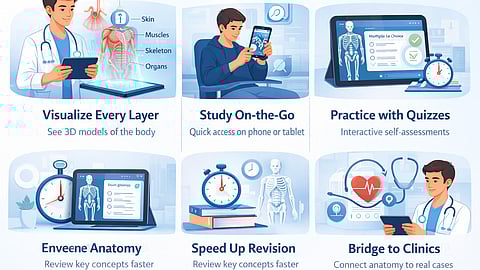
One of the biggest challenges in anatomy is visualizing structures in three dimensions. Anatomy apps allow students to rotate, zoom, and isolate structures, improving spatial comprehension significantly.
These apps enable learning anytime and anywhere, making them especially useful during clinical postings or quick revisions before exams.
Interactive features such as quizzes, animations, and layered dissection promote active learning, which helps in better retention compared to passive reading.
Some platforms integrate pathology, imaging, and procedures, helping students connect anatomical knowledge with real clinical scenarios.
Complete Anatomy is one of the most comprehensive digital anatomy platforms available. Developed by 3D4Medical, it is widely used across medical schools globally.
Highly detailed 3D anatomical models
Features like muscle movement, cross-sections, and radiology integration
Multi-device compatibility
Best suited for: In-depth understanding and clinical visualization
BioDigital Human stands out for combining anatomy with real-world clinical conditions. It allows users to explore diseases, treatments, and procedures alongside normal anatomy.
Interactive models covering anatomy and pathology
Cloud-based access across devices
Useful for both learning and patient education
Best suited for: Clinical correlation and applied learning
TeachMeAnatomy is a well-established educational platform known for its clear explanations and structured content. It is a widely used platform offering extensive anatomy articles, diagrams, and quizzes
Covers a wide range of anatomy topics with illustrations
Includes MCQs and clinical correlations
Easily accessible on mobile and desktop
Best suited for: Concept building and revision
This app is a popular choice among students who are starting their anatomy journey. It offers a simple and intuitive interface for exploring the human body.
Full 3D interaction with rotation and layer removal
Built-in quizzes for practice
Accessible across multiple platforms
Best suited for: Beginners and quick revision
Anatomy 3D Atlas provides a straightforward way to explore anatomical structures in three dimensions. It is particularly useful for building foundational knowledge.
Interactive 3D visualization of body systems
Simple navigation for focused study
Suitable for early-stage learners
Best suited for: Basic understanding of anatomy
Improve visualization and spatial learning
Encourage active and interactive study
Provide easy access to complex anatomical details
Support revision and exam preparation
Cannot fully replace cadaveric dissection
Some advanced features require paid subscriptions
Over-reliance may reduce hands-on learning experience
With advancements in augmented reality (AR), virtual reality (VR), and artificial intelligence, anatomy education is becoming more immersive. These technologies are expected to further enhance visualization, engagement, and clinical integration in the coming years.
Anatomy apps have become powerful tools in modern medical education. Platforms like Complete Anatomy and BioDigital Human offer advanced visualization and clinical insights, while TeachMeAnatomy and Anatomy Learning provide accessible and effective learning support.
The most effective approach is to combine these digital resources with traditional methods, ensuring a well-rounded understanding of human anatomy.