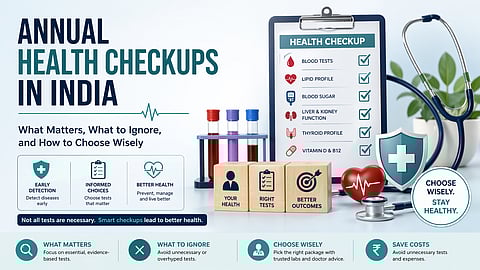
Annual health checkups have become increasingly common in India, driven by rising awareness of non-communicable diseases and the expansion of diagnostic services. These evaluations are widely promoted as essential tools for early disease detection and improved well-being.
From a clinical perspective, preventive health checkups aim to identify diseases in their preclinical phase and enable timely intervention. However, growing evidence suggests that while such checkups have benefits, their routine and indiscriminate use may not always translate into improved health outcomes.1
This raises a critical question: are annual health checkups always necessary, or are they sometimes excessive?
Preventive health checkups are designed to:
Detect diseases before symptoms appear
Identify modifiable risk factors
Promote early intervention
These checkups play a significant role in managing the growing burden of chronic diseases such as diabetes and hypertension.2 Early identification of risk factors allows for timely lifestyle modification and medical management, potentially reducing long-term complications.
Most diagnostic providers structure annual checkups as bundled test panels, combining blood investigations, imaging, and cardiac assessments into a single offering. The emphasis is on convenience and completeness rather than clinical necessity.
Research suggests that while such packages may improve awareness and encourage health-seeking behavior, they often lack risk stratification, which is essential for meaningful preventive care.3
These are comprehensive evaluations offered by tertiary care hospitals, typically marketed toward urban professionals.
They usually include:
Detailed laboratory testing
Imaging (ultrasound, X-ray)
Cardiac evaluation
Physician consultation
While these checkups provide a structured clinical interface, evidence indicates that routine, broad-based testing may not always improve long-term outcomes, particularly in asymptomatic individuals.1
Diagnostic chains offer tiered packages that can be booked directly without physician consultation.
Characteristics include:
Predefined test panels
Lower cost compared to hospital packages
Minimal clinical interpretation
Although accessible and convenient, these packages may contribute to overuse of diagnostic testing, especially when used without clinical guidance.2
Digital health platforms have further expanded the reach of preventive checkups by enabling:
Home sample collection
Online booking and reports
Minimal interaction with healthcare providers
This model improves accessibility but raises concerns about detachment from clinical context, where test results may not be appropriately interpreted or followed up.3
Health checkup packages in India are generally structured as bundled panels of investigations, combining essential screening tests with additional parameters that may or may not be clinically indicated. While these packages aim to provide comprehensive assessment, their composition often reflects standardization rather than individualisation.2
These form the foundation of nearly all health checkup packages and are primarily aimed at detecting common metabolic and systemic conditions:
Complete Blood Count (CBC)
Fasting blood glucose and/or HbA1c
Lipid profile
Liver function tests (LFT)
Kidney function tests (KFT)
These investigations are widely used for early detection of conditions such as anemia, diabetes, dyslipidemia, and organ dysfunction. Their inclusion is generally justified, as they target high-prevalence, often asymptomatic conditions.2
Many packages include additional biochemical tests that are frequently promoted as essential, despite limited indication in asymptomatic individuals:
Thyroid profile
Vitamin B12 and Vitamin D levels
Iron studies
While these tests may be clinically useful in selected individuals, routine screening without specific risk factors or symptoms can lead to overdiagnosis and unnecessary supplementation. Evidence suggests that indiscriminate testing contributes to increased healthcare costs without proportionate clinical benefit.2
Higher-tier packages often include imaging and basic cardiac assessments:
Ultrasound abdomen
Chest X-ray
Electrocardiogram (ECG)
These investigations are typically marketed as tools for “comprehensive internal assessment.” However, their routine use in asymptomatic individuals is debatable. Studies indicate that broad, non-targeted screening may increase the likelihood of incidental findings, leading to further investigations without clear improvement in health outcomes.1
Some packages incorporate gender-specific screening tests:
Women:
Pap smear
Breast ultrasound
Men:
Prostate-specific antigen (PSA)
These tests are intended for early detection of cancers. However, their effectiveness depends heavily on appropriate age, risk stratification, and screening intervals. When used outside recommended contexts, such tests may contribute to false positives and overdiagnosis, particularly in low-risk populations.1,2
Preventive health checkups enable the detection of diseases at an early, asymptomatic stage, allowing for timely treatment and improved prognosis.2
Health checkups often act as a catalyst for behavioral change. Individuals undergoing screening are more likely to adopt healthier lifestyles, including better dietary habits and increased physical activity.2
Routine screening contributes to improved detection of chronic diseases such as hypertension and diabetes, which are often asymptomatic in early stages.2
Despite their benefits, utilization of preventive health checkups remains suboptimal in certain populations. A study conducted in rural India found that only a limited proportion of individuals underwent routine screening, highlighting barriers such as lack of awareness and accessibility.3
Evidence suggests that general health checkups may not significantly reduce overall mortality, despite increasing disease detection rates.1 This highlights a gap between diagnosis and meaningful long-term outcomes.
Excessive or unnecessary screening can lead to the detection of clinically insignificant abnormalities, resulting in overdiagnosis and overtreatment.2
False-positive results and incidental findings may lead to anxiety, repeated testing, and increased healthcare costs, without proportional clinical benefit.2
Preventive health checkups tend to be more beneficial for high-risk individuals. In low-risk populations, the benefits may be limited, emphasizing the need for selective screening.2
A major limitation of annual health checkups in India is the reliance on uniform packages that do not account for individual risk factors.
Evidence indicates that targeted, risk-based screening is more effective than routine, generalized testing. Standardized packages may include unnecessary investigations, contributing to overuse of healthcare resources without improving outcomes.
A more effective strategy involves:
Screening should be tailored to:
Age
Gender
Family history
Lifestyle factors
Individuals with higher risk profiles derive greater benefit from preventive checkups and should be prioritized.
Preventive checkups should complement, not replace, healthy lifestyle practices such as balanced nutrition, regular exercise, and stress management.
Choosing a health checkup package should be based on clinical relevance rather than the number of tests included.2
Essential tests only (glucose, lipid profile, CBC) targeting common conditions
NABL-accredited labs for reliable results
Doctor consultation for proper interpretation.3
“Unlimited tests” packages, which increase the risk of false positives.1
Routine vitamin panels without symptoms, often unnecessary.2
Random hormone tests without indication, with limited clinical value
A good checkup is targeted, evidence-based, and interpreted clinically, not just a long list of tests.2
Annual health checkups play an important role in preventive healthcare by facilitating early disease detection and improving health awareness. However, their effectiveness depends on appropriate use.
Current evidence suggests that while preventive checkups can improve disease detection, they do not consistently reduce mortality and may lead to overdiagnosis if used indiscriminately.1
Therefore, a shift toward personalized, risk-based screening is essential to ensure that preventive healthcare remains both clinically meaningful and economically sustainable.
1. Honnekeri, B., A. Vyas, D. Lokhandwala, A. Vaishnav, A. Vaishnav, M. Singhal, P. Barwad, G. K. Panicker, and Y. Lokhandwala. 2016. “Routine Health Check-Ups: A Boon or a Burden?” National Medical Journal of India 29 (1): 18–21.
2. Vaishya, Raju, et al. 2025. “Significance of Preventive Health Checkups in Enhancing Well-Being: A Comprehensive Review.” National Board of Examinations Journal of Medical Sciences.
3. Arulselvan, G., S. Chidambaram, N. George, S. Rizvana, P. Narayan, P. Annamalai, P. H. R. Vadakaraiyan, N. Rajagopal, R. B. Dharmaraj, and T. M. 2024. “Preventive Health Checkup: Utilization, Motivators, and Barriers Among the General Population in a Rural District in Tamil Nadu, India.” Cureus 16 (1): e52529.