- Home
- About Us
- Contact Us
- Biography
- MedBound Hub
- InternshipInternship
- Daily Pulse
- Medicine
- Physical Therapy
- InterviewInterview
- Pharmacy
- Biotechnology
- College/InstituteCollege/Institute
- Dentistry
- Blog
- Wellness & Nutrition
- Nursing
- Opinion

Aquagenic urticaria is a very rare condition in which the skin develops small, itchy hives after coming in contact with water. The reaction affects routine activities such as bathing, sweating, washing hands or getting caught in the rain. Early recognition helps avoid confusion with other skin conditions and supports timely management.
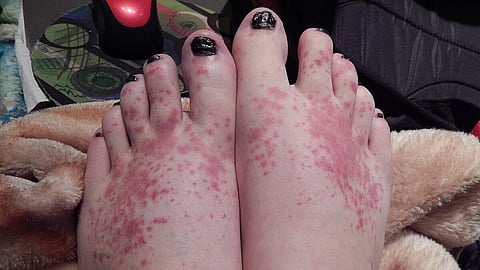
Small raised bumps, often 1 to 3 millimeters in size, appear a few minutes after the skin comes in contact with water. These bumps may be surrounded by redness and can cause itching or a mild burning sensation. The trigger can be any form of water, including rainwater, sweat, tears, tap water or seawater. The temperature and purity of the water do not influence the reaction. Symptoms usually settle within 30 to 60 minutes once the skin dries.[1]
The hives commonly appear on the upper body, arms and neck. Palms and soles are less frequently involved. Most cases present only with skin symptoms. Rare reports describe breathing difficulty or wheezing.[1]
Fewer than a hundred cases have been described in medical literature. Reports indicate a higher frequency in females. Many patients develop symptoms around puberty or early adulthood. Some children with the condition have also been documented.[2] Because aquagenic urticaria is uncommon, health care professionals may confuse it with cold induced urticaria or cholinergic urticaria.[3]
Unlike cholinergic urticaria, where sweating and heat-induced increases in body temperature are the primary triggers, aquagenic urticaria is triggered by direct contact with water itself, regardless of temperature or physical exertion.
The exact mechanism remains unclear. One explanation suggests that water interacts with natural oils or substances on the skin and forms a compound that activates mast cells, which then release histamine. This release leads to the formation of hives.[1] Another theory proposes that a water-soluble substance in the skin dissolves after exposure and enters deeper layers, where it triggers mast cell activation.[2] Temperature or pH does not influence the reaction, which helps differentiate it from other physical urticarias.[4]
Diagnosis begins with a detailed history of symptoms that appear consistently after water contact and disappear shortly afterward. A water challenge test is the key step. In this test, a cloth soaked in room temperature water is placed on the skin for 15 to 30 minutes. The appearance of hives after the cloth is removed supports the diagnosis.[1] Additional tests may be used when doctors need to rule out other types of urticaria.[3]
There is no cure, but treatment helps control symptoms. Second-generation antihistamines remain the first line of management. Some individuals require higher doses for adequate relief.[1] Many patients benefit from applying a barrier cream or petroleum jelly before bathing to prevent water from directly contacting the skin. This measure can reduce or prevent symptoms. In more difficult cases, doctors may try phototherapy or biologic medicines, although data on these approaches remain limited.[2]
To better understand the clinical challenges associated with aquagenic urticaria, MedBound Times spoke with Dr. Rutuja Lokhande, MBBS, DDVL, DNB, Consultant Dermatologist at Dr Lokhande's Skin and Orthopedic Speciality Clinic, Pune, who shared her expert perspective on diagnosis and management.
"Aquagenic urticaria is a very rare form of urticaria which occurs when skin comes in contact with water, sweat or tears. Managing aquagenic urticaria is a challenge, as sometimes it may present with other physical urticarias as well," she said.
It is very important that such topics be discussed and people be made aware of these medical conditions. As such conversation might help patients to come forward and seek help.
Dr. Rutuja Lokhande, Consultant Dermatologist
Addressing the management of aquagenic urticaria, she said, "Though treating aquagenic urticaria is a challenge as absolute non-contact with water cannot be practiced, but we can still offer patients antihistamines, which can relieve the symptoms to some extent."
"I also ask my patients to avoid contact with extreme temperatures of water, such as to avoid bathing with very hot water or very cold water. I also advise them not to rub their body to wipe off the water or sweat, as friction and extreme water temperatures can trigger other forms of physical urticarias and can worsen the situation," she added.
She noted that, "Some patients may benefit from phototherapy, which reduces mast cell activity and decreases water penetration by strengthening the skin barrier."
The more we talk about it, the more people will become aware of such conditions and will seek medical expertise. Timely medical help can increase the quality of life of a patient and reduce their day-to-day turmoil. It is the need of the hour to educate people more about such rare conditions.
Dr. Rutuja Lokhande, Consultant Dermatologist
Water exposure is a daily necessity. For individuals with aquagenic urticaria, each exposure may lead to discomfort and anxiety. Awareness among clinicians and the public helps reduce delays in diagnosis. A simple water challenge test can provide clarity and guide treatment. Early recognition allows individuals to manage symptoms effectively and maintain daily activities without unnecessary concern.
References
1. Rothbaum R, McGee JS. Aquagenic urticaria: diagnostic and management challenges. J Asthma Allergy. 2016 Nov 29;9:209-213. doi: 10.2147/JAA.S91505. PMID: 27942227; PMCID: PMC5136360.
2. Abdi P, Diamond C, Stuckless JM. Aquagenic urticaria: presentation, diagnosis and management. BMJ Case Rep. 2024 Nov 11;17(11):e260364. doi: 10.1136/bcr-2024-260364. PMID: 39532327; PMCID: PMC11557450.
3. Kabadayı G, Baysal Bakır D, Yağmur H, Atay Ö, Uzuner N. Is a Life Without Water Possible? Aquagenic Urticaria: Report of a Case and Review of the Literature. Pediatric Allergy, Immunology, and Pulmonology. 2025;38(2):57-60.
4. Wang F, Zhao YK, Luo ZY, Gao Q, Wu W, Sarkar R, Luo DQ. Aquagenic cutaneous disorders. J Dtsch Dermatol Ges. 2017 Jun;15(6):602-608. doi: 10.1111/ddg.13234. Epub 2017 May 17. PMID: 28513988.