
- Home
- About Us
- Contact Us
- Biography
- MedBound Hub
- InternshipInternship
- Daily Pulse
- Medicine
- Physical Therapy
- InterviewInterview
- Pharmacy
- Biotechnology
- College/InstituteCollege/Institute
- Dentistry
- Blog
- Wellness & Nutrition
- Nursing
- Opinion

Fever is one of the most common clinical signs across infections and inflammatory conditions. In many households, measuring temperature is the first step in deciding whether to monitor symptoms at home or seek medical care. With the widespread availability of both digital and infrared thermometers, choosing the appropriate device can be confusing. Understanding how each works, and where each performs best, is important for both accuracy and clinical relevance.
Normal body temperature varies between individuals and by measurement site. The often-cited average is 37°C (98.6°F), but studies show a normal range that can extend from about 36.1°C to 37.2°C.¹
Fever is generally defined as a body temperature of 38°C (100.4°F) or higher, especially when measured using reliable methods such as oral or rectal thermometry.²
Rectal temperatures are closest to core body temperature, while axillary readings may underestimate fever. Rectal values are generally slightly higher than oral readings, but a threshold of ≥38°C is still used to define fever across clinical settings.²
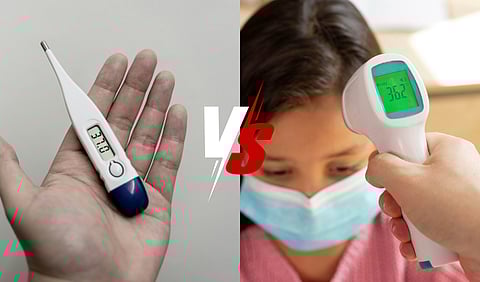
Digital thermometers are contact-based devices that use electronic heat sensors, usually thermistors, to measure body temperature.
They can be used at multiple sites:
Oral
Axillary
Rectal, especially in infants
These devices are widely used in both homes and clinical settings due to their consistency and affordability. They are among the most commonly used devices for home temperature monitoring. Devices with flexible tips, audible alerts, and quick response times are often preferred in home settings, particularly for children.
Infrared thermometers measure temperature by detecting infrared radiation emitted from the body.
Common types include:
Forehead (temporal artery) thermometers
Tympanic (ear) thermometers
They are typically non-contact or minimally contact, allowing rapid readings without direct skin contact. Many modern devices include positioning guidance and backlit displays to improve usability.
A common question is which thermometer is more accurate for detecting fever at home. Improper technique can affect both types of devices.
Digital thermometers are generally considered reliable when used correctly.
Rectal measurements are regarded as the most accurate reflection of core body temperature in infants and young children.³
Oral measurements are dependable in cooperative adults.
Axillary readings are less accurate and may underestimate fever.
Devices that meet established accuracy standards and provide stable readings are typically recommended for consistent home monitoring.
Infrared thermometers offer convenience, but their accuracy depends on several factors:
Correct positioning
Distance from the skin
Environmental conditions
Skin factors such as sweat
Studies indicate that forehead infrared thermometers may show lower sensitivity for detecting fever in children compared to rectal measurements, particularly outside controlled environments.⁴ Tympanic thermometers tend to be more consistent but still require proper technique.
Devices designed with proper sensor calibration and positioning indicators may help reduce variability.
Differences arise because:
Digital thermometers measure temperature at contact sites that better reflect core body temperature
Infrared devices measure surface temperature, influenced by blood flow and environment
Peripheral vasoconstriction or sweating can alter skin temperature readings
Infrared thermometers are preferred for rapid assessments, while digital thermometers are used for confirmatory readings.
Digital thermometers require cleaning after each use. Use probe covers and alcohol-based disinfectants.
Infrared thermometers reduce physical contact and are useful in clinical and public settings.
Rectal digital thermometers are most accurate.³
Forehead infrared readings may underestimate fever.
Non-contact devices may improve compliance.
Oral digital thermometers are commonly used.
Infrared thermometers provide convenience.
Ease of use and readability are important.
Incorrect placement
Measuring after eating or drinking
Insufficient contact time
Sweat or moisture on skin
Incorrect angle or distance
Ambient temperature effects
Accurate confirmation is needed
Measuring infants (rectal method)
Quick screening is needed
Measuring multiple individuals
Patient is uncooperative
The best thermometer depends on balancing accuracy and convenience.
Digital thermometers are preferred for accuracy. Infrared thermometers are useful for quick checks. Many households benefit from using both.
Clinical settings use calibrated devices for consistency. Home settings prioritize ease and speed.
Screening: infrared devices
Monitoring and diagnosis: digital thermometers
Seek medical attention if:
Infant under 3 months has ≥38°C
Fever lasts more than 3 days
Temperature exceeds 39–40°C
Symptoms include:
Lethargy
Seizures
Difficulty breathing
Accuracy standards
Response time
Ease of cleaning
Battery life
Display clarity
No single thermometer is universally superior. Choice depends on purpose, patient, and context.
Infrared devices are useful for screening. Digital thermometers are preferred for confirmation.
Digital thermometers are more accurate for confirmatory readings. Infrared thermometers are faster and more convenient. The best choice depends on the situation.
Digital and infrared thermometers serve different roles.
Digital thermometers offer consistent accuracy
Infrared thermometers provide speed and convenience
In this digital vs infrared thermometer comparison, the best choice depends on context. Confirm readings when clinically important.
Are infrared thermometers reliable?
They can be reliable if used correctly, but depend on technique and environment.
Which thermometer is best for babies?
Rectal digital thermometers are most accurate.
Can forehead thermometers give wrong readings?
Yes, due to sweat, positioning, and environmental factors.
How to check body temperature correctly at home?
Follow instructions, ensure proper placement, and avoid measuring after eating or exposure to temperature extremes.
Mackowiak PA, Wasserman SS, Levine MM. A critical appraisal of 98.6°F. JAMA. 1992;268(12):1578–1580. https://jamanetwork.com/journals/jama/article-abstract/400116
Centers for Disease Control and Prevention. “How to Use an Infrared Thermometer.” Last reviewed May 10, 2024. https://www.cdc.gov/ebola/hcp/communication-resources/how-to-use-an-infrared-thermometer.html
American Academy of Pediatrics. “How to Take Your Child’s Temperature.” https://www.healthychildren.org/English/health-issues/conditions/fever/Pages/How-to-Take-Your-Childs-Temperature.aspx
Centers for Disease Control and Prevention. “General Instructions: How to Use an Infrared Thermometer.” https://stacks.cdc.gov/view/cdc/119141/cdc_119141_DS1.pdf
