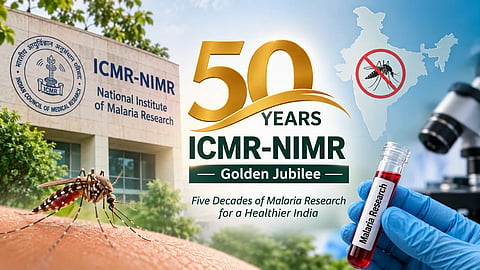
On 17 November, 2026, the Indian Council of Medical Research – National Institute of Malaria Research (ICMR-NIMR) celebrated its Golden Jubilee. The significance of controlling malaria in India, and the role played by ICMR-NIMR in vector-borne disease research, was acknowledged by the President of India, Droupadi Murmu, and the Union Health Minister, J.P. Nadda. The importance of innovative research to reach elimination of malaria in India was highlighted.
The Indian Council of Medical Research (ICMR) was founded as the Indian Research Fund Association (IRFA) on 15 November, 1911, by Sir Harcourt Butler, for medical research in India. Following independence, in 1949, the name was changed to ICMR.
Since its formation, many research institutes have been formed under ICMR to combat certain diseases within India. Research performed at ICMR has focused on infectious diseases, nutrition, reproductive health, immunology, and epidemiology.
Examples of significant achievements within ICMR include:
The Beri-Beri Enquiry was established in 1918 by Sir Robert McCarrison at the Pasteur Institute, Coonoor. It was a significant step in understanding nutrition in India. This ultimately led to the creation of the National Institute of Nutrition (NIN) in Hyderabad.
Discoveries in this institute have increased understanding of nutritional requirements within India. Deficiencies of specific nutrients have also been identified.
In 1952, Dr. Y.M. Bhende and his group discovered the Bombay blood group in Mumbai. The Bombay blood group is very rare and different from the common ABO blood groups. Before transfusion with this blood group, compatibility testing is required.
This has been a significant discovery in transfusion medicine. It has improved identification of rare blood groups, meaning safer transfusion of rare blood groups.
The National Institute of Malaria Research (previously Malaria Research Centre) was established on 1 November, 1977 in Delhi. In 2005, its name was changed to the National Institute of Malaria Research.
The institute has aimed to reduce malaria in both the short and long term. Research has been undertaken to understand the malaria parasite and mosquito vectors, identify insecticide resistance, improve diagnostic techniques, and discover effective interventions to prevent and control malaria.
New insecticides, bio-larvicides, insecticide-treated bed nets, antimalarials and diagnostic tests have been developed and assessed within this research institute. Field facilities have been set up in malaria endemic regions to implement interventions and assess effectiveness in real-life settings. These facilities allow a more efficient transfer of new technologies.
Between 2015 and 2025, there has been almost an 80% reduction in malaria cases and deaths in India. There has been a large reduction in high-burden districts, from 155 to 33. 160 districts had no local malaria cases between 2022 and 2025.
Globally, there have been fewer cases of malaria and fewer deaths due to malaria in India. Despite containing ~16% of the world’s population, only ~0.7% of cases and ~0.6% of deaths in the world are from India. In 2024, India was removed from the World Health Organisation’s ‘High Burden to High Impact’ initiative.
In addition to malaria, ICMR has made significant contributions in reducing the number of cases of tuberculosis, leprosy, and kala-azar. During the pandemic, they implemented a nationwide screening system. They have also worked on developing the first native vaccine to protect against COVID-19.
Despite progress, malaria remains an issue in many areas of India. During the Golden Jubilee Ceremony, President Murmu outlined that climate change, unplanned urban development, and increased insecticide resistance are major issues in achieving malaria elimination in the future.
Changing rainfall patterns and warmer temperatures can affect mosquito reproduction and therefore transmission of disease. Unplanned developments and poor water management can create new breeding sites for disease-carrying mosquitoes.
Higher numbers of other vector-borne diseases, particularly dengue, highlight that improvements in surveillance, diagnosis, and vector control strategies are required.
Improvements in the surveillance of the disease, diagnosis, treatment methods, and public awareness are required in order to achieve this.
The ICMR has many initiatives in place to tackle public health issues other than malaria. Within its National Health Research Programme, the ICMR is prioritising research on 11 issues within public health. These include: Tuberculosis, Antimicrobial resistance, Vector-borne diseases, Cancer, Mental Health, Anaemia, and Neonatal Mortality. In addition, the National One Health Mission means that the ICMR is collaborating with other governmental departments to identify and control zoonotic diseases.
The ICMR has many initiatives in place to encourage innovation in medical technologies. It includes MedTech Mitra, which allows innovators in medical technologies to improve healthcare products, and Patent Mitra, which encourages innovation and provides advice on patents. The 2024-29 Action Plan of the ICMR places an emphasis on low-cost medical technologies, digital medicine, and improved disease surveillance.
Union Minister of Health J.P. Nadda spoke about the importance of research and innovation to eliminate Malaria. He emphasised the importance of collaboration between research institutes, healthcare schemes and communities.
In order to meet healthcare targets within Viksit Bharat 2047, President Droupadi Murmu emphasised the importance of collaboration between research institutes, universities and industries. She also emphasised that scientific research should be taken out of labs and used at a community level, in order to improve healthcare.
Overall, in celebrating its Golden Jubilee, ICMR-NIMR has an opportunity to build upon 50 years of success within scientific research. Continuing scientific research, innovation, and collaboration will be key in ensuring a malaria-free future within India, and improved healthcare within the country as a whole.
OG/MF