India's TB Deaths Fall 38% in a Decade, Beating Global Decline, but Why Does the Country Still Account for 1 in 4 TB Cases Worldwide?

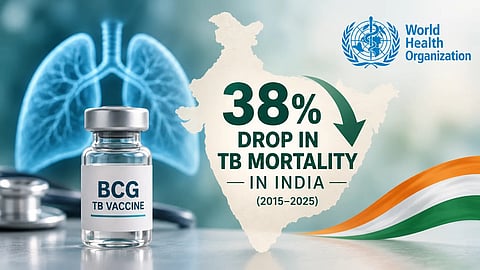
India reports a 38% decline in TB mortality between 2015 and 2025, surpassing the global reduction of 35%, according to WHO's Global TB Report 2026
94% treatment success rate for drug susceptible TB
India reports a 38% decline in TB mortality.AI Image
Author:
Mariyam F.
Published on: 
Updated on: 

The report, published on 12 November, 2026, shows that there has been a reduction from 28 TB-related deaths per lakh population in 2015 to 18 TB-related deaths per lakh population, in 2025. Despite this progress, India continues to be accountable for a quarter of TB cases globally.

However, there has been great success in India, with a 94% treatment success rate for drug susceptible TB.

India's Share of Global TB Cases and Drug-Resistant TB Burden

There were approximately 10.6 million people who developed TB globally in 2025. Of these, there were approximately 1.13 million TB related deaths.

India made up around 25% of TB cases globally. 23% of TB-related deaths were in India. Other countries included Indonesia, the Philippines, China, Pakistan, Nigeria, Democratic Republic of Congo and Bangladesh. These 8 countries account for around 67% of TB cases globally.

This reduction shows that progress has been made in diagnosing and treating TB. However, it highlights how difficult it can be to diagnose previously undiagnosed cases.

Drug-resistant TB remains another important concern. Globally, an estimated 3.7 lakh people developed rifampicin-resistant TB (RR-TB) in 2025. However, only 1,55,333 people were started on treatment, representing 42% of the estimated cases. This highlights the continuing gaps in diagnosing and treating drug-resistant TB.

TB Mukt Bharat Abhiyaan: India's Screening and Diagnosis Efforts

India has implemented several interventions into its National TB Elimination Program (NTEP). This includes the TB Mukt Bharat Abhiyaan initiative to increase early diagnosis, screening, treatment support, and community involvement.

Between 7 December 2024 and 8 November 2026, the TB Mukt Bharat Abhiyaan brought over 25 crore people under screening activities. The campaign also recorded the following achievements:

  • Increased screening: Over 11 crore chest x-rays and 3 crore NAAT tests have been completed.

  • Case detection: Approximately 48.64 lakh TB cases have been detected, including 14.97 lakh asymptomatic cases.

  • Funding: Approximately 96% of funding needs have been met through domestic funding.

  • Community involvement: 67,933 Gram Panchayats declared themselves TB free in 2025.

Technology has been implemented successfully. This includes using AI supported chest x-rays for screening. Digital tools are being used to increase patient engagement.

Nutritional support through the Ni-kshay Poshan Yojana and community involvement with the Ni-kshay Mitra initiative are additional components of India’s TB response.

Close-up of vaccine vials with a syringe, emphasizing healthcare and vaccination
TB incidence rates are not decreasing evenly and haven't met the targets set out in the WHO’s End TB Strategy.Thirdman/Pexels

How WHO Assessed India's TB Mortality Estimates

The WHO looked at several sources of information to measure TB deaths in India. This included information from the Sample Registration System (SRS) of the Registrar General of India, verbal autopsies, and information from the Ni-kshay portal.

A nationally representative TB Prevalence Survey was conducted by the Indian Council of Medical Research–National Institute for Research in Tuberculosis (ICMR-NIRT) in 2025. Information has been provided to the WHO, and technical discussions are now underway. An updated country profile is likely to be published by the WHO.

India's TB Incidence Estimates Await Review

The WHO has withheld India's latest TB incidence estimates in the Global TB Report 2026, pending the analysis of new district-level surveillance data. The estimates are under review and are expected to be updated in early 2027.

According to The Indian Express, a population-level TB disease prevalence survey was conducted in 2025 across 50 representative districts. The data are being analyzed to establish updated country-level estimates. The WHO has indicated that the findings need to be assessed for comparability with the previous national TB prevalence survey conducted in 2020–2021 before the revised estimates are released.

India's Progress Towards TB Elimination: Targets and Challenges

India reduced TB-related deaths by 38%, however, it still accounts for nearly a quarter of cases globally. Improving prevention, early diagnosis, and treatment will be important.

India's progress, however, remains below the targets set under the WHO End TB Strategy. The strategy aimed to reduce TB-related deaths by 75% by 2025, using 2015 as the baseline. Although India recorded a 38% reduction during this period, it remains short of the target. The country also did not achieve its national TB elimination goal of 2025.

The WHO End TB Strategy had set the following targets for reducing TB-related deaths compared with 2015:

  • 2020: 35% reduction

  • 2025: 75% reduction

  • 2030: 90% reduction

  • 2035: 95% reduction

The WHO findings demonstrate that, on a global level, TB incidence rates are not decreasing evenly and haven't met the targets set out in the WHO’s End TB Strategy.

Improving disease surveillance, early treatment, nutritional support, and community involvement will be important to continue to improve.

While India has had some success at reducing TB related deaths, reducing the number of people getting TB will be an important target.

References:
1. World Health Organization. Global Tuberculosis Report 2026. Geneva: World Health Organization, 2026. https://www.who.int/teams/global-tuberculosis-programme/tb-reports/global-tuberculosis-report-2026. 

2. World Health Organization. The End TB Strategy. Geneva: World Health Organization, 2015. https://www.who.int/publications/i/item/WHO-HTM-TB-2015.19. 

Rh/MF/MSM
94% treatment success rate for drug susceptible TB
WHO Report: India's Breast Cancer Survival Improves to 65.7% but Still Trails High-Income Countries
