
- Home
- About Us
- Contact Us
- Biography
- Column
- MedBound Hub
- InternshipInternship
- Daily Pulse
- Medicine
- Physical Therapy
- InterviewInterview
- Pharmacy
- Biotechnology
- College/InstituteCollege/Institute
- Dentistry
- Blog
- Wellness & Nutrition
- Nursing
- Opinion

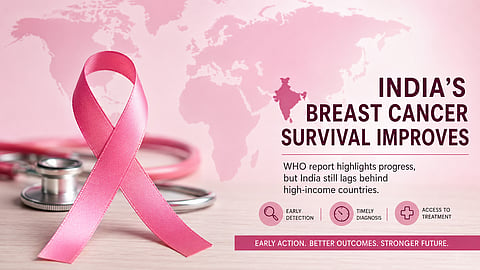
WHO's first global breast cancer survival report shows India's five-year survival has improved to 65.7%.
India's survival rate remains lower than that of many high-income countries, where it exceeds 85%.
Delayed diagnosis and unequal access to treatment continue to affect breast cancer outcomes.
The initiative focuses on early detection, timely diagnosis, and completion of recommended treatment.
Breast cancer survival in India has improved over the past two decades, according to the World Health Organization's (WHO) first global country-level breast cancer survival estimates. However, the report shows that survival rates in India remain significantly lower than those recorded in many high-income countries, highlighting ongoing gaps in early diagnosis and access to cancer care.
The findings were published in Nature Medicine as part of the WHO Global Breast Cancer Initiative (GBCI), which tracks progress in reducing deaths from breast cancer worldwide. The analysis evaluated women diagnosed with breast cancer between 2017 and 2021 and compared survival across countries.
The WHO estimates that India's estimated age-standardized five-year net survival is 65.7%, according to the WHO analysis, meaning around two-thirds of women diagnosed with the disease survive for at least five years after diagnosis. While this represents an improvement compared with previous decades, survival remains lower than in several high-income countries, where five-year survival often exceeds 85%.
The report identifies substantial differences in survival across regions and income groups, reflecting variations in healthcare access, early detection, and treatment availability.
Dr. Alarcos Cieza, Unit Head, Management of Noncommunicable Diseases, Department of Noncommunicable Diseases and Mental Health at WHO headquarters said,
Breast cancer survival is an important measure of how well a country's health system detects and treats breast cancer. It reflects the combined impact of early detection, linked to timely diagnosis and effective multimodality treatment, and the quality of care they receive, supporting countries to assess their progress, and identifying areas for improvement in their national breast cancer control efforts.
Dr. Alarcos Cieza, Unit Head, Department of Noncommunicable Diseases and Mental Health, WHO headquarters.
The WHO launched the Global Breast Cancer Initiative in 2021 with the goal of reducing breast cancer mortality by 2.5% every year, which could prevent an estimated 2.5 million deaths by 2040.
The initiative focuses on three key areas:
Promote early detection: Ensure that at least 60% of invasive breast cancer cases are diagnosed at Stage I or Stage II, when treatment is generally more effective.
Ensure timely diagnosis: Confirm a breast cancer diagnosis within 60 days of a patient's first presentation at a healthcare facility.
Complete recommended treatment: Ensure that 80% or more of patients diagnosed with breast cancer complete the recommended multimodality treatment, which may include surgery, systemic therapy (such as chemotherapy, hormone therapy, or targeted therapy), and radiotherapy, depending on the individual's condition.
Highlighting the role of radiotherapy within multimodality cancer care, Dr. Sneha Jha, Chief Consultant in Radiation Oncology at Paras HMRI, Patna, previously told MedBound Times that modern techniques such as VMAT and stereotactic radiotherapy enable highly precise treatment while reducing radiation exposure to surrounding healthy tissues, helping minimize side effects and improve treatment delivery.
According to WHO, strengthening these three components can substantially improve survival, particularly in low- and middle-income countries.
According to the WHO, these interventions are cost-effective and are included among its recommended "Best Buy" strategies for preventing and controlling non-communicable diseases (NCDs). However, despite these evidence-based measures, only 20 high-income countries achieved the targeted reductions in breast cancer mortality between 1990 and 2020.
The WHO report notes that women in many low- and middle-income countries are frequently diagnosed when breast cancer has already reached an advanced stage. Advanced-stage disease is generally associated with lower survival because treatment becomes more complex and less effective.
In India, healthcare experts continue to identify delayed diagnosis as a major challenge. Limited awareness of early warning signs, unequal access to diagnostic services, financial barriers, and differences in healthcare infrastructure can contribute to women seeking medical care later in the course of the disease.
While national financial safety nets like the Ayushman Bharat Pradhan Mantri Jan Arogya Yojana (AB-PMJAY) have significantly improved access by providing cashless hospitalization coverage of up to ₹5 lakh per family annually, public health experts note structural gaps in handling long-term multimodality breast cancer treatments. While the scheme covers over 200 oncology packages and 37 specialized targeted therapy packages, advanced-stage breast cancers requiring a combination of extended chemotherapy, multi-cycle radiation, and novel targeted therapies frequently breach the ₹5 lakh ceiling, as complex advanced cases can range between ₹20 to ₹30 lakhs in total cost.
Beyond the policy ceiling, administrative friction like delayed treatment pre-authorizations, coupled with out-of-pocket costs for outpatient scans, long-term medicines, and travel, can still trigger care delays and severe financial strain for vulnerable families.
The WHO report emphasizes that improving awareness and ensuring timely referral for diagnosis remain essential components of cancer control strategies.
Breast cancer continues to be the most commonly diagnosed cancer among women globally.
According to WHO, approximately 694,000 women died from breast cancer worldwide in 2024. The organization also notes that most women diagnosed with breast cancer do not have identifiable risk factors other than increasing age and female sex.
India also carries a substantial burden of the disease. Based on GLOBOCAN 2022 estimates, the country reported approximately 192,020 new breast cancer cases and 98,337 deaths, making breast cancer one of the leading causes of cancer-related mortality among Indian women.
The WHO explains that differences in breast cancer survival are influenced by several healthcare-related factors rather than the disease alone.
These include:
Early recognition of symptoms by patients.
Availability of diagnostic facilities.
Access to pathology services.
Timely initiation of treatment.
Completion of recommended cancer therapy.
Availability of multidisciplinary cancer care.
Countries with organized healthcare systems and broader access to cancer services generally report higher survival rates.
The WHO report emphasizes that improving early detection, ensuring timely treatment, and expanding access to quality cancer care are essential for improving breast cancer survival worldwide.
While India's survival estimates demonstrate measurable progress over recent years, the findings indicate that continued improvements in healthcare delivery, diagnostic services, and treatment access will be necessary to reduce the survival gap between India and higher-income nations.
1. Girardi, Francesca, Mary Nyangasi, Claire Callender, et al. "Global Breast Cancer Survival Estimates in 2017–2021 to Advance the WHO Global Breast Cancer Initiative." Nature Medicine (2026). https://doi.org/10.1038/s41591-026-04531-2.
2. World Health Organization. "First Global Breast Cancer Survival Estimates Show Wide Regional and Income Disparities." World Health Organization. July 8, 2026. https://www.who.int/news/item/08-07-2026-first-global-breast-cancer-survival-estimates-show-wide-regional-and-income-disparities.
3. World Health Organization. The Global Breast Cancer Initiative. Accessed July 15, 2026. https://www.who.int/initiatives/global-breast-cancer-initiative.
(Rh/SS/MSM)
