From Warplanes to Air Ambulances: How Military Aviation Transformed Emergency Medicine

From battlefield evacuations to modern emergency response, military aviation played a pivotal role in shaping the air ambulance systems that save lives today.
From battlefield evacuations to modern emergency response, military aviation innovations laid the foundation for the air ambulance systems that save lives today.
From battlefield evacuations to modern emergency response, military aviation innovations laid the foundation for the air ambulance systems that save lives today.AI Image
Published on
Updated on

When a person is seriously injured or critically ill, every minute matters. In many emergencies, air ambulances help patients reach specialized medical care much faster than ground transport. Today, these aircraft are an essential part of emergency medicine, but their origins can be traced back to military conflicts, where the need to evacuate wounded soldiers quickly led to innovations that transformed healthcare.

Aeromedical evacuation emerged from the need to provide timely medical care to injured soldiers during conflict. As military aviation advanced, new methods of transporting casualties were developed, transforming battlefield medicine and ultimately influencing the civilian air ambulance services that play a critical role in emergency care today.1

When Distance Meant Death

Before aircraft became part of medical transport, injured soldiers relied on horses, wagons, trains, and ships for evacuation. These methods were often slow, particularly in difficult terrain or active combat zones. Delays in reaching medical facilities frequently worsened outcomes, with many casualties dying from injuries that might have been treatable if care had been available sooner.

With the rapid advancement of aviation in the early 1900s, military planners started exploring new uses for aircraft beyond warfare. One of the most promising ideas was using them to transport injured soldiers. The ability to cover long distances in a short time meant that casualties could reach medical care sooner, increasing their chances of survival.

Although limited experiments with medical aviation occurred before and during the First World War, widespread implementation remained difficult due to technological constraints. It was not until the Second World War that aeromedical evacuation began to develop into an organized system.2

World War II: The Birth of Modern Aeromedical Evacuation

World War II marked a turning point in the relationship between aviation and medicine. Military aircraft were increasingly adapted to transport wounded personnel from combat zones to medical facilities. These missions demonstrated that rapid evacuation significantly improved access to surgical care and reduced delays in treatment.1

During World War II, air evacuation became a routine part of military medical care rather than a rare experiment. Aircraft were adapted to carry injured soldiers, medical equipment, and healthcare personnel, making it possible to transport casualties more efficiently. These missions reinforced an important lesson that still guides emergency medicine today: the sooner a patient receives appropriate treatment, the better their chances of survival.

The Korean War and the Helicopter Revolution

If World War II introduced aeromedical evacuation, the Korean War transformed it.

The Korean War occurred at a time when helicopters were becoming increasingly common in military operations. Unlike conventional aircraft, helicopters could land in rugged and hard-to-reach areas, allowing injured soldiers to be picked up much closer to where they had been wounded.

Casualties could be transported directly from the battlefield to Hospitals, dramatically reducing evacuation times. Instead of waiting hours or even days for transport, many patients reached surgical care within a matter of hours.1

The experiences gained during this period contributed to the development of concepts that would later influence modern trauma systems.

The image of wounded soldiers being lifted from remote battlefields by helicopter captured public attention and helped establish the helicopter as a lifesaving medical tool rather than solely a military asset.

Vietnam and the Rise of Critical Care in the Sky

During the Vietnam War, aeromedical evacuation reached an unprecedented scale. Helicopter missions became routine, transporting hundreds of thousands of casualties throughout the conflict.1

More importantly, medical care during transport evolved significantly. Aircraft were no longer viewed simply as vehicles for moving patients. Instead, they became extensions of the healthcare system.

Flight medics received advanced training, communication systems improved, and aircraft carried increasingly sophisticated medical equipment. Life-saving interventions could begin before arrival at a hospital, helping stabilize patients during transport.3

According to historical analyses of military aeromedical evacuation, the Vietnam era highlighted the value of integrating transport with ongoing medical care, a principle that remains central to modern helicopter emergency medical services.3

From Battlefield Innovation to Civilian Medicine

The success of military aeromedical evacuation did not go unnoticed outside the armed forces.

Beginning in the 1970s, many countries adopted helicopter-based emergency medical services modeled on military systems. Civilian air ambulances incorporated innovations pioneered during wartime, including rapid response deployment, advanced life-support capabilities, specialized flight crews, and coordinated communication networks.1

Today, modern air ambulances function as highly specialized mobile intensive care units. Equipped with ventilators, cardiac monitors, infusion pumps, and trained medical personnel, they provide advanced care while en route to definitive treatment facilities.3

New Missions, New Challenges

Although many principles of aeromedical evacuation originated during conventional warfare, modern operations present different challenges.

After the Cold War, the role of military medical teams began to expand beyond the battlefield. They were increasingly called upon to support peacekeeping missions, humanitarian crises, natural disasters, and international operations. In many of these situations, patients needed to be transported over long distances, often from remote areas with limited healthcare facilities and poor transportation networks.4

Transporting critically ill or injured patients from remote locations introduces complex logistical and clinical challenges. Weather conditions, flight duration, resource limitations, and international coordination can all influence patient outcomes.

Recent literature also highlights the growing need for specialized training, technological integration, and evidence-based protocols to support safe aeromedical transport in both military and civilian settings.5

What Does the Evidence Say Today?

A recent study examining contemporary aeromedical systems highlights how innovations in aviation, patient monitoring, and emergency response continue to shape outcomes in critical care transport.5

Researchers continue to examine the impact of helicopter emergency medical services on patient outcomes. Although air transport is not required in every emergency, evidence suggests that certain trauma patients may benefit from being transported quickly to specialized trauma centers where advanced care is available.5

At the same time, researchers emphasize the importance of balancing clinical benefits with operational costs and resource allocation. Advances in aircraft technology, communication systems, and onboard medical equipment continue to improve the safety and effectiveness of aeromedical transport.

A Legacy Beyond the Battlefield

Modern air ambulances are the result of years of experience, innovation, and lessons learned in military medicine. The aircraft that now transport civilians during medical emergencies trace their roots back to wartime efforts to move injured soldiers quickly and safely to treatment.

From warplanes to air ambulances, the journey of aeromedical evacuation is ultimately a story about reducing the distance between injury and care, and, in doing so, giving more patients a chance to survive.

References

1. Blue Dot Air Ambulance, "Evolution of Air Ambulances," Blue Dot Air Ambulance Blog, accessed August 6, 2026, https://www.bluedotairambulance.com/blog/evolution-of-air-ambulances/

2. Flarity, Kathleen M., Tamara A. Averett-Brauer, and Jennifer J. Hatzfeld. "Aeromedical Evacuation: A Historical Perspective." In Aeromedical Evacuation, edited by William W. Hurd and William Beninati, 5–20. 2nd ed. Cham, Switzerland: Springer, 2019. https://doi.org/10.1007/978-3-030-15903-0_2.

3. Maddry, Joseph K., Alexandra Arana, Andrew Mora, Jessica A. Paciocco, Paul C. Ng, and colleagues. "Management of Combat Casualties during Aeromedical Evacuation from a Role 2 to a Role 3 Medical Facility." Military Medicine 189, nos. 5–6 (2024): e1003–e1008. https://doi.org/10.1093/milmed/usad395

4. Bruce B. Green, "Challenges of Aeromedical Evacuation in the Post-Cold-War Era," Air & Space Power Journal 15, no. 4 (2001): 14.

5. Akutsu, Tomohiro, Akira Endo, Ryo Yamamoto, Kazuma Yamakawa, Hiraaki Okuzawa, Keisuke Suzuki, Hiromasa Hoshi, Yasuhiro Otomo, and Koji Morishita. "Mortality Rates in Physician Staffed Ground vs. Air Ambulance for Severe Trauma Patients: Retrospective Analysis of the Japanese Nationwide Trauma Registry." Scientific Reports 15 (2025): 6255. https://doi.org/10.1038/s41598-025-89489-w
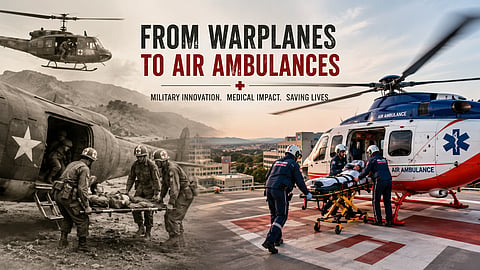

From battlefield evacuations to modern emergency response, military aviation innovations laid the foundation for the air ambulance systems that save lives today.
Ranchi–Delhi Air Ambulance Crash: All 7 On Board Killed Near Simaria Forest in Jharkhand
logo
Medbound Times
www.medboundtimes.com