Swiss pharmaceutical company Novartis has paused eight clinical trials of its experimental CAR-T cell therapy rapcabtagene autoleucel, also known as rap-cel or YTB323, after three patients died following severe immune complications.
Novartis is conducting a safety review and working with independent safety boards and health authorities. The pause has affected rap-cel studies for neurological and autoimmune disorders, while oncology studies of the therapy continue.
Research on rap-cel for use in neurological and autoimmune disorders has been impacted by this pause. However, Novartis has not halted its oncology studies involving the therapy.
The program has four Phase 2 AUTOGRAPH studies that evaluate the application of rap-cel in individuals suffering from systemic lupus erythematosus and lupus nephritis, systemic sclerosis, ANCA-associated vasculitis, and idiopathic inflammatory myopathies.
The company has also paused Phase 1/2 studies investigating the therapy in rheumatoid arthritis and Sjögren's disease, generalised myasthenia gravis, relapsing multiple sclerosis, and non-active progressive multiple sclerosis.
Novartis stopped screening, randomisation and administration of the treatment in the affected studies. The patients who have already received the therapy continue to be monitored.
The affected studies have been paused, including screening, randomization, and treatment administration. Patients who have already received rap-cel will continue to be monitored.
Novartis has not disclosed further clinical details about the patients or provided a timeline for the deaths. The company said all three patients developed IEC-HS, a rare and potentially life-threatening inflammatory complication associated with CAR-T cell therapy. They eventually succumbed due to the complication.
IEC-HS is a hyperinflammatory syndrome that can resemble hemophagocytic lymphohistiocytosis and macrophage activation syndrome. The American Society for Transplantation and Cellular Therapy describes IEC-HS as a hyperinflammatory condition that can occur independently of cytokine release syndrome and neurological toxicity associated with CAR-T.
In simple terms, IEC-HS occurs when the immune response becomes excessively intense, leading to widespread inflammation. It differs from an allergic reaction or anaphylaxis and is instead linked to an excessive immune response following cellular immunotherapy.
Signs of IEC-HS may include markedly elevated ferritin, low blood cell counts, clotting abnormalities, low fibrinogen and liver inflammation. In severe cases, patients may develop organ dysfunction, and the condition can be fatal.
The three deaths led Novartis to review safety data from its autoimmune and neurological CAR-T program.
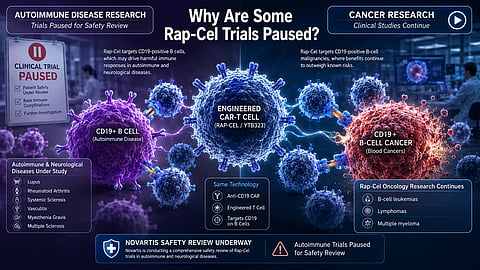
Rap-cel is an autologous CAR-T cell therapy designed to target CD19. In this treatment, doctors collect T cells from the patient and modify them in a laboratory so they produce a chimeric antigen receptor (CAR). The modified cells are then infused back into the patient. The CAR helps these engineered T cells identify and attack cells carrying a specific target.
Rap-cel targets CD19, a protein found on B cells. These immune cells play an important role in producing antibodies. In autoimmune diseases, B cells can act up and cause the body's immune system to attack itself. Scientists are looking into whether CAR-T therapy could fix this by getting rid of the B cells that are causing the problem. CAR-T therapy is already approved for some blood cancers, but its use for autoimmune conditions is still being explored.
Bristol Myers Squibb has put a pause on adding new participants to some of their trials for an experimental CAR-T therapy called zolacabtagene autoleucel, or zola-cel, which targets CD19 and is being tested for autoimmune diseases.
The company took the precautionary step after routine safety monitoring identified transient and reversible inflammatory events. No deaths associated with zola-cel have been reported.
Both zola-cel and rap-cel use rapid manufacturing techniques. The reason for the inflammatory events remains under investigation. Factors related to individual patients or their underlying diseases may also have contributed.
Novartis is reviewing the safety data from the affected rap-cel studies and has not said when enrollment or treatment will restart.
(Rh/MSM)