The Puerto Rico Pill Trials: The Untold Human Cost Behind the First Birth Control Pill

How Puerto Rican women became the forgotten faces behind one of the most revolutionary medical inventions in history
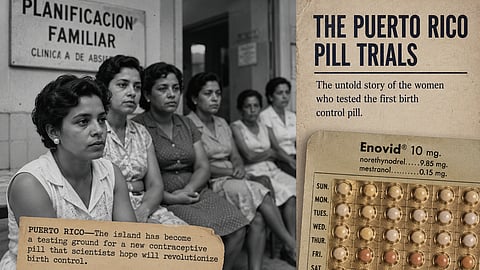
Puerto Rican women during the 1950s birth control pill trials, alongside vintage contraceptive pills and medical imagery symbolizing the ethical controversies surrounding the development of the first oral contraceptive.
Puerto Rican women played a crucial yet often overlooked role in the development of the first oral contraceptive pill during controversial clinical trials in the 1950s.AI Image
Published on
Updated on

Key Highlights

  • Puerto Rican women were central to the first birth control pill trials in the 1950s.

  • Many participants were not fully informed about the experimental nature of the pill.

  • The trials raised serious concerns about consent, colonialism, and medical ethics.

  • Women reported severe side effects that were often dismissed by researchers.

  • The pill’s history reflects both scientific progress and hidden human suffering.

The birth control pill is often described as one of the most transformative medical inventions of the twentieth century. It gave women greater control over reproduction, reshaped family planning, and contributed to major social and economic changes across the world. For many women, it symbolized freedom and independence.

However, the story behind the development of the first oral contraceptive is far more complicated than most people realize. Hidden beneath the scientific achievement is a history marked by medical exploitation, colonial power imbalance, inadequate consent, and the suffering of vulnerable women in Puerto Rico.

Long before the pill became widely available, thousands of Puerto Rican women participated in large-scale clinical trials that helped pave the way for its approval. Their experiences, side effects, and voices were often ignored in the rush to create what would become a revolutionary drug.

Gregory Pincus and John Rock: The Scientists Behind the First Birth Control Pill

The creation of the first oral contraceptive pill was led by scientist Gregory Pincus and physician John Rock. Pincus was a reproductive biologist interested in hormonal regulation, while Rock was a gynecologist known for his work in fertility and reproductive medicine.

Together, they developed a hormonal pill capable of preventing ovulation. Financial support for the research came largely from birth control activist Margaret Sanger and philanthropist Katharine McCormick, who strongly believed women needed access to reliable contraception.

At the time, available contraceptive methods such as condoms and diaphragms were less effective and often inconvenient. The possibility of a simple oral medication that could reliably prevent pregnancy represented a major scientific breakthrough.1

Why the Birth Control Pill Was Considered Revolutionary

The pill changed reproductive healthcare in ways few medical inventions ever had. For the first time, women could separate sexual activity from pregnancy with a relatively reliable method controlled entirely by them.

This innovation had far-reaching consequences. Women gained greater opportunities to pursue higher education, careers, and financial independence. The pill also became closely linked with the women’s liberation movement of the 1960s and 1970s.

Scientifically, the drug demonstrated that hormones could effectively suppress ovulation, opening new possibilities in reproductive endocrinology and hormonal therapy. Yet while the benefits of the pill would eventually become global, the process used to test it raised serious ethical concerns.

Why Puerto Rico Was Chosen for the Pill Trials

Before the large Puerto Rico trials began, the pill had already been tested on a small number of women in Boston. These early studies showed promising contraceptive results, but researchers still needed a much larger group of participants before the drug could receive regulatory approval. Puerto Rico offered exactly what they were looking for, a large population of women, existing birth control clinics, and fewer social and legal barriers to contraception.5

In the 1950s, Puerto Rico became the primary location for large-scale human trials of the birth control pill. Several social and political factors influenced this decision.

At the time, Puerto Rico was experiencing high population density, widespread poverty, and significant unemployment. American policymakers and public health officials frequently described the island as “overpopulated,” and birth control programs were heavily promoted as a solution to economic problems.2

Puerto Rico also had an established network of birth control clinics, making it easier for researchers to recruit women quickly. Puerto Rico’s position as a United States territory also played an important role in the decision. Because the island existed under American political control but outside the mainland, researchers were able to conduct large-scale trials with far less public attention and regulatory pressure than they likely would have faced in the continental United States.5

Clarence Gamble, Eugenics, and Population Control

The Puerto Rico pill trials were closely connected to the ideas of Clarence Gamble, a physician and wealthy supporter of birth control initiatives.

Gamble strongly believed in eugenics, a movement that claimed society could be improved by controlling reproduction among certain populations. During the early twentieth century, eugenic ideas influenced public health policies in many countries, including the United States.

In Puerto Rico, poverty and rapid population growth were increasingly viewed through a eugenic lens. Gamble funded sterilization campaigns and supported aggressive population control efforts on the island long before the birth control pill trials began.

By the 1950s, Puerto Rico already had one of the highest sterilization rates in the world. Critics argue that these policies disproportionately targeted poor women and reflected deeper social prejudices regarding race, class, and colonial governance.3,6

Colonialism and the Power Imbalance in Medical Research

Puerto Rico’s colonial relationship with the United States played a major role in shaping the pill trials.

Although Puerto Ricans were American citizens, the island remained under significant political and economic control from the mainland United States. Medical research conducted there often reflected unequal power dynamics between American institutions and local populations.

Many scholars now view the trials as an example of colonial medicine, where vulnerable communities were used for medical experimentation without receiving equal protection or autonomy.6

The women involved in the trials had limited influence over the research process. Decisions regarding dosage, safety, and study design were controlled primarily by American researchers and pharmaceutical interests. The participants themselves were rarely treated as active decision-makers in the experiments that affected their bodies.5

Lack of Informed Consent During the Puerto Rico Pill Trials

One of the most serious ethical problems surrounding the trials was the lack of proper informed consent.

Many women reportedly did not fully understand that the medication they were taking was experimental. Researchers often failed to explain potential risks or possible long-term complications in a clear and meaningful way.4

The pills used during the trials contained hormone levels far higher than those used in modern contraceptive pills. As a result, many participants experienced severe side effects, including:

  • Nausea

  • Vomiting

  • Headaches

  • Dizziness

  • Blood clot complications

Several women left the study because of the intensity of these symptoms.

Reports also suggest that at least three women died during the trials, although no formal investigation conclusively linked their deaths to the drug. Critics argue that researchers did not adequately investigate whether the experimental medication contributed to these fatalities.

How Women’s Complaints Were Ignored

A particularly disturbing aspect of the Puerto Rico trials was the dismissal of women’s suffering.

Dr. Edris Rice-Wray, one of the physicians involved in the Puerto Rico trials, reported that many women experienced serious side effects from the high hormone doses used in the pill. She believed the formulation was too strong to be acceptable for widespread use. However, her concerns were largely dismissed because the drug proved highly effective at preventing pregnancy.5

This reflected a broader historical problem in medicine where women’s pain and symptoms were frequently ignored or dismissed.

In hindsight, the experiences of Puerto Rican women exposed the dangers of prioritizing scientific success over patient well-being. Their concerns, which might today trigger immediate safety reviews, were largely overlooked during the early stages of contraceptive development.

FDA Approval of Enovid in 1960

In 1960, the U.S. Food and Drug Administration approved Enovid as the first oral contraceptive pill.

Interestingly, the drug had initially been approved in 1957 for menstrual disorders before later receiving approval specifically for contraception.1

At the time, regulators considered pregnancy itself to carry significant medical risks. Since the pill proved highly effective at preventing pregnancy, many experts believed its benefits outweighed its potential harms.

Importantly, this approval occurred before stricter drug safety regulations emerged following the thalidomide tragedy and before the 1962 Drug Amendments strengthened clinical trial oversight in the United States.

Over the following decade, evidence gradually linked oral contraceptives to serious complications such as blood clots and thromboembolism. This eventually led to lower hormone doses and improved safety standards.

The Complicated Legacy of the Birth Control Pill Today

Today, the birth control pill remains one of the most influential medical innovations in modern history. It transformed reproductive healthcare and expanded opportunities for women worldwide.

At the same time, the Puerto Rico trials continue to raise important ethical questions about informed consent, medical exploitation, and the treatment of marginalized populations in research.

The story of the pill is therefore not simply one of scientific triumph. It is also a reminder that medical progress can sometimes come at a human cost that society later struggles to acknowledge.

Acknowledging what Puerto Rican women went through does not take away from the importance of the birth control pill or the freedom it gave millions of women worldwide. Instead, it allows us to look at medical history more honestly, recognizing both the progress that was made and the people who paid the price for it. Their experiences remind us why informed consent, patient safety, and ethical research practices should never be overlooked in the pursuit of scientific advancement.

References

1. Junod, Suzanne White. “FDA’s Approval of the First Oral Contraceptive, Enovid.” U.S. Food and Drug Administration, 1998.

2. “The Puerto Rico Pill Trials.” PBS American Experience.

3. “History of the Birth Control Pill Trials in Puerto Rico.” History.com.

4. “The Bitter Pill.” The Harvard Crimson.

5. Junod, Suzanne White, and Lara V. Marks. “Women’s Trials: The Approval of the First Oral Contraceptive Pill in the United States and Great Britain.” Journal of the History of Medicine and Allied Sciences 57, no. 2 (2002): 117–160.

6. Presser, Harriet B. “The Role of Sterilization in Controlling Puerto Rican Fertility.” Population Studies 23, no. 3 (1969): 343–361.

Puerto Rican women during the 1950s birth control pill trials, alongside vintage contraceptive pills and medical imagery symbolizing the ethical controversies surrounding the development of the first oral contraceptive.
Antibiotic Use in Farming May Spur Bacteria Resistant to Human Immune System
logo
Medbound Times
www.medboundtimes.com