Top Medical Colleges in India with Advanced Anatomy Labs, Cadaver Training, and Research Facilities

Exploring Leading Institutions with Cutting-Edge Anatomy Labs, Cadaveric Training, and Research Facilities
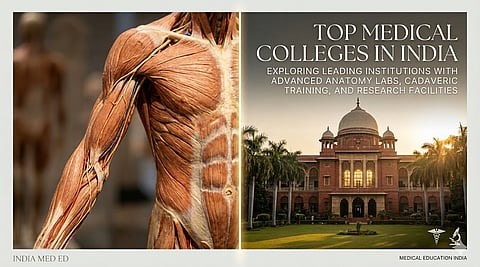
A split-screen composition. On one side, a detailed, close-up artistic view of a high-quality anatomical plastination model. On the other side, the grand historical architecture of an Indian medical college.
Looking for top anatomy colleges in India? Find institutes with advanced labs, cadaver training, and research facilities.
Published on
Updated on

Anatomy is the backbone of medical science, forming the basis for clinical practice, surgical precision, and diagnostic reasoning. While cadaveric dissection remains essential, modern medical education increasingly relies on advanced laboratory infrastructure, imaging technologies, and research integration to deepen anatomical understanding.

Today, leading medical colleges in India are enhancing anatomy education through molecular research labs, plastination techniques, digital learning tools, and interdisciplinary teaching methods. Choosing the right institution can significantly influence a student’s academic exposure and clinical readiness.

All India Institute of Medical Sciences, New Delhi – Leader in Advanced Anatomy Research

AIIMS -New Delhi's Ward Block Building
AIIMS Delhi stands out for combining traditional anatomy teaching with high-end research infrastructure, offering students exposure to both clinical and molecular aspects of anatomy.Vishnoi M, CC BY-SA 4.0, via Wikimedia Commons

Key Anatomy Facilities

  • Dedicated cadaveric dissection halls for hands-on training

  • Access to electron microscopy for ultrastructural studies

  • Research programs in genetics, neurobiology, and cancer biology

  • Regular cadaver-based surgical training workshops

What Makes It Unique

AIIMS Delhi stands out for combining traditional anatomy teaching with high-end research infrastructure, offering students exposure to both clinical and molecular aspects of anatomy.

Christian Medical College, Vellore – Excellence in Clinical and Applied Anatomy

Christian Medical College in Vellore
CMC Vellore is particularly known for its strong clinical orientation in anatomy education, where cadaveric training is closely linked to surgical and diagnostic applications. Ahp101, CC BY-SA 4.0, via Wikimedia Commons

Key Anatomy Facilities

  • Regularly conducted cadaver-based surgical workshops across multiple specialties including ENT, Neurosurgery, Orthopaedics, and Anaesthesia

  • Training in dissection, histology, microscopy, plastination, embalming, and museum techniques

  • Dedicated plastination laboratory supporting long-term specimen preservation and advanced learning

  • Structured postgraduate training with mandatory dissertation and research publication opportunities

  • Peripheral exposure to radiology and cytogenetics departments for integrated learning

  • Well-developed e-learning platform featuring histology slides, anatomy videos, clinical case modules, and digital teaching resources

What Makes It Unique

CMC Vellore is particularly known for its strong clinical orientation in anatomy education, where cadaveric training is closely linked to surgical and diagnostic applications. The presence of structured workshops and interdisciplinary training ensures that students gain practical, hands-on experience.

In addition, its emphasis on plastination, digital learning, and international elective dissection programs enhances both conceptual understanding and global academic exposure.

Jawaharlal Institute of Postgraduate Medical Education and Research – Integrated Anatomy Teaching and Research

Administrative block of JIPMER
JIPMER stands out for its integration of traditional anatomy teaching with advanced cytogenetic and molecular research facilities. Akk7a at English Wikipedia, Public domain, via Wikimedia Commons

Key Anatomy Facilities

  • Well-structured undergraduate, postgraduate, and research training programs in anatomical sciences

  • Established cytogenetics unit involved in long-term karyotyping services for patient care

  • Availability of automated workstations supporting advanced techniques such as FISH and interphase FISH

  • Facilities for DNA damage analysis, including comet assay and micronucleus scoring

  • Molecular research infrastructure with Polymerase Chain Reaction (PCR) laboratories for gene and genetic studies

  • Active involvement in research projects, diagnostic services, and academic dissertations

  • Integration of histology, dissection, and interdisciplinary teaching approaches

What Makes It Unique

JIPMER stands out for its integration of traditional anatomy teaching with advanced cytogenetic and molecular research facilities. The presence of diagnostic services such as karyotyping, along with modern tools like PCR and FISH, allows students to explore anatomy beyond morphology into genetic and cellular-level understanding.

This combination of clinical service, research activity, and academic training creates a dynamic learning environment, particularly beneficial for students interested in genetics, molecular medicine, and translational research.

Institute of Medical Sciences Banaras Hindu University – Strong Foundation in Research-Oriented Anatomy

Banaras Hindu University, Varanasi Entrance gate
IMS-BHU combines classical anatomical teaching with modern research techniques, providing a strong academic foundation.Kuber Patel, Rosehub, CC BY-SA 4.0, via Wikimedia Commons

Key Anatomy Facilities

  • Advanced laboratories equipped with molecular research tools

  • Facilities for genetic and chromosomal analysis

  • Well-maintained anatomy and radiology museums

  • Comprehensive MBBS and postgraduate training programs

What Makes It Unique

IMS-BHU combines classical anatomical teaching with modern research techniques, providing a strong academic foundation.

King George’s Medical University, Lucknow – Advanced Cadaveric Training and Research Integration

King George Medical University, Lucknow
KGMU offers a strong blend of practical skill-based training and research-oriented learning. Bhanu Chaudhary, CC BY-SA 4.0, via Wikimedia Commons

Key Anatomy Facilities

  • Presence of advanced cadaveric skill laboratories for hands-on learning

  • Regularly conducted cadaver-based workshops across multiple clinical departments

  • Dedicated cytogenetics laboratory for genetic and molecular studies

  • Active involvement in research projects, including postgraduate theses and ICMR-funded studies

What Makes It Unique

KGMU offers a strong blend of practical skill-based training and research-oriented learning. The routine use of cadaveric skill labs for interdisciplinary workshops enhances clinical understanding, while the cytogenetics facility supports in-depth exploration of molecular and genetic aspects of anatomy. This integrated approach helps students develop both technical proficiency and research competence.

Kasturba Medical College, Manipal – Innovation in Anatomy Education and Research

Key Anatomy Facilities

  • Strong focus on undergraduate anatomy training, building a solid foundation in early medical education

  • Adoption of innovative teaching-learning methods to enhance student engagement and understanding

  • Active involvement in research projects funded by national and international agencies such as ICMR, DST, and DBT

  • Integration of academic teaching with ongoing research activities in anatomical sciences

  • Supportive environment with modern teaching aids and structured learning resources

What Makes It Unique

KMC Manipal stands out for its emphasis on progressive teaching methodologies and continuous academic innovation. The department actively explores new approaches to make anatomy more interactive, student-centered, and clinically relevant.

In addition, the presence of a dedicated and academically driven faculty team ensures continuous advancement in both teaching and research. This combination of quality education, research exposure, and faculty development makes it a strong choice for students seeking a well-rounded anatomy learning experience.

Dr. D. Y. Patil Medical College Hospital and Research Centre Pune – Comprehensive Anatomy Infrastructure with Modern Teaching Tools

Key Anatomy Facilities

  • Spacious dissection hall supporting structured cadaver-based learning

  • Well-maintained anatomy museums with diverse specimens for study and reference

  • Dedicated research laboratories and central laboratory equipped with modern instruments

  • Availability of advanced teaching aids, including LCD projectors, display screens, audio-visual systems, and recording studio for lectures

  • Microscopy facilities featuring trinocular microscopes, LCD-enabled microscopes, and projection systems

  • Well-stocked departmental library with updated textbooks and scientific journals

  • Facilities for first aid and student safety, including stretcher and wheelchair access

  • Development of advanced units such as molecular genetics lab and FISH-based genetic analysis facilities

  • Initiatives toward electron microscopy and virtual anatomy museum development

  • Specialized museum concepts including clinical, prenatal, neonatal, and pediatric anatomy collections

  • Promotion of body donation and organ donation awareness programs

  • Establishment of bone bank for osteological study and teaching

What Makes It Unique

Dr. D. Y. Patil Medical College stands out for offering a comprehensive and evolving anatomy infrastructure, combining traditional teaching methods with modern technology. The integration of advanced microscopy, digital teaching tools, and developing molecular genetics facilities enhances both academic and research potential.

Additionally, its focus on specialized anatomy museums, body donation awareness, and bone bank development reflects a commitment to holistic and resource-rich anatomy education. This makes it particularly valuable for students seeking diverse learning resources and practical exposure within a single institution.

Choosing the Right Medical College for Anatomy Excellence

A circular infographic with "Anatomy Excellence" in the center. Four branches coming out
For aspiring medical professionals, such environments not only enhance anatomical knowledge but also prepare them for clinical practice, surgery, and research careers.

Selecting a medical college with advanced anatomy facilities is crucial for building a strong medical foundation. Institutions like AIIMS Delhi, CMC Vellore, JIPMER, and IMS-BHU demonstrate how anatomy education is evolving through:

  • Hands-on cadaveric training

  • Modern laboratory and imaging technologies

  • Research-driven academic environments

  • Clinical integration from early stages

For aspiring medical professionals, such environments not only enhance anatomical knowledge but also prepare them for clinical practice, surgery, and research careers.

A split-screen composition. On one side, a detailed, close-up artistic view of a high-quality anatomical plastination model. On the other side, the grand historical architecture of an Indian medical college.
Must-Have Anatomy Apps for Medical Students: 3D Visualization, Interactive Learning, and Smarter Study Tools

Related Stories

No stories found.
logo
Medbound Times
www.medboundtimes.com