
- Home
- About Us
- Contact Us
- Biography
- MedBound Hub
- InternshipInternship
- Daily Pulse
- Medicine
- Physical Therapy
- InterviewInterview
- Pharmacy
- Biotechnology
- College/InstituteCollege/Institute
- Dentistry
- Blog
- Wellness & Nutrition
- Nursing
- Opinion

Stress and anxiety disorders continue to rise globally, prompting the search for innovative, non-pharmacological therapies. One such emerging approach is vagus nerve stimulation (VNS), particularly in its non-invasive forms such as transcutaneous auricular VNS (taVNS).
Recent research1 suggests that these devices may influence both psychological and physiological components of stress. But how strong is the evidence?
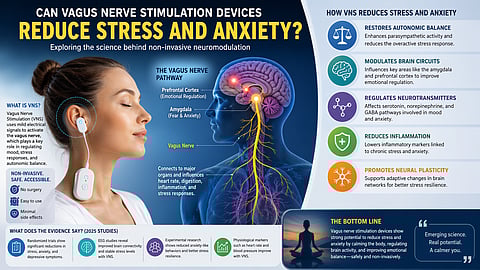
The vagus nerve is a major component of the parasympathetic nervous system and plays a central role in regulating emotional and physiological responses to stress. VNS involves delivering electrical stimulation to this nerve, thereby influencing brain regions responsible for mood, fear processing, and autonomic regulation.
Non-invasive VNS devices, especially those targeting the auricular branch of the vagus nerve, are gaining attention due to their safety, accessibility, and potential therapeutic benefits. These devices aim to restore autonomic balance by enhancing parasympathetic activity and reducing sympathetic overdrive, which is often elevated in anxiety states.2
A randomized controlled trial published in Applied Sciences (2025) evaluated the effects of VNS on stress and anxiety in athletes exposed to high-performance pressure.1 The study reported significant reductions in stress, anxiety, and depressive symptoms in participants receiving VNS compared to controls.
These findings are particularly relevant because they demonstrate measurable benefits in individuals exposed to real-world stressors rather than controlled laboratory conditions.
A study combined subjective stress assessments with electroencephalography (EEG) analysis. The results showed that while stress levels increased in the control group, individuals receiving taVNS maintained stable stress levels.2
Additionally, improvements in brain connectivity patterns suggested that VNS may enhance neural mechanisms involved in emotional regulation.2
VNS shifts the balance of the autonomic nervous system toward parasympathetic dominance.
This leads to reduced heart rate, improved heart rate variability, and a calmer physiological state, all of which are associated with reduced stress.4
Research indicates that VNS influences key brain regions such as the amygdala and prefrontal cortex, which are involved in fear, anxiety, and emotional control. It also modulates neurotransmitters like serotonin and norepinephrine, both of which play a role in mood regulation.3,5
Chronic stress is associated with systemic inflammation and impaired neural plasticity. Studies suggest that VNS may reduce inflammatory markers and promote adaptive changes in neural circuits, contributing to improved resilience against stress.4
Experimental studies have demonstrated that taVNS can reduce anxiety-like behaviors and improve stress resilience in controlled settings. These findings are supported by observed changes in synaptic activity and neural connectivity, indicating that VNS may act at both functional and structural levels in the brain.4
Similarly, broader neuromodulation research highlights that auricular VNS can reduce physiological stress markers and attenuate stress-induced arousal, reinforcing its potential clinical relevance.1
Vagus nerve stimulation devices show promise as:
An adjunct therapy for anxiety and stress-related disorders
A tool for acute stress modulation
A potential intervention in high-stress populations, such as athletes or healthcare professionals
However, current evidence does not support replacing standard treatments like psychotherapy or medication. Instead, VNS may complement existing approaches.
Emerging evidence suggests that vagus nerve stimulation devices can reduce stress and anxiety by modulating autonomic function, brain activity, and inflammatory processes. Clinical trials, neurophysiological studies, and experimental research collectively support their therapeutic potential.
However, VNS remains an evolving field. While promising, it requires further validation before becoming a mainstream treatment for stress and anxiety disorders.
1. Park, Sang-Hyuk, Changhoon Seong, Nyeonju Kang, Kyoungkyu Jeon, Sekee Kil, Hyosung Ahn, and Seung-Taek Lim. 2025. "The Effects of Vagus Nerve Stimulation on Stress, Competitive Anxiety, and Depression in Elite Shooters: Randomized Controlled Trial" Applied Sciences 15, no. 16: 9105. https://doi.org/10.3390/app15169105
2. Kim, W.-J., Y.-S. Lee, K. H. Hong, H. Choi, J.-J. Song, and H.-J. Hwang. 2025. “Effect of Transcutaneous Auricular Vagus Nerve Stimulation on Stress Regulation: An EEG and Questionnaire Study.” Frontiers in Digital Health 7: 1593614.
3. Molaeizadeh, S. Z., A. A. Galan, and Z. Zolghadr. 2026. “Effects of Transcutaneous Vagus Nerve Stimulation, Neurofeedback, and Their Combination on Cortisol, Anxiety, and Depression Subtypes in Non-Clinical Adults.” Applied Psychophysiology and Biofeedback.
4. Austelle, C. W., S. S. Cox, K. E. Wills, and B. W. Badran. 2024. “Vagus Nerve Stimulation (VNS): Recent Advances and Future Directions.” Clinical Autonomic Research 34, no. 6: 529–547.
5. Diao, Z., Y. Zuo, J. Zhang, et al. 2025. “Transcutaneous Auricular Vagus Nerve Stimulation Alleviates Anxiety-like Behaviors in Mice with Post-Traumatic Stress Disorder by Regulating Glutamatergic Neurons in the Anterior Cingulate Cortex.” Translational Psychiatry 15: 313.
