Can Seafood Cause Eye Disease? Marine Virus Jumps to Humans, Study Finds Vision Loss Risk from Raw Exposure

A marine virus known as CMNV is now linked to a newly identified eye disease in humans, with evidence pointing to seafood exposure and potential vision loss
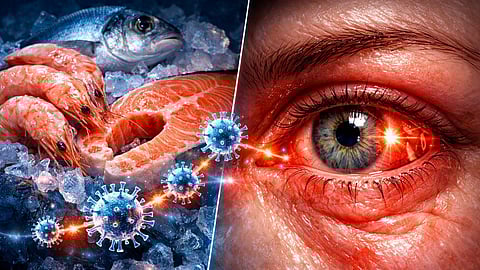
A split-scene medical illustration showing raw seafood like shrimp and fish on one side, and a close-up human eye with inflammation and pressure effects on the other
CMNV, a marine virus, is linked to an emerging eye disease in humans, with cases tied to seafood exposure and high eye pressure.
Published on
Updated on

Key Takeaways

  • A seafood virus called CMNV has been linked to a new eye disease in humans

  • The condition can cause high eye pressure and vision loss

  • Most cases are linked to handling or consuming raw aquatic animals

  • The virus can infect human eye cells and replicate in laboratory studies

  • Human-to-human transmission is not confirmed

A virus previously known to infect only marine animals has now been linked to a newly emerging eye disease in humans. A recent study, published in Nature Microbiology, identifies covert mortality nodavirus (CMNV), a seafood virus causing eye disease, as a possible cause of persistent ocular hypertension viral anterior uveitis (POH-VAU), a condition marked by increased eye pressure and inflammation. Researchers describe this as a CMNV virus linked to eye disease in humans and an example of a virus from aquatic animals to humans.

Rising Cases of an Eye Disease Linked to a Seafood Virus

Doctors in China have reported an increasing number of patients with POH-VAU in recent years, with no previously identified cause. The condition presents with elevated intraocular pressure and inflammation of the uvea, the middle layer of the eye. This presentation resembles glaucoma and can damage the optic nerve, leading to vision loss and in severe cases can cause blindness. This eye inflammation virus appears to disrupt normal fluid drainage inside the eye, increasing pressure and damaging vision.

Unlike typical viral anterior uveitis, which is commonly caused by herpes-related viruses, patients with POH-VAU tested negative for known viral causes, prompting further investigation.

Study Links CMNV Seafood Virus to Eye Disease in Humans

Researchers studied 70 patients diagnosed with POH-VAU between January 2022 and April 2025. Laboratory analysis confirmed the presence of CMNV in ocular tissues and blood samples of affected individuals.

Microscopy revealed virus particles approximately 25 nanometres in size in eye tissues. These particles were not found in healthy control samples. Antibody testing and genetic sequencing showed a 98.96 percent match between the virus detected in humans and CMNV strains found in aquatic animals.

All 70 patients showed evidence of CMNV infection, supporting an association between the virus and the disease. This is one of the first documented cases of a nodavirus infecting humans and causing disease. Patients also demonstrated CMNV-specific IgM and IgG antibodies, indicating an active immune response, with higher IgG levels observed in individuals experiencing recurrent episodes of the disease.

Lab Evidence Shows Seafood Virus Can Infect Human Eye Cells

To investigate causation, researchers conducted laboratory experiments. CMNV infected mammalian cells and caused cell damage in vitro. The virus was also shown to infect human corneal epithelial cells, where it caused direct cell death, supporting its ability to affect human ocular tissues. In mouse models, infection led to increased intraocular pressure and pathological changes in the cornea, iris, and retina, similar to those observed in human patients.

Transmission between animals was also observed in experimental settings, where infected mice were able to spread the virus to others through shared environments.

See also: Finding the Future of Eye Care with Frogs

How Exposure to Seafood and Aquatic Animals Increases Risk

Step-by-step infographic showing seafood handling → virus entry → eye infection → increased pressure → optic nerve damage, labeled arrows, clean medical diagram style, blue-white palette
Unprotected handling of seafood, especially when associated with cuts or puncture wounds, was identified as a key exposure route.

Epidemiological data showed that most patients had direct exposure to aquatic animals. About 71.4 percent reported handling or consuming raw aquatic animals, and over half were home-based aquatic animal handlers. Smaller proportions included those who consumed raw aquatic products or had close contact with high-risk individuals, each accounting for 15.7 percent of cases.

Unprotected handling of seafood, especially when associated with cuts or puncture wounds, was identified as a key exposure route. The study also reported that repeated or severe exposure increased the risk of developing the disease. Severe exposure frequency was identified as an independent risk factor, with statistical analysis showing significantly increased odds of developing POH-VAU with repeated high-risk exposures.

The incubation period was estimated to be typically within 3 to 12 months following exposure in documented cases. Higher-risk exposures, such as repeated injuries or frequent consumption of raw aquatic products, were associated with shorter incubation periods, in some cases less than 3 months. These findings raise questions about whether frequent exposure to a seafood virus could increase the likelihood of developing an eye infection from seafood.

Possible Human-to-Human Transmission

Most cases were linked to direct exposure to aquatic animals. However, some patients had no known exposure history. Investigators identified a subgroup of patients whose only risk factor was close contact with family members who handled seafood.

This raises the possibility of limited human-to-human transmission, although there is currently no direct evidence confirming this route. Researchers note that while this marine zoonotic virus shows patterns suggestive of spread, it does not currently indicate widespread transmission.

Global Spread of the Seafood Virus Across Marine Species

CMNV is widely distributed in marine ecosystems. The study detected the virus in 49 aquatic species across Asia, Europe, Africa, the Americas, and Antarctica.

Evidence suggests that Antarctic marine species, particularly krill, may act as reservoirs of the virus. The virus may also spread within aquatic food chains, including through feed used in aquaculture. Environmental factors may influence viral behavior, with studies noting that CMNV infection in aquatic animals can worsen under higher temperatures or environmental stress conditions.

Additional analysis of market-available seafood samples detected CMNV in multiple categories, including fish, crabs, and molluscs, with viral loads ranging from thousands to tens of thousands of copies per gram of tissue, indicating potential real-world exposure through commonly consumed aquatic products.

The widespread presence of this seafood virus linked to eye disease across global marine species highlights concerns about zoonotic transmission in the ocean and its relevance as an emerging infectious disease.

The virus has previously caused disease in shrimp populations and has been associated with economic losses in aquaculture. This shrimp virus infecting humans adds a new dimension to known aquatic infections and raises questions about broader risks from marine environments.

Symptoms, Vision Loss Risk, and Disease Outcomes
POH-VAU can be recurrent and difficult to manage. In the study, 82.9 percent of patients experienced recurrent episodes, and over half had intraocular pressure exceeding 45 mm Hg. Around 30 percent required surgical intervention due to uncontrolled pressure, while approximately one-third needed long-term medication. At least one patient developed irreversible vision loss.

Common Symptoms Observed

  • Increased eye pressure

  • Eye inflammation

  • Recurrent episodes

  • Vision impairment in severe cases

The study also found that higher CMNV viral loads were significantly associated with higher intraocular pressure, indicating a link between viral burden and disease severity.

The disease can lead to optic nerve damage and long-term visual impairment if not effectively controlled.

See also: Are Eye Floaters a Warning Sign? Research Investigates Risk of Retinal Detachment

How the Virus Affects the Eye

The infection is believed to trigger inflammation inside the eye, which interferes with the normal drainage of fluid. This leads to increased intraocular pressure. Over time, sustained pressure damages the optic nerve and impairs vision. Repeated episodes of inflammation further increase the risk of long-term complications.

Why This Marine Virus Matters for Public Health

The study provides evidence that a virus originating from aquatic animals can infect humans and be associated with disease. Researchers describe this as a potential example of zoonotic transmission from the ocean, expanding the understanding of how infections can move between species.

Notably, some individuals tested positive for CMNV without developing POH-VAU, and a proportion of individuals without the disease but with elevated intraocular pressure were also CMNV-positive, suggesting possible subclinical or early-stage infection.

Experts note that this finding expands the understanding of zoonotic diseases, which are typically associated with terrestrial animals. The study also highlights the role of increasing human interaction with aquatic environments through aquaculture and seafood consumption.

However, researchers emphasize that further studies are required to confirm causation, understand transmission dynamics, and assess the overall risk to human populations. Current evidence does not indicate widespread transmission or an epidemic scenario.

Reference:

1. Liu, Shuang, Die Hu, Tingting Xu, Jia Yin, Xinmiao Shan, Jitao Xia, et al. 2026. “An Emerging Human Eye Disease Is Associated with Aquatic Virus Zoonotic Infection.” Nature Microbiology. https://doi.org/10.1038/s41564-026-02266-x

(Rh/MSM)

A split-scene medical illustration showing raw seafood like shrimp and fish on one side, and a close-up human eye with inflammation and pressure effects on the other
First-Ever Human Case of Snake Parasite Found in Woman’s Brain After Lung Infection and Memory Loss

Related Stories

No stories found.
logo
Medbound Times
www.medboundtimes.com
