Milk Leaking from Armpits? Doctors Report Rare Case in Woman

Rare case highlights how ectopic breast tissue can lead to milk secretion from the axillary region during lactation.
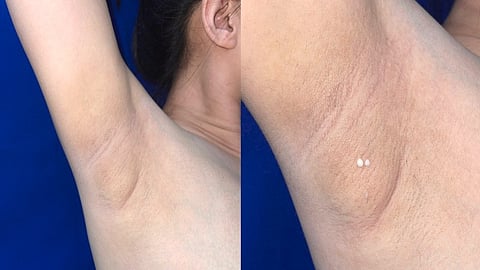
Clinical presentation of ectopic breast tissue with milky secretions in the axillary region.
A rare case of ectopic breast tissue caused milk leakage from a woman’s armpits during lactation.Image from Silor AFS et al., JAAD Case Reports, 2025, licensed under Creative Commons Attribution 4.0 (CC BY 4.0).
Published on
Updated on

Can ectopic breast tissue become cancerous?A woman in the Philippines was found to have milk discharge from her armpits due to a rare condition known as ectopic breast tissue. The case was documented by clinicians and published in a peer-reviewed dermatology journal in 2025, bringing attention to an unusual but medically recognized condition.1

Woman Reports Milk Leakage from Armpits After Pregnancy

The case involved a 35-year-old woman who reported recurring swelling in both underarm regions. The swelling was associated with a milk-like discharge, particularly during periods when she was breastfeeding after her pregnancies. The symptoms first appeared around 15 years ago following her first childbirth and reoccurred with subsequent pregnancies.

Doctors noted that the swelling and discharge resolved once breastfeeding stopped, indicating a hormonal link to the condition.

Doctors Identify Rare Condition Behind Unusual Symptom

The case was identified and managed by medical professionals in the Philippines and later published in JAAD Case Reports in 2025.1 Doctors confirmed the diagnosis through histopathological examination, which identified breast tissue in the axillary region and ruled out other causes of swelling.

The report highlighted the clinical findings, diagnostic process, and follow-up of the patient.

What Is Ectopic Breast Tissue?

Ectopic breast tissue, also referred to as polymastia, is the presence of breast tissue outside the normal chest area. This occurs due to incomplete regression of the embryonic milk line, a structure that extends from the armpits to the groin during early development.2

Although this tissue is present from birth, it often remains unnoticed until hormonal changes stimulate it. Events such as puberty, pregnancy, or lactation can activate this tissue, causing it to enlarge or produce milk.

In this case, small openings resembling accessory nipples were observed in the axilla, allowing milk discharge during lactation.

How Hormonal Changes Trigger Milk Production in Armpits

During pregnancy and breastfeeding, hormonal changes, particularly increased levels of prolactin, stimulate breast tissue to produce milk. In this case, the ectopic tissue located in the axillary (underarm) region responded similarly to normal breast tissue.

As a result, the patient experienced swelling and milk discharge from the armpits during lactation periods.

Treatment Options and When Surgery Is Considered

In most cases, ectopic breast tissue does not require treatment unless it causes discomfort, cosmetic concerns, or complications. Management options may include observation or surgical removal, depending on the severity of symptoms.

In this case, the patient chose not to undergo surgery, as her symptoms resolved after breastfeeding ended. Doctors recommended regular monitoring because ectopic breast tissue can develop the same conditions as normal breast tissue, including infections or, in rare cases, malignancy.

See also: Why Your Armpit Skin Matters More Than You Think

Can Ectopic Breast Tissue Lead to Complications?

Ectopic breast tissue is usually benign, but it can develop the same conditions seen in normal breast tissue. These include inflammation such as mastitis, pain during hormonal changes, and, in rare cases, benign or malignant tumors. Because this tissue responds to hormonal fluctuations, symptoms may become more noticeable during puberty, pregnancy, or lactation.

Ectopic breast tissue carries the same risk of pathological changes as normal breast tissue, including infection and, in rare cases, malignancy.1

Although complications are uncommon, clinicians advise regular monitoring, especially if there is persistent swelling, pain, or unusual discharge. Any new changes in size, consistency, or symptoms should be evaluated to rule out underlying pathology.

Why Awareness of This Condition Matters in Clinical Practice
This case demonstrates that breast tissue can exist and function outside its usual location. It also emphasizes the need for awareness among both patients and clinicians when evaluating unusual swelling or discharge in areas such as the armpit.

Early recognition can help ensure appropriate diagnosis, monitoring, and management when required.

FAQs

Q

How common is ectopic breast tissue?

A

Ectopic breast tissue is relatively uncommon but not rare. It is estimated to occur in about 2–6% of women and 1–3% of men.

Q

Is milk leakage from the armpit dangerous?

A

Milk leakage itself is not harmful, but it may indicate the presence of ectopic breast tissue. Medical evaluation is recommended to confirm the diagnosis and rule out other conditions.

Q

How is ectopic breast tissue diagnosed?

A

Diagnosis is based on clinical examination and may be confirmed through imaging or histopathological analysis (biopsy) to identify breast tissue in an unusual location.

Q

Can ectopic breast tissue become cancerous?

A

Yes, although rare, ectopic breast tissue can develop the same conditions as normal breast tissue, including benign tumors and breast cancer. Regular monitoring is advised.

Q

Can men have ectopic breast tissue?

A

Yes, ectopic breast tissue can occur in men, although it is less common and usually less noticeable due to lower hormonal stimulation.

References

1. Silor, A., M. Villaverde, and C. Silva. “Ectopic Breast Tissue with Milky Secretions on the Axillae in a Lactating Filipino Female: A Case Report.” JAAD Case Reports 63 (2025): 61–65.

2. Bland, Kirby I., J. Harrison Howard, and Lynn J. Romrell. “Congenital and Acquired Disturbances of Breast Development and Growth.” In The Breast, 4th ed., edited by Kirby I. Bland and Edward M. Copeland, 189–207. Philadelphia: W.B. Saunders, 2009. https://doi.org/10.1016/B978-1-4160-5221-0.00009-7.

(Rh/SS/MSM)

Clinical presentation of ectopic breast tissue with milky secretions in the axillary region.
Breast Milk Turns Green After Severe Allergic Reaction: UK Mother’s Near-Fatal Case Stuns Doctors

Related Stories

No stories found.
logo
Medbound Times
www.medboundtimes.com