
- Home
- About Us
- Contact Us
- Biography
- MedBound Hub
- InternshipInternship
- Daily Pulse
- Medicine
- Physical Therapy
- InterviewInterview
- Pharmacy
- Biotechnology
- College/InstituteCollege/Institute
- Dentistry
- Blog
- Wellness & Nutrition
- Nursing
- Opinion

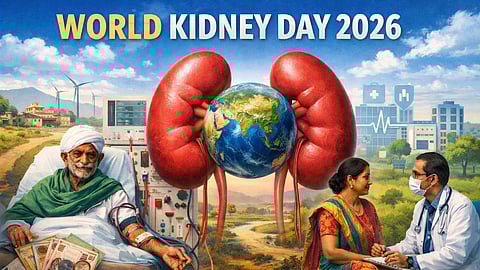
Every year, World Kidney Day is observed on the second Thursday of March, bringing global attention to kidney health, prevention of chronic kidney disease (CKD), and equitable access to treatment. In 2026, World Kidney Day falls on March 12 and marks the 20th anniversary of the global awareness campaign.
The theme for World Kidney Day 2026 is “Kidney Health for All: Caring for People, Protecting the Planet.” The campaign emphasizes equitable access to kidney care while also highlighting how environmental factors and healthcare systems influence kidney health.
In India, where chronic kidney disease is increasing due to diabetes, hypertension, and ageing populations, dialysis remains a life-saving yet expensive treatment. The country continues to face major challenges in ensuring that dialysis is affordable, accessible, and sustainable for millions of patients.
Dialysis remains a life-saving yet expensive treatment for kidney failure treatment in India, and unequal dialysis access in India continues to affect millions of patients who require long-term care.
Chronic kidney disease (CKD) has become a major public health challenge in India. Deaths related to CKD increased from about 0.59 million in 1990 to 1.18 million in 2016, highlighting the growing burden of kidney-related illnesses. Estimates suggest that around 175,000 patients in India were on chronic dialysis in 2018, representing a prevalence of 129 patients per million population. 1
However, access to treatment remains limited. A systematic review estimated that nearly two-thirds of patients with kidney failure died without receiving dialysis in 2010, largely due to lack of access or affordability.
About 16 percent of cases have an unknown cause, sometimes referred to as CKD of unknown etiology. Such cases have been reported from several states including Andhra Pradesh, Odisha, Maharashtra, Goa, and Tamil Nadu.
MedBound Times connected with Dr. N. Jaish George, Consultant Nephrologist, Apollo Speciality hospital, Vanagaram Chennai. He said:
Geographic inequality remains one of the biggest barriers to dialysis care. Around two-thirds of India’s population lives in rural areas, where dialysis facilities are scarce.
Research indicates that almost 60 percent of patients on dialysis must travel more than 50 km to reach a dialysis center, while nearly one-quarter travel over 100 km for treatment. These long distances increase out-of-pocket expenses and cause loss of wages, contributing to treatment discontinuation in many cases. 1
Hemodialysis is the most widely used form of renal replacement therapy in India. The country had approximately 12,881 hemodialysis stations in 2018, and dialysis units are now present across all states and union territories.
The National Dialysis Program, launched by the Government of India in 2016, aimed to expand access by establishing eight-station dialysis facilities in each of the country’s 688 districts to provide treatment to economically disadvantaged patients.
Despite these efforts, the program can only accommodate about 50,000 new patients, roughly one-third of the estimated current requirement, even without considering future growth in kidney failure cases.
Most dialysis services in India are still driven by the private sector, reflecting low public spending on healthcare. Public hospitals often focus on acute kidney injury and critically ill patients, leaving limited capacity for those requiring long-term maintenance dialysis. 2
Kidney transplantation remains the preferred long-term treatment for eligible patients with kidney failure. However, donor shortages, treatment costs, and the limited number of transplant centers continue to restrict access for many patients in India. Although thousands of patients develop end stage kidney disease each year, only a small proportion receive kidney transplants due to organ shortages and infrastructure limitations.⁴
Financial barriers remain one of the most significant challenges in dialysis care.
Although government insurance schemes exist, only about 35 percent of patients on dialysis have any form of insurance coverage, meaning many patients rely on out-of-pocket payments.
The cost of dialysis varies widely depending on the facility. Studies estimate that the average cost per dialysis session ranges from ₹600 to ₹5,000. Even subsidized dialysis can impose a heavy financial burden, with research suggesting that 40 percent to 93 percent of dialysis patients experience catastrophic healthcare expenditure within months of starting treatment.
Government reimbursement schemes typically cover approximately ₹2,900–₹3,335 per dialysis session in certain employee health programs, but they often do not include medication costs, travel expenses, or treatment of complications. 2
Dr. Jaish said:
MedBound Times connected with Dr. Lubna Kamal, Senior Consultant from Nano Homeopathy Institute, Lucknow. Explaining the homeopathic way of diagnosis and the course of treatment for Kidney Diseases, Dr. Lubna said:
"At least 50% of the total economic burden of kidney failure can be resolved with regular screening for diabetes and hypertension. Homeopathy effectively arrests the progression of disease and improving the quality of life of chronic kidney disease patients thus averting the urgent need for dialysis".
Such approaches are often used as complementary care by some patients.
Public health experts emphasize that early detection plays a crucial role in reducing the burden of chronic kidney disease. Routine screening for diabetes, hypertension, and kidney function can help identify kidney damage in its early stages. Blood tests such as serum creatinine measurement are used to estimate the glomerular filtration rate, while urine tests such as the urine albumin to creatinine ratio can detect early signs of kidney damage known as albuminuria.³
Clinical guidelines highlight that measuring estimated glomerular filtration rate along with urine albumin testing is one of the most effective strategies for screening and diagnosing chronic kidney disease at an early stage. Detecting kidney disease early can help slow disease progression and improve patient outcomes through timely treatment and lifestyle changes.⁵
India also faces shortages of trained nephrology professionals. The country has about 2,600 nephrologists, equivalent to roughly 1.9 nephrologists per million population, one of the lowest workforce densities globally.
There are around 72 nephrology training programs in India, producing about 150 trainees annually through a three-year training course. Shortages of dialysis nurses and technicians further strain dialysis services.
Studies show that around 90 percent of dialyzers in Indian dialysis centers are reused four to six times before being discarded, a practice adopted to reduce costs in resource-limited settings.
Dr. N. Jaish George notes that improving dialysis access in India will require strengthening public infrastructure, increasing insurance coverage, and expanding services closer to rural populations.
As the burden of chronic kidney disease continues to grow, experts stress that improving early detection, expanding dialysis infrastructure, and strengthening insurance coverage will be essential to ensure equitable kidney care across India.
References:
Bharati, Joyita, and Vivekanand Jha. “Global Dialysis Perspective: India.” Kidney360 (2020). https://pmc.ncbi.nlm.nih.gov/articles/PMC8815477/.
Konnur, Abhijit M., Nitiraj B. Shete, M. Sahay, M. Karishetti, S. V. Dhaygude, U. Anandh, U. Khanna, A. G. Patel, D. S. Ookalkar, P. S. Priyamvada, et al. “Dialysis Practices Across India: A Nationwide Study.” Indian Journal of Nephrology 34 (2024): 1–5. https://indianjnephrol.org/dialysis-practices-across-india-a-nationwide-study/.
National Kidney Foundation. “Urine Albumin to Creatinine Ratio (uACR).” https://www.kidney.org/kidney-failure-risk-factor-urine-albumin-creatinine-ratio-uacr.
Shroff, Sunil. “Current Trends in Kidney Transplantation in India.” Indian Journal of Nephrology (2016). https://pmc.ncbi.nlm.nih.gov/articles/PMC4970385/.
Christofides, Eva A., et al. “Optimal Early Diagnosis and Monitoring of Diabetic Kidney Disease.” Diabetes Therapy (2021). https://pmc.ncbi.nlm.nih.gov/articles/PMC7983418/.
World Kidney Day. “2026 Campaign: Kidney Health for All: Caring for People, Protecting the Planet.” https://www.worldkidneyday.org/2026-campaign/.
