
- Home
- About Us
- Contact Us
- Biography
- Column
- MedBound Hub
- InternshipInternship
- Daily Pulse
- Medicine
- Physical Therapy
- InterviewInterview
- Pharmacy
- Biotechnology
- College/InstituteCollege/Institute
- Dentistry
- Blog
- Wellness & Nutrition
- Nursing
- Opinion

Every year on World AIDS Day, we pin the red ribbon to our coats, sometimes with hurried fingers between ward rounds, sometimes because a colleague reminds us just in time. For most healthcare workers, it begins as a symbol of awareness, a reminder of a global struggle. But over the years, I’ve realized that this ribbon often becomes much more than that—it becomes a mirror. A mirror that reflects the human stories we encounter, the silences we witness, and the quiet courage that rarely makes it to our textbooks. It wasn’t a lecture, a seminar, or an epidemiology graph that taught me this. It was a patient I met during my MBBS posting at the Rural Health Training Centre (RHTC)—someone whose name I would never disclose, but whose story continues to shape my understanding of HIV long after that day.
I remember the afternoon vividly. I was preparing health education material on STI prevention when the medical officer asked if I could sit in for a counselling session. The patient walked in softly, almost trying not to disturb the air around him. He couldn’t have been more than his late twenties, but his eyes carried the exhaustion of someone far older. He avoided eye contact, kept adjusting the end of his dupatta-like gamcha, and spoke in a voice so low that we had to lean in to hear him. He had just learned his HIV status. What struck me wasn’t his fear of the virus—it was his fear of the world outside that room. He wasn’t afraid of opportunistic infections or CD4 counts; he was afraid that someone in his village would see him step out of the ICTC door. “Madam… yahan aate dikh gaya toh log jaan jayenge.” (Ma'am, what if someone sees me here.) he whispered. That moment shattered the illusion I had carried through most of my medical training: that information, awareness and treatment alone were enough. That day, I understood something we rarely say out loud—HIV affects the immune system, but stigma attacks everything else.
That quiet encounter taught me more than any classroom could. We learn about surveillance indicators, DALYs, incidence curves, prevention cascades and 95-95-95 goals, but no textbook teaches us the emotional geography of HIV. In public health, we speak about high-risk groups, key populations, bridge populations, condom use, harm reduction and ART adherence. But no one prepares you for the weight carried by someone who travels 40, 60 or even 100 kilometers just to avoid being recognized at an ART center. No one warns you that a newly married woman will sit across from you, trembling—not because she fears her diagnosis, but because she dreads the blame her family might place on her.
No module on HIV ever describes how a patient hesitates before touching the pen you hand them, or how a teenager asks, in absolute earnestness, whether holding hands is risky behavior. We talk about “access issues” in presentations—but we don’t talk about the loneliness that often walks in before the patient does.
Over the years, World AIDS Day stopped being just a symbolic date for me. It became a day of remembrance—of every patient who whispered, “Doctor, please don’t tell anyone.” For those of us who’ve worked even briefly in HIV care, the day carries a quiet heaviness. We know that while medical treatment has evolved tremendously, stigma continues to travel faster than the virus ever did. We see how fear delays testing, how shame delays treatment, how misinformation delays disclosure, and how society still treats HIV not as a disease, but as a judgment.
I often think back to my RHTC patient and how he held his reports—as if they were both a burden and a secret. And then, years later, during my internship and residency, I met patients at ART centers who carried the same silence.
Some believed they deserved the diagnosis.
Some believed they would never find acceptance again.
Some believed their lives had shrunk to the size of a pillbox.
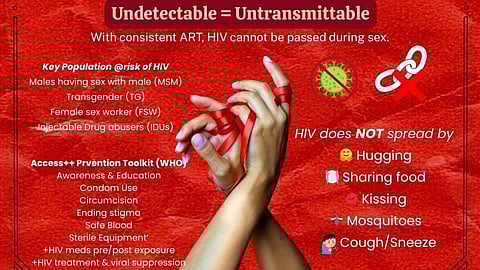
But then there were others—patients who walked back to the center after months of counselling, with their viral load down to undetectable levels, their shoulders lighter, their eyes brighter. Patients who learned to live again, not just survive. Their strength taught me something that no virology chapter ever did.
ART suppresses the virus, but empathy heals the wounds that medicine cannot touch.
People often ask whether awareness days still matter in 2025, now that ART is accessible, viral suppression is achievable, and HIV-related deaths have reduced drastically. My answer is always yes. Because despite all our progress, young people still hesitate to get tested, married women still silently bear the consequences of their husbands’ risk behaviors, LGBTQ+ individuals still navigate healthcare with caution, and adolescents still receive misinformation at the speed of light.
Awareness days matter because conversations matter. They keep reminding us that the fight today is more social than biomedical.
As healthcare workers, our responsibility goes beyond prescriptions, guidelines and counselling checklists. We owe our patients confidentiality that is fiercely protected, counselling that feels like conversation and not interrogation, and trust that is built one interaction at a time. Public health is not only about disease control—it is about dignity, acceptance and human connection. Those soft skills we often overlook? They are as powerful as any drug in the ART regimen.
Maybe one day, walking into an ART center won’t require courage. Maybe one day, a positive test will evoke clarity rather than fear. Maybe one day, a child will learn that HIV is simply another chronic condition—manageable, treatable, non-judgmental. Maybe stigma will lose its power. Until then, the red ribbon will stay a mirror—reflecting not just the struggle against the virus, but the humanity we bring into that struggle.
World AIDS Day, to me, is not just about raising awareness. It is about remembering the patient who taught me that the real battle is often silent. It is about honoring the countless individuals who face judgment long before they face symptoms. And it is about reaffirming something I now hold close to my heart:
Ending AIDS is not only a medical goal—it is a collective act of empathy and courage.
To bring grounded, field-based perspectives into this conversation, MedBound Times connected with Unnati Machchhar (She/Her) Associate Director - Strategy and Organisation Development SNEHA (Society for Nutrition, Education and Health Action), she is a senior public health professional who has worked extensively in HIV/AIDS programs, gender-based violence prevention, and community health systems in India. With prior experience across state AIDS control initiatives and women-centric NGOs, the expert shared candid reflections drawn from years of counselling, community engagement, and frontline public health work.
Here is what she had to say:
In your work with HIV programs, what gender-related challenges do women face that the public often doesn’t see?
Unnati Machchhar: While working as a counsellor in an HIV Counselling and Testing Centre, I frequently encountered women facing deeply gendered challenges. Women were often blamed for “bringing the infection into the family,” even when their male partners were HIV-positive and, in many cases, already aware of their status. Male partners were typically the ones using drugs or having multiple sexual partners, yet women were the ones abandoned—often because their HIV status was revealed first during mandatory testing in pregnancy.
As counsellors, we were required to demonstrate condom use to every client. However, many women felt unable to ask their partners to use condoms for contraception, fearing that their partners would question how they had learned about condom use in the first place.
During your time working with public HIV programs, what was the most persistent stigma you noticed in communities—and how did it affect care-seeking?
Unnati Machchhar: The strongest stigma was attached simply to being diagnosed with HIV. Hiding one’s HIV-positive status deeply affected care-seeking behavior and took a serious toll on mental health. Many people lived in constant fear that their status would be revealed, and for some, this fear became overwhelming.
I recall a male client who came to the counselling center carrying a bottle of poison. Placing it in front of me, he said, “If my HIV report is positive, I will drink this and end my life right here.” I paused, gathered myself, and asked him about his fears—what he believed would happen if the report was positive. Once he felt heard, he began to calm down. I asked him to call someone he trusted to accompany him home. That moment reminded me how stigma, not the virus, can push people to the brink.
How does violence—physical, emotional, or economic—shape a woman’s risk of acquiring HIV?
Unnati Machchhar: Our societal structure assigns rigid gender roles, placing women at high risk of acquiring HIV. Physically and sexually, many women cannot make decisions about their own bodies. The decision to use contraception is often controlled by husbands or extended family members. Many male partners do not understand consent and force sexual contact without considering a woman’s wishes.
Emotionally, this leaves women feeling unseen and objectified. Economically, women often delay seeking healthcare when unwell, while male family members can access care more easily because they control household finances. These layers of vulnerability directly increase women’s risk.
What challenges do frontline health workers and counsellors face that people rarely acknowledge?
Unnati Machchhar: Frontline workers often feel helpless because they want to support people beyond what the system allows. I remember counselling a 16-year-old girl with Thalassemia Major who was also diagnosed with both HIV-1 and HIV-2. She lived with her grandmother after losing both parents. Given her frequent need for blood transfusions and multiple comorbidities—tuberculosis and recurrent skin infections—it was difficult to remain hopeful.
As a counsellor, I felt responsible not only for supporting the girl so she could remain as healthy as possible, but also for her grandmother, who was physically frail yet never missed a single hospital visit. These emotional burdens are rarely spoken about in public health discussions.
If you could share one message with the public that data alone cannot convey about HIV, what would it be?
Unnati Machchhar: There is life after being diagnosed with HIV. Start treatment early, adhere to ART, and maintain a healthy lifestyle with balanced nutrition, regular exercise, and adequate rest. I personally know people who have been living healthy, meaningful lives with HIV for more than 20 years.
HIV today is a manageable chronic condition with timely diagnosis and sustained ART adherence.
Stigma, not the virus, remains one of the biggest barriers to testing, treatment initiation, and continuity of care.
Women, adolescents, and marginalized groups often face compounded social risks that increase vulnerability and delay healthcare access.
Confidentiality, empathy, and nonjudgmental counselling are as critical as medical treatment in HIV care.
As India moves closer to its public health targets for HIV control, addressing stigma remains essential to achieving meaningful progress. Ending AIDS will require not only medical innovation, but sustained social change, community dialogue, and healthcare spaces where patients feel safe to seek care without fear.
Until then, the red ribbon remains more than a symbol. It is a reminder that HIV care does not end with a prescription. It begins with empathy.
Why is HIV still stigmatized?
HIV stigma persists due to long-standing associations with morality, sexuality, and misinformation. While treatment has transformed outcomes, public understanding has not evolved at the same pace, allowing fear and judgment to continue influencing behavior.
How does stigma affect HIV treatment and outcomes?
Stigma delays testing, discourages disclosure, and interferes with consistent ART adherence. Fear of being identified at testing centers or ART clinics often leads patients to travel long distances or avoid care altogether.
Why do people avoid ART centres despite free treatment?
Many people avoid ART centers due to fear of being recognized, loss of confidentiality, and social stigma rather than concerns about treatment itself. In some communities, visiting an ART center can lead to unwanted disclosure, discrimination, or strained family relationships, causing individuals to delay care even when antiretroviral therapy is freely available.
