
- Home
- About Us
- Contact Us
- Biography
- MedBound Hub
- InternshipInternship
- Daily Pulse
- Medicine
- Physical Therapy
- InterviewInterview
- Pharmacy
- Biotechnology
- College/InstituteCollege/Institute
- Dentistry
- Blog
- Wellness & Nutrition
- Nursing
- Opinion

Have you ever noticed how much of what we experience, what we see, smell, or taste depends on chemistry? From the scent of a flower to the way medicines work in our bodies, these tiny molecules play a huge role. Yet something even more fascinating is that two molecules made of the exact same atoms can behave very differently. This happens due to a phenomenon known as chirality.
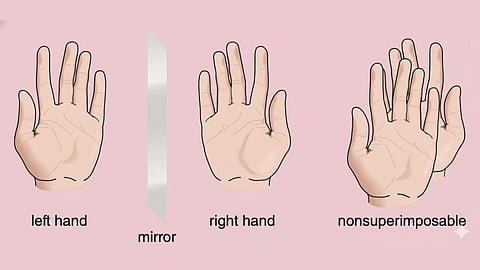
To understand chirality, think about your hands. Your left and right hands look similar and are made of the same parts, but no matter how hard you try, you cannot place one perfectly on top of the other. They are mirror images that do not match exactly. This “handedness” is what scientists call chirality, and many organic molecules behave in the same way.
In organic chemistry, molecules are often built around chains of carbon atoms. Sometimes, compounds share the same molecular formula but differ in how their atoms are arranged. These compounds are called isomers.
A special type of isomer is a stereoisomer, which differs only in the three-dimensional arrangement of its atoms. Chirality is a specific property of certain stereoisomers. Among them, enantiomers are particularly fascinating. Enantiomers are pairs of molecules that are mirror images of each other, much like your hands. Although they have the same chemical formula and connectivity, their spatial arrangement makes all the difference.
Although enantiomers behave almost identically in many chemical and physical properties, they differ in two important ways:
How they interact with polarized light
How they interact with other chiral molecules, especially those in living systems
Biological molecules such as enzymes, receptors, and proteins are themselves chiral. Even a small change in orientation can determine whether a molecule fits perfectly, poorly, or not at all.
In a discussion on MedBound Hub regarding chirality of molecules and how they interact with the body, Ketan Laxman Sonawane, Master of Pharmacy in Quality Assurance, explained:
"Our body is highly selective. The receptors and enzymes that interact with medicines are also three-dimensional and “handed.” So, when a drug enters the body, one mirror-image form may fit perfectly into a receptor and produce the desired healing effect."
He further explained, " Its twin, however, may not fit well at all. Sometimes it does nothing. In worse cases, it may even cause unwanted side effects."
Chemists distinguish enantiomers using the R/S system, based on the Cahn-Ingold-Prelog (CIP) rules. Groups attached to a chiral carbon are ranked according to atomic number. When viewed in a specific orientation, if the priorities run clockwise, the configuration is labelled R (from the Latin rectus, meaning right). If they run counterclockwise, it is labelled S (sinister, meaning left).
One of the most striking demonstrations of chirality comes from the spice rack in our homes include spearmint and caraway. Spearmint has a fresh, sweet, minty aroma, while caraway seeds offer a warm, spicy, earthy scent. Surprisingly, both owe their distinctive smells to the same molecule named carvone.
In both cases, carvone has the same atoms, the same bonds, and the same chemical formula. The only difference is its three-dimensional orientation:
(R)-carvone smells like spearmint
(S)-carvone smells like caraway
This subtle difference in spatial arrangement leads to dramatically different smells because our olfactory receptors are chiral and interact differently with each enantiomer of carvone. This phenomenon is well documented in sensory chemistry literature.²
Another compelling example is limonene, which also exists as two enantiomers with distinct sensory experiences.
d-Limonene (R-enantiomer) smells strongly of oranges and is widely used in foods, cosmetics, and eco-friendly solvents.
l-Limonene (S-enantiomer) has a pine or turpentine-like scent and is found in plants such as dill, caraway, and mint.
These odor differences are attributed to enantiomer-specific binding to olfactory receptors.²
Chirality does not only affect smell and taste, it can be a matter of life and death. Perhaps no case illustrates this better than the thalidomide tragedy of the late 1950s and early 1960s.
Thalidomide is a chiral drug that exists as two enantiomers: (R)-thalidomide and (S)-thalidomide. It was marketed as a racemic mixture containing equal amounts of both forms (50/50). Later studies, including work by Blaschke et al., revealed that only the (S)-enantiomer is teratogenic and responsible for severe birth defects.
"History taught us this lesson the hard way. In the past, a drug called thalidomide was given to pregnant women for nausea. One form helped with symptoms, while the other caused severe birth defects. At that time, both forms were given together because they were thought to be the same. This tragedy changed how medicines are studied forever," explained Ketan Laxman Sonawane.
Even more troubling, the two enantiomers can interconvert. This means that administering only the “safe” enantiomer would not have prevented the harmful effects. 1
Tokunaga, E., T. Yamamoto, E. Ito, et al. 2018. “Understanding the Thalidomide Chirality in Biological Processes by the Self-disproportionation of Enantiomers.” Scientific Reports 8: 17131. https://doi.org/10.1038/s41598-018-35457-6.
Bentley, R. “Role of Chirality in Flavor and Fragrance.” Chemical Reviews 106, no. 9 (2006): 4099–4113. https://doi.org/10.1021/cr050223t.
MSM
