On January 14 2026, the U.S. Senate Health, Education, Labor and Pensions (HELP) Committee convened a hearing titled “Protecting Women: Exposing the Dangers of Chemical Abortion Drugs” at the Dirksen Senate Office Building in Washington, D.C. The focus was on the safety and regulation of medication abortion, particularly pills such as mifepristone, which have been widely studied and used for decades in the United States. During the hearing, experts were invited to testify on medical evidence and public health considerations.
Dr. Nisha Verma, an Indian-origin obstetrician-gynecologist based in Georgia and Massachusetts, was called as a witness by Democratic lawmakers and identified as a senior adviser to Physicians for Reproductive Health. Verma provides reproductive healthcare and testified on the scientific evidence surrounding abortion medications and patient care.
During the questioning portion, Republican Senator Josh Hawley (Missouri) and Florida Senator Ashley Moody asked Dr. Verma whether biological men can become pregnant. The exchange became a focal point of the hearing and subsequently went viral:
Senator Ashley Moody first posed the question in the context of concerns over how abortion pills might be obtained and used by men to pressure partners.
Dr. Verma responded that she treats patients with a variety of identities and hesitated to provide a direct yes-or-no answer, stating she was “not really sure what the goal of the question is” and emphasizing patient diversity.
Hawley then interjected, framing the query as an attempt to “establish a biological reality” and pressed Verma for a direct response about whether men can get pregnant. Verma reiterated that she felt the question was polarizing and declined a simple biological reply.
The exchange continued with Hawley insisting on a clear answer and Verma maintaining that the complexity of patient identities and healthcare considerations influenced her hesitation. Hawley stated for the record that “it’s women who get pregnant and not men” and urged that basic scientific clarity was necessary.
The exchange occurred against the backdrop of national and legal debates over abortion access, medication regulation, and the role of scientific evidence in policymaking. Senator Hawley cited concerns about adverse health events associated with abortion drugs, terming reported rates higher than official labels indicate. Testimony by Verma emphasized that medication abortion has been rigorously studied and proven safe and effective in multiple peer-reviewed studies and has been used by millions in the United States since early FDA approval.
The intense focus on a seemingly simple biological question illustrates how scientific terminology and lived experiences intersect with public policy, particularly in discussions involving gender identity, reproductive healthcare, and legislative oversight.
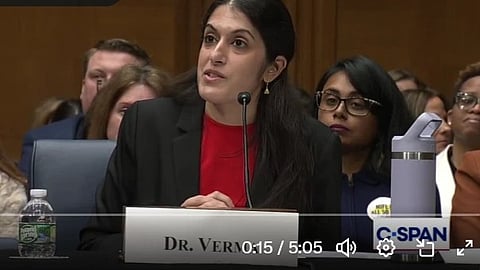
What began as a technical hearing on abortion pill safety evolved into a widely shared exchange between Senator Josh Hawley and Dr. Nisha Verma over a direct question about whether men can become pregnant. The moment attracted media attention, social discussion, and broader debates at the intersection of science, policy, and gender in reproductive health.
Reference
Koenig, Leah R., Elizabeth G. Raymond, Ushma D. Upadhyay, Laura J. Frye, Bliss Kaneshiro, Christy M. Boraas, Catherine E. Oldenburg, and David V. Glidden. “Effectiveness and Safety of Medication Abortion with vs Without Screening Ultrasonography or Pelvic Examination.” American Journal of Obstetrics and Gynecology 233, no. 5 (2025): 453.e1-453.e16. https://doi.org/10.1016/j.ajog.2025.06.013
(Rh)