Hollinwell Incident: The 1980 Mass Collapse Mystery That Still Remains Unresolved

During a summer event in Nottinghamshire, around 300 children and adults suddenly experienced fainting, nausea and other symptoms. The cause was never definitively determined.
A large empty ground.
Site of the Hollinwell Incident.Site of the Hollinwell Incident by Jonathan Clitheroe, CC BY-SA 2.0, via Wikimedia Commons
Published on
Updated on

On 13 July 1980, an unexplained medical event occurred at the Hollinwell Showground, near Kirkby-in-Ashfield in Nottinghamshire, England, when hundreds of children and adults suddenly fell ill during a well-attended summer gathering.

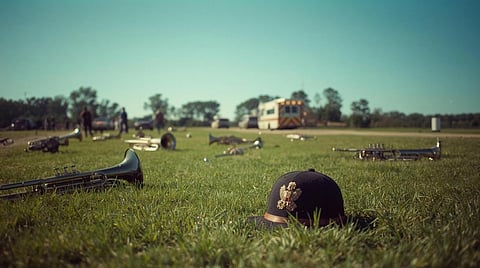
The event, known since as the Hollinwell Incident, affected participants in a Junior Brass and Marching Band competition and sparked widespread concern and mystery, as no conclusive cause has ever been identified.

What is the Hollinwell Incident?

The Hollinwell Incident took place on Sunday, 13 July 1980, during an annual show at the Hollinwell Showground, a field used for community fairs and music competitions. Around 500 children from 11 marching bands attended the event, with many traveling from across the East Midlands, including from towns up to 65 km away.

The incident began around 10am, shortly after marching bands had assembled and were preparing for performances. Witnesses reported that a few children first became weak and then collapsed in rapid succession, prompting bystanders to describe the scene as chaotic.

Symptoms and Immediate Response in Hollinwell Incident

As the event unfolded, around 300 people, mostly children aged 8–14 but also some adults and few babies, experienced a range of symptoms, including:

  • Fainting and dizziness

  • Nausea and vomiting

  • Headaches and stomach pains

  • Irritated or sore eyes and throats

  • General weakness and tingling

Many witnesses described seeing participants fall “like ninepins” as they collapsed one after another across the field.

Emergency services were rapidly called. St John Ambulance volunteers, local police and fire crews attended, establishing on-site first aid as ambulances arrived from neighboring towns to transport the stricken to hospitals including Queen’s Medical Centre in Nottingham and facilities in Mansfield, Chesterfield and Nottingham City. Four local hospitals reported being placed on red alert as an unprecedented number of casualties arrived.

In total, 259 people were taken to hospitals, and nine children were kept overnight for observation according to BBC report. Many others recovered later that day or within a short period.

Eyewitness Accounts and Experiences of Hollinwell Incident

Numerous firsthand accounts emerged from the day. One young participant described her legs and arms feeling as if they “had no bones in them” before collapsing. Parents recalled thousands of ambulances on site, frantic scenes with injured children scattered across the field, and relatives searching for their own among the affected. Some children reported odd tastes or smells variously likened to bleach or onions just before feeling unwell. One girl who left the show early reportedly developed symptoms later at home, raising questions for some observers about psychological vs physical causes.

Official Investigation and Conclusion

A formal inquiry was conducted by the Ashfield District Council, local police and medical officers. The investigation examined:

  • Food and water supplies

  • Soil and environmental conditions

  • Possible radio waves or gas exposure

  • Proximity of nearby crop spraying and pesticides

Despite extensive testing and interviews, no definitive toxic or infectious agent was found. The official report ultimately concluded that the most plausible explanation was mass hysteria, a type of mass psychogenic illness (MPI) in which psychological stress and social contagion can produce real physical symptoms among a group. The pattern observed, widespread fainting, subsequent quick recovery in many cases, and absence of identifiable toxin, supported this theory in the official view.

However, many parents and witnesses questioned this conclusion, arguing that the wide range of physical symptoms and occurrence even among those not directly exposed to any environmental stressor were difficult to reconcile with mass hysteria alone.

Pesticide Exposure Theory

In later years, journalists and researchers revisiting the incident examined agricultural practices near the showground. A BBC Inside Out investigation highlighted the use at the time of pesticides such as tridemorph, which was later banned in the UK and classified as “hazardous” by the World Health Organization. Some locals have suggested that pesticide poisoning, crop spraying or other chemical exposure may have contributed to the symptoms, though no direct causal link was established in official reports.

Long-Term Recollections and Legacy

Despite the lack of conclusive scientific findings, the Hollinwell Incident remains one of Britain’s most discussed unexplained mass illness events, frequently referenced in discussions of mass psychogenic illness, public health mysteries, and collective stress responses. Survivors and families have shared memories of lingering anxiety and questions about the event that unfolded on a warm summer’s morning over four decades ago.

Understanding Mass Psychogenic Illness or Mass Hysteria

Mass psychogenic illness (MPI) refers to the rapid spread of symptoms without an identifiable environmental or biological cause, often following stress or anxiety in group settings. Examples may include episodes of fainting, nausea or dizziness that occur among tightly grouped individuals, particularly when they observe peers exhibiting similar symptoms. MPI is a diagnosis of exclusion, meaning other causes must first be ruled out before it is considered.

Some clinicians and researchers caution that while MPI can explain certain patterns, it does not imply deliberate or imagined symptoms, rather, real physiological responses can arise from subconscious processes triggered in group dynamics.

Summary

The Hollinwell Incident of 13 July 1980 remains an enigmatic episode in public health history. Despite official findings pointing toward mass hysteria, alternative theories involving environmental exposures have persisted in public discourse, perplexing unexplained mass health events in modern British history.

References

  1. BBC News. “The Hollinwell Incident.” BBC Inside Out East Midlands. Accessed 28th December 2025. https://www.bbc.co.uk/insideout/eastmidlands/series4/holinwell_incident.shtml.

  2. BBC News. “Hollinwell Incident – Nottinghamshire.” BBC News, October 2003. http://news.bbc.co.uk/2/hi/uk_news/england/nottinghamshire/3128402.stm.

  3. Fortean Times. “All Fall Down: The Hollinwell Incident.” Fortean Times, archived September 19, 2014. https://web.archive.org/web/20140919210755/http://www.forteantimes.com/features/articles/4237/all_fall_down.html.

Related Stories

No stories found.
logo
Medbound Times
www.medboundtimes.com