
- Home
- About Us
- Contact Us
- Biography
- MedBound Hub
- InternshipInternship
- Daily Pulse
- Medicine
- Physical Therapy
- InterviewInterview
- Pharmacy
- Biotechnology
- College/InstituteCollege/Institute
- Dentistry
- Blog
- Wellness & Nutrition
- Nursing
- Opinion

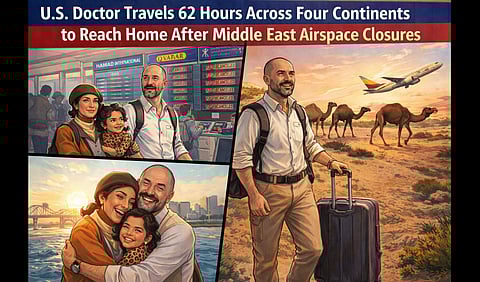
A U.S. physician undertook a 62-hour journey across several countries to return home after being stranded in Qatar during flight disruptions linked to escalating tensions involving Iran.
Dr. Jay Miller, a pulmonary and critical care specialist based in New Orleans, Louisiana, was travelling internationally when the conflict led to widespread aviation disruptions across parts of the Middle East. The incident occurred in early March 2026 after military escalation prompted several countries in the region to restrict or close their airspace.
The sudden travel disruptions left many international passengers unable to leave regional airports, including Doha, Qatar.
Dr. Miller had been travelling in India with his family and began his return journey earlier because he needed to resume his medical duties in Louisiana. His planned route included a connecting flight from Doha to Dallas.
However, shortly after departure, the aircraft was forced to return to Hamad International Airport in Doha because of rapidly changing security conditions and airspace restrictions related to the conflict.
The unexpected return left him stranded in Qatar as airlines suspended flights and rerouted aircraft to avoid potentially unsafe airspace.
Dr. Miller remained stranded in the city for five nights, during which he reported hearing explosions strong enough to shake the windows of his hotel room, He told The New York Times,
It was one of the moments when you tell your spouse you love them, which I did.
Dr. Jay Miller, Pulmonary and Critical Care Specialist
The disruption followed military strikes involving the United States and Israel against targets in Iran on February 28, 2026, which were followed by retaliatory missile and drone attacks. As tensions escalated, aviation authorities in several countries introduced airspace restrictions as a precaution for civilian aircraft.
Airlines typically suspend operations in conflict zones because commercial flights may be at risk from military activity. Such restrictions can affect international travel routes, particularly in regions that serve as major transit hubs for long-haul flights.
As a result, passengers travelling through the Middle East experienced delays and cancellations across multiple airlines.
After several days without confirmed flights from Doha, Dr. Miller arranged an alternative route to leave Qatar. His plan involved travelling by road to Riyadh, Saudi Arabia, where international flights were still operating.
The road journey to Riyadh took approximately nine hours. From King Khalid International Airport, he boarded an Ethiopian Airlines flight to Addis Ababa, Ethiopia.
After a layover in Addis Ababa, he continued his journey to Chicago, United States, with a refuelling stop in Rome, Italy.
We felt we had to move on our own. There was not time or the circumstances to wait for someone.
Dr. Jay Miller, Pulmonary and Critical Care Specialist
Upon arrival in Chicago, Dr. Miller boarded a domestic flight to New Orleans, completing the final leg of his trip.
The entire journey took about 62 hours of travel time and involved travelling across several countries and continents. Reports indicate that the travel arrangements, including road transport and flights, cost approximately $10,000.
According to reports, the U.S. State Department contacted him only after he had already reached home.
The episode occurred during a period of widespread travel disruption in the Middle East as airlines responded to airspace restrictions introduced during the conflict.
(Rh/SS/MSM)
