India's Biotechnology Roadmap Explained: How NITI Aayog Plans to Build a $691 Billion Bioeconomy by 2035 with Six National BioMissions

NITI Aayog's biotechnology roadmap proposes six National BioMissions, a ₹50,000 crore BioEconomy Growth Fund, and reforms to help India build a $691 billion bioeconomy by 2035
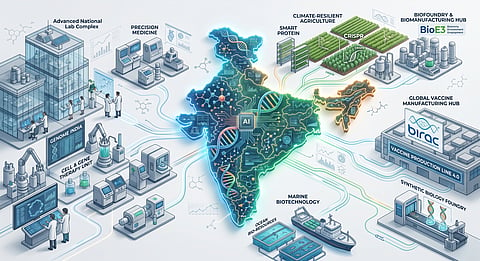
Editorial illustration of a futuristic India map formed by DNA strands, molecular networks, AI circuits, biotechnology laboratories & more
India aims for a $691B bioeconomy by 2035. Explore the six National BioMissions, AI, healthcare, and biotechnology strategy.
Published on
Updated on

Key Points:

  • India aims to build a $691 billion bioeconomy by 2035 under NITI Aayog's biotechnology roadmap.

  • The roadmap proposes six National BioMissions to advance healthcare, agriculture, and biotechnology innovation.

  • A ₹50,000 crore BioEconomy Growth Fund aims to accelerate biotechnology commercialisation.

  • Artificial intelligence will support drug discovery, genomics, disease surveillance, and biomanufacturing.

  • The strategy targets over 30 million jobs and positions India among the world's top biotechnology leaders.

India has proposed six National BioMissions and a ₹50,000 crore BioEconomy Growth Fund as part of a NITI Aayog roadmap that aims to expand the country's bioeconomy to $691 billion by 2035.

The roadmap, released jointly by NITI Aayog and the Department of Biotechnology (DBT), outlines reforms spanning precision medicine, agricultural biotechnology, synthetic biology, marine biotechnology, disease surveillance, and biopharmaceutical innovation. It also proposes measures to strengthen biotechnology research, manufacturing, and innovation while improving coordination across the sector.

The report, titled "Roadmap for Building India as a Leading BioEconomy Powerhouse by 2035," was released on July 16 by Union Minister of State (Independent Charge) for Science and Technology Dr. Jitendra Singh and Prof. Gobardhan Das, Member, NITI Aayog. According to the roadmap, India aims to become one of the world's top three biotechnology powers by 2035 while creating more than 30 million high-value jobs and strengthening its position in global biotechnology value chains.

India's Bioeconomy Grew to $195.3 Billion Before the 2035 Roadmap

Timeline infographic illustrating the growth of India's bioeconomy from $10 billion in 2014 to $195.3 billion in 2025
India's bioeconomy has grown from approximately $10 billion in 2014 to $195.3 billion in 2025, with NITI Aayog's roadmap targeting a $691 billion bioeconomy by 2035 and a long-term vision of $2.6 trillion by 2047.

According to the roadmap, India's bioeconomy has grown from approximately $10 billion in 2014 to $195.3 billion in 2025, representing nearly a sixteen-fold increase over the past decade. The sector currently contributes about 4.8% of India's Gross Domestic Product (GDP) and supports more than 3.3 million professionals across biotechnology-related industries. The report also notes that India has nearly 12,000 biotechnology startups, making it one of the world's fastest-growing biotechnology startup ecosystems.

Despite this growth, NITI Aayog states that India's biotechnology ecosystem remains fragmented, with multiple programmes operating independently across sectors. The roadmap proposes a mission-oriented framework to improve coordination, strengthen research translation, encourage commercialisation, and enhance India's competitiveness in the global bioeconomy.

The Six National BioMissions in India's Biotechnology Roadmap

The roadmap proposes six National BioMissions, each with a defined strategic objective. Rather than broadly categorising biotechnology sectors, the report assigns each mission a specific name and implementation focus.

1. GeneIndia

GeneIndia aims to strengthen India's capabilities in precision medicine, gene therapies, cell therapies, and advanced diagnostics. The mission seeks to improve access to next-generation medical technologies while supporting research, manufacturing, and clinical translation. Precision diagnostics use genetic and molecular information to help guide diagnosis and treatment decisions.

2. AgriBio 2.0

AgriBio 2.0 focuses on developing climate-resilient crop varieties, improving agricultural productivity, and promoting quality-assured biological inputs such as biofertilisers and biopesticides. The roadmap identifies agricultural biotechnology as an important tool for improving food security while responding to climate-related challenges.

3. BioX Foundry

BioX Foundry aims to accelerate synthetic biology and engineering biology by supporting the development of biofoundries and improving the translation of laboratory discoveries into commercially viable technologies. The mission seeks to strengthen India's capacity to manufacture medicines, enzymes, biomaterials, and other bio-based products using engineered biological systems.

4. One Health Grid

The One Health Grid proposes an integrated platform for human, animal, and environmental health surveillance. It would use digital technologies and artificial intelligence to improve disease monitoring, early detection of outbreaks, and data sharing across sectors, supporting the internationally recognised One Health approach.

5. BlueBio Mission

The BlueBio Mission focuses on harnessing marine biological resources for applications in healthcare, agriculture, nutrition, industrial biotechnology, and sustainable manufacturing. Areas of interest include seaweed cultivation, marine microorganisms, bioactive compounds, and marine-derived biomaterials.

6. BioPharmaNext

BioPharmaNext aims to strengthen India's leadership in next-generation biologics, biosimilars, vaccines, and AI-enabled drug discovery. The mission builds on India's established pharmaceutical manufacturing capabilities while promoting innovation in advanced biological medicines.

The Science Behind NITI Aayog's Six National BioMissions

While the proposed National BioMissions focus on different sectors, they share a common objective of translating scientific research into practical applications that improve healthcare, agriculture, manufacturing, and environmental sustainability.

GeneIndia: Advancing Precision Medicine

The proposed GeneIndia mission focuses on expanding India's capabilities in precision medicine, an approach that tailors disease prevention, diagnosis, and treatment based on an individual's genetic makeup, environment, and lifestyle.

Unlike conventional treatments that apply the same therapy to large groups of patients, precision medicine aims to identify the treatment most likely to benefit a specific patient. This approach increasingly relies on technologies such as genome sequencing, molecular diagnostics, and biomarker analysis.

The roadmap also identifies gene and cell therapies as priority areas. Gene therapy seeks to treat or prevent disease by modifying faulty genes, while cell therapy uses living cells to repair or restore damaged tissues. These approaches have shown promise for certain inherited disorders, blood cancers, and other conditions, although they remain resource-intensive and require specialised infrastructure.

Expanding domestic research, manufacturing capacity, and clinical translation could improve access to these advanced therapies while reducing dependence on imported technologies.

AgriBio 2.0: Supporting Climate-Resilient Agriculture

Agricultural biotechnology applies biological sciences to improve crop production, disease resistance, and environmental sustainability.

According to the roadmap, AgriBio 2.0 would prioritise the development of climate-resilient crop varieties capable of withstanding drought, heat, salinity, and emerging plant diseases. Such crops may help farmers adapt to changing climatic conditions while improving food security.

The mission also proposes expanding the use of biological inputs such as biofertilisers and biopesticides. Unlike many conventional chemical products, these biological alternatives use naturally occurring microorganisms or biological compounds to improve soil health, increase nutrient availability, and manage crop pests.

The report also recommends strengthening seed innovation, plant genomics, and agricultural biotechnology research through closer collaboration among research institutions, universities, and industry.

BioX Foundry: Accelerating Synthetic Biology

One of the roadmap's most technology-focused proposals is the BioX Foundry mission.

Synthetic biology combines biology, engineering, computer science, and automation to design or redesign biological systems for useful applications. Scientists can modify microorganisms such as bacteria or yeast to manufacture medicines, industrial enzymes, specialty chemicals, biodegradable materials, and other high-value products.

The roadmap proposes establishing biofoundries, highly automated research facilities that integrate robotics, artificial intelligence, high-throughput experimentation, and advanced biological engineering to accelerate innovation.

Biofoundries can automate and test hundreds of biological designs simultaneously, helping researchers develop and optimise new products more efficiently than conventional laboratory workflows.

According to the roadmap, expanding these capabilities could strengthen India's position in next-generation biotechnology manufacturing.

One Health Grid: Connecting Human, Animal, and Environmental Health

The proposed One Health Grid builds upon the internationally recognised One Health concept, which acknowledges that the health of humans, animals, and ecosystems are closely interconnected.

Many infectious diseases affecting people, including COVID-19, avian influenza, Nipah virus infection, and several antimicrobial-resistant pathogens, originate in animals or circulate between humans, animals, and the environment.

The roadmap proposes integrating surveillance systems across these sectors using digital platforms, artificial intelligence, and advanced data analytics.

By improving the sharing of information between public health agencies, veterinary services, laboratories, and environmental monitoring programmes, authorities could detect disease outbreaks earlier and coordinate responses more effectively.

The proposal aligns with global efforts led by organisations including the World Health Organization (WHO), the Food and Agriculture Organization (FAO), the World Organisation for Animal Health (WOAH), and the United Nations Environment Programme (UNEP).

BlueBio Mission: Harnessing Marine Bioresources

India has a coastline extending over 7,500 kilometres and possesses significant marine biodiversity.

The BlueBio Mission seeks to strengthen research and commercial applications involving marine organisms, including algae, seaweeds, marine microorganisms, and bioactive compounds.

Seaweed cultivation has received increasing attention because it can provide raw materials for food, pharmaceuticals, cosmetics, agriculture, and biodegradable products.

Marine microorganisms also produce unique natural compounds that researchers continue to investigate for potential applications in antibiotic development, cancer research, nutraceuticals, and industrial biotechnology.

According to the roadmap, strengthening marine biotechnology could contribute to both economic development and sustainable use of marine resources.

BioPharmaNext: Building the Next Generation of Biopharmaceutical Innovation

India is already one of the world's leading manufacturers of vaccines and generic medicines.

The proposed BioPharmaNext mission aims to expand this leadership into advanced biologics, biosimilars, novel vaccines, and AI-assisted drug discovery.

Unlike conventional medicines produced through chemical synthesis, biologics are manufactured using living cells or biological systems. These include monoclonal antibodies, recombinant proteins, therapeutic enzymes, and several modern vaccines.

Because biologics are generally more complex to manufacture than small-molecule drugs, they require specialised production facilities, quality control systems, and regulatory oversight.

The roadmap identifies advanced biomanufacturing and artificial intelligence as important tools for accelerating drug discovery and reducing development timelines.

Artificial Intelligence in India's Biotechnology Roadmap

Artificial intelligence features throughout the roadmap rather than being confined to a single mission.

According to the report, AI could support several biotechnology applications, including:

  • Drug target identification

  • Molecular design

  • Clinical data analysis

  • Disease surveillance

  • Genomic data interpretation

  • Precision agriculture

  • Automated laboratory workflows

  • Manufacturing optimisation

AI systems can analyse large biological datasets more quickly than traditional computational methods, helping researchers identify patterns that may otherwise take much longer to detect.

However, the roadmap also emphasises the importance of responsible data governance, secure data sharing, and appropriate regulatory oversight while expanding AI-enabled biotechnology.

Why India's Bioeconomy Roadmap Matters

India has long been recognised globally for its vaccine manufacturing capacity and generic pharmaceutical industry. The proposed National BioMissions broaden that vision by supporting emerging areas such as precision medicine, engineering biology, synthetic biology, marine biotechnology, advanced biologics, and AI-enabled drug discovery. According to the roadmap, these initiatives are intended to strengthen the translation of scientific discoveries into commercially viable products while expanding domestic manufacturing capabilities. If implemented effectively, the strategy could help India move beyond being primarily a manufacturing hub towards becoming a stronger source of biotechnology innovation, with potential benefits for healthcare, agriculture, sustainability, and high-value employment.

₹50,000 Crore BioEconomy Growth Fund Explained

Dashboard-style infographic summarising India's bioeconomy with key statistics
NITI Aayog's roadmap builds on India's rapidly growing bioeconomy, setting ambitious targets for economic growth, biotechnology innovation, employment, and investment through 2035 and beyond.

To support these ambitions, one of the roadmap's central recommendations is the establishment of a ₹50,000 crore BioEconomy Growth Fund for the period 2026 to 2035.

According to NITI Aayog, the proposed fund would help address what the report describes as the biotechnology sector's "valley of death," the stage where many promising technologies struggle to progress from laboratory research to commercial-scale manufacturing because of limited financing and infrastructure.

The roadmap proposes using the fund to support:

  • Mid-stage and late-stage biotechnology ventures

  • Biomanufacturing infrastructure

  • Advanced therapeutics

  • Precision fermentation platforms

  • Biomaterials

  • Diagnostics

  • Medical technologies

  • Synthetic biology projects

Support mechanisms could include blended finance, catalytic equity, viability gap funding, milestone-based grants, and infrastructure financing to help biotechnology companies scale up manufacturing and commercial production.

The report also recommends aligning the proposed BioEconomy Growth Fund with India's Research, Development and Innovation (RDI) Scheme, enabling biotechnology to benefit from broader national investments in deep technology research and commercialisation.

Governance Reforms Proposed in India's Bioeconomy Roadmap

In addition to financial support, the roadmap recommends several institutional reforms to improve coordination across India's biotechnology ecosystem.

These include:

  • An Empowered Committee on National BioMissions to oversee implementation.

  • A National BioData Council to develop standards for secure biological and health data sharing.

  • A BioEconomy Investment and Policy Forum to coordinate public and private investments.

  • A dedicated biotechnology intellectual property pathway to streamline patent filing, protection, licensing, and technology transfer.

According to the roadmap, these governance measures are intended to improve policy coordination, strengthen intellectual property protection, mobilise private investment, and accelerate the commercialisation of biotechnology innovations.

Building India's Biotechnology Ecosystem

Funding, Biomanufacturing and Commercialisation

A recurring theme throughout the roadmap is the need to strengthen India's biotechnology ecosystem by improving funding, manufacturing capacity, and the commercialisation of research.

Biomanufacturing uses living organisms or biological systems to produce products such as medicines, vaccines, industrial enzymes, biofuels, food ingredients, biodegradable materials, and specialty chemicals.

Scaling these technologies requires more than laboratory research. Companies also need pilot-scale facilities, commercial manufacturing plants, skilled personnel, reliable supply chains, and regulatory support.

The roadmap notes that expanding domestic biomanufacturing capacity could help India move beyond contract manufacturing towards developing and commercialising its own biotechnology innovations.

The roadmap also emphasises bridging the gap between laboratory discoveries and commercially available products.

Although India has a large network of universities, research institutes, biotechnology startups, and public laboratories, many innovations face challenges when progressing from early-stage research to industrial production.

To address this gap, the roadmap proposes greater collaboration between academia, government agencies, healthcare institutions, investors, and biotechnology companies.

It also recommends improving technology transfer mechanisms, strengthening intellectual property support, expanding incubators, and increasing access to financing for companies developing biotechnology products.

According to NITI Aayog, these measures could accelerate technology transfer, strengthen domestic innovation, and support the growth of biotechnology enterprises.

Developing India's Biotechnology Workforce

Beyond research funding, the roadmap identifies talent development as an important requirement for achieving India's biotechnology goals.

The report recommends strengthening multidisciplinary education by integrating biology with engineering, artificial intelligence, data science, and entrepreneurship. It also calls for expanding biotechnology training programmes and improving collaboration between universities, research institutions, startups, and industry to develop a workforce equipped for emerging areas of biotechnology.

At the roadmap launch, Union Minister of State (Independent Charge) for Science and Technology Dr. Jitendra Singh also announced India's first undergraduate programme in Engineering Biology. According to the Ministry of Science and Technology, the programme is intended to support the country's future biotechnology workforce by combining biological sciences with engineering principles and computational technologies.

Developing India's Biotechnology Workforce

The roadmap recommends expanding biotechnology incubators, pilot-scale manufacturing facilities, shared research infrastructure, and technology transfer mechanisms to help researchers and startups translate innovations into market-ready products.

According to NITI Aayog, achieving the proposed bioeconomy targets will require coordinated action across multiple stakeholders.

The roadmap recommends:

  • Stronger collaboration between academia, industry, investors, and government agencies.

  • Faster regulatory pathways for emerging biotechnology products.

  • Improved intellectual property support and technology licensing.

  • Greater private-sector participation in biotechnology research and manufacturing.

  • Expansion of biotechnology clusters and innovation hubs across the country.

  • Increased access to pilot-scale and commercial biomanufacturing facilities.

The report notes that while India has developed a strong biotechnology research base and startup ecosystem, scaling innovations into commercially successful products will require sustained investment, manufacturing infrastructure, supportive regulation, and continued collaboration across sectors.

What the Roadmap Could Mean for Healthcare

Several of the proposed National BioMissions have direct implications for healthcare and biomedical research.

For example, GeneIndia aims to strengthen capabilities in precision medicine, gene therapies, cell therapies, and advanced diagnostics. BioPharmaNext focuses on expanding India's capacity to develop biologics, biosimilars, vaccines, and AI-supported drug discovery. The proposed One Health Grid seeks to improve infectious disease surveillance by integrating human, animal, and environmental health data.

According to the roadmap, these initiatives could strengthen India's biomedical research ecosystem while supporting the development of new diagnostics, therapeutics, and public health surveillance systems. However, the document presents these as long-term strategic objectives that will depend on implementation, investment, and collaboration across sectors.

What This Means for Biotechnology Students and Researchers

The roadmap places significant emphasis on research, innovation, and skilled workforce development.

If implemented, the proposed initiatives could expand opportunities in areas such as:

  • Genomics and precision medicine

  • Synthetic biology

  • Bioprocess engineering

  • Bioinformatics

  • Artificial intelligence in life sciences

  • Marine biotechnology

  • Agricultural biotechnology

  • Biomanufacturing

  • Regulatory science

  • Translational research

The report also highlights the need for stronger industry-academia partnerships, interdisciplinary education, and entrepreneurship to support the next generation of biotechnology professionals.

From 2035 to 2047: India's Long-Term Bioeconomy Vision

While the current roadmap focuses on achieving a $691 billion bioeconomy by 2035, NITI Aayog also outlines a longer-term vision.

According to the accompanying Press Information Bureau release, the strategy aims to position India as a $2.6 trillion bioeconomy by 2047, aligning biotechnology development with the broader goal of Viksit Bharat. If successfully implemented, the roadmap could mark an important step in India's transition from a global biotechnology manufacturing hub to a leading biotechnology innovation ecosystem.

Conclusion

If implemented, the roadmap could reshape India's biotechnology ecosystem by strengthening research, manufacturing, healthcare innovation, and workforce development. The success of the proposed National BioMissions will depend on future funding decisions, inter-agency coordination, regulatory reforms, and sustained collaboration among academia, industry, startups, investors, healthcare organisations, and government.

Attachment
PDF
Roadmap-for-Building-India-as-a-Leading-Bioeconomy-Powerhouse
Preview

FAQs 

Q

What is the ₹50,000 crore BioEconomy Growth Fund?

A

The proposed BioEconomy Growth Fund is a financing initiative designed to help biotechnology startups and companies scale innovations from laboratory research to commercial manufacturing. It would support biomanufacturing, diagnostics, advanced therapeutics, synthetic biology, and other biotechnology sectors between 2026 and 2035.

Q

How will artificial intelligence support India's biotechnology roadmap?

A

According to the roadmap, artificial intelligence can accelerate drug discovery, analyse genomic and clinical data, improve disease surveillance, automate laboratory workflows, support precision agriculture, and optimise biotechnology manufacturing.

Q

What is India's bioeconomy target for 2035?

A

NITI Aayog aims to expand India's bioeconomy from $195.3 billion in 2025 to $691 billion by 2035, with a long-term vision of building a $2.6 trillion bioeconomy by 2047.

References

  1. NITI Aayog. Roadmap for Building India as a Leading BioEconomy Powerhouse by 2035. July 2026. Available at: https://www.niti.gov.in/index.php/node/2362.

  2. Press Information Bureau. NITI Aayog launches a ten-year roadmap to build India into a leading bioeconomy powerhouse by 2035. July 16, 2026. Available at: https://www.pib.gov.in/PressReleasePage.aspx?PRID=2285858&lang=1&reg=48.

  3. Press Information Bureau. Union Minister Dr. Jitendra Singh Announces India's First Engineering Biology Graduation Course to Build Future Biotechnology Workforce. July 16, 2026. Available at: https://www.pib.gov.in/PressReleasePage.aspx?PRID=2285438&lang=2&reg=48.

Editorial illustration of a futuristic India map formed by DNA strands, molecular networks, AI circuits, biotechnology laboratories & more
BioE3 Challenge Explained: What It Is, Who Can Apply, and How to Participate
logo
Medbound Times
www.medboundtimes.com