Why India May Face an Anatomy Faculty Crisis by 2030

India’s rapid expansion of medical colleges may soon face a major challenge as shortages of anatomy faculty continue to grow across both government and private institutions.
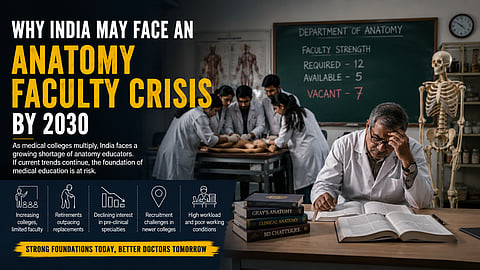
An anatomy professor sits stressed in a medical college anatomy lab while students perform cadaver dissection in the background, illustrating the growing anatomy faculty shortage crisis in India’s medical education system.
Anatomy faculty shortages in Indian medical colleges may affect the quality of undergraduate medical education in the coming years.AI Image
Published on
Updated on

India’s medical education system is growing rapidly, with new medical colleges and MBBS seats increasing across the country. According to National Medical Commission data for the 2025 to 2026 academic session, India now has more than 780 medical colleges offering approximately 1,26,600 MBBS seats. However, the number of qualified anatomy faculty has not grown at the same pace. If this gap continues, India may face a serious anatomy faculty shortage by 2030.

The problem is not just about vacant posts. Declining interest in pre-clinical specialties, limited career growth, faculty burnout, retirements, and recruitment challenges in newer medical colleges are all contributing to the issue. Since anatomy is the foundation of medical education, a shortage of experienced educators could directly affect the quality of future healthcare training in India.

Rapid Growth of Medical Colleges Is Increasing Faculty Demand

Over the last decade, India has seen a rapid increase in the number of medical colleges and MBBS seats. While this expansion aims to improve healthcare access and doctor-to-population ratios, faculty recruitment has not kept pace.

Many medical colleges continue to function with vacant teaching posts, especially in pre-clinical departments such as anatomy, physiology, and biochemistry. In some institutions, students reportedly face irregular teaching schedules because of faculty shortages. This gap between institutional growth and faculty availability is becoming more noticeable with every new college that opens.

The issue is particularly concerning in anatomy departments, where teaching involves not only lectures but also cadaveric dissection, laboratory supervision, and practical demonstrations. Finding experienced anatomy educators for newly established colleges is becoming increasingly difficult.

Although anatomy and physiology have faced faculty shortages for years, the crisis is gaining attention now because of the rapid rise in both government and private medical colleges across India.

Under National Medical Commission minimum standard requirements, newly established colleges are expected to maintain mandated faculty strength in anatomy, physiology, and biochemistry before admissions and periodic inspections.

Recent evidence suggests some institutions are already struggling to meet these norms. In February 2026, an RTI-based report found that ESIC Medical College, Basaidarapur in New Delhi was functioning without professors in anatomy, physiology, and biochemistry despite already admitting its first MBBS batch.

Declining Interest in Pre-Clinical Specialties Among Medical Graduates

One of the biggest reasons behind the potential shortage is the declining preference for pre-clinical branches among MBBS graduates.

Most medical graduates today prefer clinical specialties that offer higher income potential, better career growth, and opportunities for private practice. In comparison, anatomy is often perceived as academically demanding with limited financial incentives. As a result, fewer students choose MD Anatomy or other pre-clinical postgraduate programs.

This trend has gradually reduced the number of young educators entering anatomy departments.

Another major reason for declining interest in anatomy is the lack of awareness regarding career opportunities within the field. During the MBBS course, students are rarely guided about the long-term academic, research, and teaching pathways available after pursuing MD Anatomy. Many students remain unaware that anatomy includes diverse areas such as embryology, histology, neuroanatomy, genetics, and clinical anatomy.

Unlike several clinical branches, anatomy also lacks clearly defined super specialization pathways. The absence of advanced dedicated fellowships or super specialty programs may discourage students who seek long-term academic progression and specialization opportunities.

Recent postgraduate counselling trends also support this concern. In 2026, the National Board of Examinations informed the Supreme Court that nearly 2,980 postgraduate medical seats remained vacant nationally after counselling, with multiple states reporting lower interest in non-clinical specialties such as anatomy, physiology, microbiology, and pathology.

Introducing advanced training pathways in areas such as neuroanatomy, clinical embryology, surgical anatomy, or anatomical imaging may help attract more graduates toward the subject.

Limited Faculty Openings in Government Medical Colleges May Reduce Academic Motivation
Government medical colleges, particularly apex institutions, often have very limited faculty vacancies. Many senior faculty members spend decades within the same institutions, resulting in very few openings for younger academicians. In several premier colleges, only one or two assistant professor positions may become available over long periods.

This limited upward mobility may reduce motivation among young doctors considering anatomy as a long-term academic career. Even highly qualified postgraduates may find it difficult to secure stable teaching positions in reputed institutions.

The situation becomes more complicated with the expansion of autonomous state medical colleges, many of which are located in lower-tier cities and semi-urban regions. Relocating to such areas may involve significant lifestyle adjustments, limited academic exposure, and fewer professional opportunities for spouses and families. As a result, many faculty members hesitate to join institutions in remote locations, contributing further to vacant teaching posts.

Working Conditions in Private Medical Colleges May Discourage Faculty Retention

Private medical colleges also face challenges in retaining experienced anatomy faculty. In many institutions, pre-clinical faculty members are often overburdened with administrative responsibilities in addition to teaching duties. Since they are not involved in regular clinical practice, there is sometimes a misconception that they are more available for non-academic work.

In some cases, faculty salaries may be delayed by one or two months, creating financial instability and dissatisfaction among teachers.

Faculty members in multiple states have publicly raised concerns regarding delayed salary payments and administrative pressures in private medical institutions, particularly in pre-clinical departments where alternative practice opportunities are limited.

Strict attendance policies and rigid administrative rules may further contribute to frustration among faculty members. Some institutions reportedly enforce salary deductions for minor delays in attendance or early departures, sometimes without prior communication. Such working environments may discourage experienced educators from continuing long-term academic careers in anatomy departments.

Retirement of Senior Anatomy Professors May Worsen the Shortage

Another major concern is the aging faculty workforce in medical colleges.

Many senior anatomy professors in government and older institutions are nearing retirement, but the number of young anatomy specialists entering academia may not be enough to replace them. Training a skilled anatomy educator takes years of postgraduate education, teaching experience, and academic exposure.

The problem may become even more serious in newer medical colleges located in smaller cities and rural areas, where recruiting faculty is already difficult. Together, increasing retirements and declining interest in anatomy as a career could significantly affect anatomy departments over the next decade.

Faculty Vacancies Are Already Affecting Medical Education

The shortage of teachers in medical colleges is no longer a future concern alone. Several reports from different states suggest that students are already experiencing the consequences of inadequate faculty strength.

In some government medical colleges, students have increasingly relied on recorded online lectures, open educational platforms, and peer-led academic groups when regular faculty availability has been inconsistent.

Although digital platforms can support learning, anatomy remains a subject that relies heavily on direct teaching, practical guidance, and interactive dissection-based instruction. Virtual resources cannot completely replace experienced anatomy faculty, especially during foundational medical training.

Traditional Dissection-Based Teaching May Also Influence Specialty Preference

Cadaveric dissection remains one of the most important aspects of anatomy education. However, many medical students today show reduced interest in dissection-based learning because of discomfort associated with formalin-preserved cadavers, prolonged laboratory hours, and changing learning preferences.

For anatomy residents, dissection is not only mandatory for learning but also an essential part of teaching undergraduate students. This may discourage some graduates from choosing anatomy as a postgraduate specialty.

The integration of newer educational technologies such as artificial intelligence-based learning systems, virtual reality (VR), augmented reality (AR), and virtual dissection tables may help modernize anatomy teaching. Incorporating these tools into medical education could improve student engagement while reducing some of the logistical and practical difficulties associated with traditional dissection methods.

Increasing Academic Pressure and Burnout Among Faculty

The role of medical faculty has changed significantly in recent years.

Apart from teaching, anatomy educators are expected to participate in research publications, curriculum reforms, competency-based medical education implementation, administrative responsibilities, inspections, and accreditation-related work. In departments already facing staff shortages, these responsibilities create additional stress and burnout.

Young faculty members may therefore find long-term academic careers less attractive, particularly when workload increases without proportional financial or professional incentives. This may further reduce retention within pre-clinical departments.

NMC Regulations Have Increased Recruitment Pressure

The National Medical Commission (NMC) has strengthened monitoring and inspection mechanisms for medical colleges in recent years. Institutions with inadequate faculty strength may face warnings, reduced student intake, or compliance-related scrutiny.

As a result, colleges are under increasing pressure to recruit qualified anatomy faculty quickly. However, many institutions struggle to find suitable candidates because the available pool of educators remains limited.

Some colleges rely on temporary or contractual appointments to fulfill regulatory requirements, but such measures may not provide long-term academic stability.

Why Anatomy Faculty Shortage Matters Beyond the First Year

Anatomy is one of the most important foundational subjects in medicine. A strong understanding of human anatomy influences surgical training, radiology interpretation, anesthesia practice, orthopedics, pathology, and multiple other clinical specialties.

Weak anatomy training during undergraduate years may affect clinical competence later in professional practice. Therefore, the shortage of anatomy faculty is not merely an academic issue; it may ultimately influence the quality of future healthcare delivery.

Experienced anatomy educators also play an important role in mentoring students, improving spatial understanding, correlating anatomical concepts clinically, and developing professional discipline during the early years of medical education.

Greater clinical integration of anatomy teaching may also help improve student interest in the subject. Anatomy forms the basis of all surgical and procedural specialties, yet students often fail to see its direct clinical relevance during undergraduate training. Stronger correlation between anatomy and radiology, surgery, orthopedics, anesthesiology, and interventional specialties may help students appreciate the practical importance of anatomical sciences and encourage more graduates to pursue the subject academically.

Steps That May Help Prevent the Crisis

Addressing the anatomy faculty shortage will require long-term policy changes and institutional support rather than temporary recruitment drives.

Some possible solutions include:

  • Better salaries and career incentives for pre-clinical faculty

  • Improved research funding opportunities

  • Stronger mentorship programs for postgraduate students

  • Better infrastructure for anatomy laboratories and cadaveric teaching

  • Integration of AI-based anatomy learning, VR, AR, and virtual dissection technologies

  • Flexible recruitment policies for experienced educators

  • Faculty development programs and academic training initiatives

  • Better awareness regarding career opportunities after MD Anatomy

  • Introduction of advanced fellowships and superspecialization pathways within anatomy

  • Stronger clinical integration of anatomy teaching during MBBS training

  • Increased respect and recognition for medical educators

Encouraging more medical graduates to consider academic careers may become essential for sustaining quality medical education in India.

Conclusion

India’s healthcare education system is expanding rapidly, but the shortage of anatomy educators may become one of its biggest academic challenges by 2030. The combination of increasing medical colleges, declining interest in pre-clinical specialties, faculty retirements, difficult working conditions, limited academic growth opportunities, and rising administrative burden may create a serious imbalance in anatomy teaching capacity.

Without timely intervention, medical colleges may struggle not only to meet regulatory requirements but also to maintain strong foundational medical training for future doctors. India can build new medical colleges in a few years, but building skilled anatomy educators takes an academic generation. Unless that pipeline is strengthened now, the foundation of undergraduate medical training may face its toughest test before the decade ends.

An anatomy professor sits stressed in a medical college anatomy lab while students perform cadaver dissection in the background, illustrating the growing anatomy faculty shortage crisis in India’s medical education system.
Top 5 Reasons to Choose (or Avoid) MD Anatomy in 2026
logo
Medbound Times
www.medboundtimes.com