
- Home
- About Us
- Contact Us
- Biography
- MedBound Hub
- InternshipInternship
- Daily Pulse
- Medicine
- Physical Therapy
- InterviewInterview
- Pharmacy
- Biotechnology
- College/InstituteCollege/Institute
- Dentistry
- Blog
- Wellness & Nutrition
- Nursing
- Opinion

Anatomy teaching has undergone a major transformation over the past decade. What was once confined to dissection halls and live lectures has now expanded into recorded sessions, virtual simulations, and digital platforms. This shift accelerated during the COVID-19 pandemic, forcing educators to rethink how anatomy can be delivered effectively.
Today, it is less about picking one method over the other and more about figuring out what actually helps students understand better, remember longer, and apply anatomy confidently in clinical practice.
Live anatomy teaching, especially cadaver-based learning, continues to play a crucial role in medical education.
Working with a cadaver gives students a real, hands-on understanding of the human body that screens simply cannot match. It helps them see how structures relate to each other, notice natural variations, and get a feel for tissue textures in a way that feels authentic. Research shows that students perceive traditional methods as essential for building a strong conceptual foundation and improving long-term retention humanize.1
Additionally, live classes promote:
Immediate interaction with faculty
Real-time clarification of doubts
Development of professional attitudes and teamwork
Studies emphasize that traditional teaching methods contribute significantly to deep learning and clinical orientation, especially in early medical training.2
However, live teaching comes with limitations, including restricted access to cadavers, time constraints, and variability in teaching quality.
Recorded lectures and virtual anatomy tools have introduced flexibility into medical education.
Students can revisit complex topics multiple times, pause and reflect, and learn at their own pace. This becomes especially useful in anatomy, where revisiting concepts multiple times is often what leads to true understanding.
Virtual tools such as 3D models and digital dissection platforms enhance spatial visualization, which is often difficult to achieve through textbooks alone. According to a study, students using virtual resources reported improved understanding of anatomical relationships and greater engagement with the subject.4
Similarly, research indicates that recorded sessions are especially beneficial for revision and exam preparation, as they reduce cognitive overload during initial learning.1
Despite these advantages, virtual learning lacks the hands-on experience and emotional engagement associated with cadaveric dissection, which many educators consider essential for clinical training.
Student feedback across multiple studies reveals a consistent pattern. Most learners do not view live and recorded classes as mutually exclusive.
A study exploring medical students’ perspectives found that while digital tools improved understanding and accessibility, traditional methods were still preferred for practical exposure and retention.3
In another study, students expressed that virtual learning should serve as a supplement rather than a replacement for live teaching. They valued recorded lectures for revision but relied on live sessions for deeper comprehension and interaction.2
This growing preference highlights the importance of integrating both approaches into a cohesive learning model.
From an educational standpoint, both methods offer distinct advantages:
Live classes enhance experiential learning, professional development, and clinical relevance
Recorded classes improve accessibility, repetition, and visual understanding
While live teaching supports active engagement, recorded learning allows for self-directed study, which is increasingly important in modern medical curricula.
From personal experience as a medical student and anatomist, dissection was one of the most effective ways to truly understand anatomy. It made complex structures easier to visualize and turned learning into an engaging process rather than a passive one.
Handling real bones added another layer to this understanding. Observing surfaces, grooves, crests, depressions, and curvatures directly helped in appreciating anatomical features and muscle attachments in a way that textbooks could not replicate.
Whether studying the clavicle, the femur, or even delicate structures like the ear ossicles and skull foramina, the experience of physically examining them brought a sense of clarity and satisfaction that remains difficult to replace.
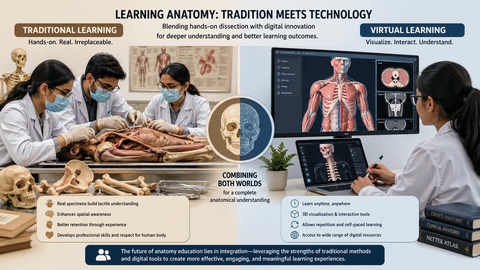
Current evidence suggests that neither live nor recorded anatomy classes alone can fully meet the learning needs of medical students.
Instead, the most effective approach is a hybrid model that combines:
Hands-on dissection and live interaction
Recorded lectures and digital visualization tools
Such an integrated strategy ensures that students benefit from both experiential learning and flexible revision, ultimately leading to better academic performance and clinical readiness.3,4
From a teaching perspective, combining traditional and virtual methods has proven to be the most effective approach.
While cadaveric dissection and physical models provide foundational understanding, digital tools offer advantages that go beyond what is possible in a conventional setup.
Anatomy applications allow structures to be visualized in multiple planes and enable virtual “slicing” of organs, something that is difficult to achieve during dissection without compromising anatomical integrity.
These tools enhance spatial understanding and make it easier to explain complex relationships. When used alongside traditional methods, they create a more comprehensive and engaging learning experience for students.
The future of anatomy education lies in balance.
Live classes bring depth, realism, and professional context, while recorded sessions offer convenience and reinforcement. When used together, they create a comprehensive learning environment that supports diverse learning styles.
Rather than asking which method is better, educators and institutions should focus on how to effectively integrate both to enhance the overall learning experience.
1. Sharma, Ankur, Archisha Bansal, Nirupma Gupta, Gaurav Bansal, Shweta Bansal, and Uday Goel. 2025. “Anatomical Approach of Learning Anatomy: Perspective of Medical Students on Traditional versus Virtual Methods.” Journal of Neonatal Surgery 14 (10s): 112–126.
2. Totlis, Trifon, Maksim Tishukov, Maria Piagkou, Michael Kostares, and Konstantinos Natsis. 2021. “Online Educational Methods vs. Traditional Teaching of Anatomy during the COVID-19 Pandemic.” Anatomy & Cell Biology 54 (3): 332–339.
3. Jeeva, Keba, and Himiki Selvindev. 2023. “Effectiveness of Recorded Video Lectures vs Live Online Lectures as Teaching Tools among Phase 1 Medical Students: A Prospective Study.” Journal of Clinical and Diagnostic Research 17 (7): JC01–JC03.
4. Fox, A. L., G. L. B. Dallaghan, and K. O. Gilliland. 2022. “The Effectiveness of a Virtual Anatomy Curriculum Versus Traditional Cadaveric Dissection in UNC SOM’s First-Year Class.” Medical Science Educator 32: 1319–1321.
