
- Home
- About Us
- Contact Us
- Biography
- MedBound Hub
- InternshipInternship
- Daily Pulse
- Medicine
- Physical Therapy
- InterviewInterview
- Pharmacy
- Biotechnology
- College/InstituteCollege/Institute
- Dentistry
- Blog
- Wellness & Nutrition
- Nursing
- Opinion

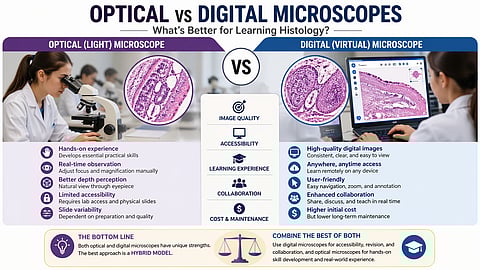
Histology has traditionally been taught using light microscopes, where students examine glass slides to understand tissue architecture. In recent years, however, digital microscopy has gained significant traction, allowing learners to study high-resolution virtual slides on screens.
This transition raises an important question for medical education: does digital microscopy enhance learning, or does traditional optical microscopy still hold an edge?
An optical (light) microscope uses visible light and a system of lenses to magnify tissue sections. Students directly view specimens through the eyepiece, adjusting focus and magnification manually.1
This method has long been central to medical training because it:
Builds hands-on technical skills
Helps students understand microscope handling
Provides a realistic laboratory experience
Despite its educational value, optical microscopy can sometimes be challenging for beginners due to focusing difficulties and variability in slide quality.2
Digital microscopy involves scanning glass slides to create high-resolution images that can be viewed on computers or tablets. These virtual slides can be zoomed, rotated, and annotated, closely mimicking the experience of using a physical microscope.
Key features include:
Easy navigation with zoom and pan tools
Uniform image quality across all users
Access from any location
This approach has become especially relevant in modern, technology-driven medical education systems.3
Optical microscopes offer excellent resolution and depth perception through direct visualization. However, digital microscopy now provides highly detailed and standardized images, reducing inconsistencies caused by poorly prepared slides.
For beginners, digital slides often make tissue identification easier because they are pre-focused and optimized.
One of the biggest advantages of digital microscopy is accessibility. Students can review slides anytime without being restricted to laboratory hours.
In contrast, optical microscopy depends on:
Physical lab access
Availability of microscopes
Maintenance of glass slides
This makes digital platforms more suitable for revision and self-paced learning.
Optical microscopy plays a crucial role in developing fundamental laboratory skills, such as:
Adjusting focus
Handling slides
Understanding magnification levels
Digital microscopy simplifies the process by removing these technical barriers. While this improves efficiency, it may reduce hands-on skill acquisition.
Digital microscopy enhances teaching by allowing:
Simultaneous viewing of the same slide by multiple students
Real-time annotations by instructors
Seamless integration into online learning
Optical microscopy, on the other hand, often limits interaction due to shared equipment and individual viewing.
Research suggests that students perform equally well, or sometimes better, when using digital microscopy compared to traditional methods. Many learners also report a preference for digital platforms due to ease of use and convenience.1
Virtual microscopy has been shown to improve engagement, reduce frustration, and support independent learning.
Optical microscopes generally have lower initial costs but require ongoing maintenance, including slide replacement and equipment servicing.
Digital systems involve higher upfront investment but offer advantages such as:
Minimal physical wear and tear
Scalability for large student groups
Long-term cost efficiency
Advantages:
Hands-on learning experience
Better depth perception
Essential for clinical skill development
Limitations:
Limited accessibility outside the lab
Variable slide quality
Requires technical proficiency
Advantages:
Learn anytime, anywhere
Consistent, high-quality images
Supports collaborative and remote learning
User-friendly for beginners
Limitations:
Reduced tactile experience
Dependence on devices and software
High initial setup cost 4
There is no single definitive answer. Instead, both methods serve different but complementary roles.
Digital microscopy excels in accessibility, efficiency, and student engagement
Optical microscopy remains essential for developing practical laboratory skills
The most effective approach is a hybrid model, where students use digital slides for learning and revision while also gaining hands-on experience with traditional microscopes.1,2
The evolution from optical to digital microscopy reflects broader changes in medical education. While digital tools have made learning more flexible and interactive, they cannot fully replace the practical experience offered by traditional microscopy.
A balanced integration of both methods ensures that students develop not only strong conceptual understanding but also essential technical skills, making them better prepared for clinical practice.
1. Maity, S., et al. 2023. “Virtual Versus Light Microscopy Usage among Students: A Systematic Review and Meta-Analytic Evidence in Medical Education.” Diagnostics 13 (3): 558. https://doi.org/10.3390/diagnostics13030558.
2. Kuo, K.-H., and J. M. Leo. 2019. “Optical Versus Virtual Microscope for Medical Education: A Systematic Review.” Anatomical Sciences Education 12 (6): 678–685. https://doi.org/10.1002/ase.1844.
3. Sharmin, Nazlee, Ava K. Chow, and Alice S. Dong. 2023. “A Comparison Between Virtual and Conventional Microscopes in Health Science Education.” Canadian Journal of Learning and Technology 49 (2).
4. Precision Engineering Supply. “Digital Microscopes vs Optical Microscopes: What’s the Difference?” 2023. https://precisionengineeringsupply.com/blogs/news/digital-microscopes-vs-optical-microscopes-what-s-the-difference
