
- Home
- About Us
- Contact Us
- Biography
- MedBound Hub
- InternshipInternship
- Daily Pulse
- Medicine
- Physical Therapy
- InterviewInterview
- Pharmacy
- Biotechnology
- College/InstituteCollege/Institute
- Dentistry
- Blog
- Wellness & Nutrition
- Nursing
- Opinion

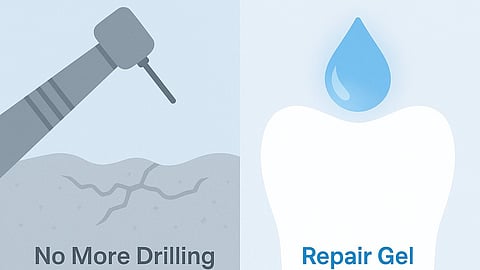
Cavities and associated dental pain have been a universal childhood fear. But this is going to change soon. A new tooth enamel repair gel can help teeth heal themselves. Instead of just sealing or filling damaged enamel, the protein-based gel encourages new enamel-like crystals to grow, restore strength and protection.
But before we understand this breakthrough, we need to understand what enamel really is and why losing it is such a big deal.
Your tooth has three layers
Pulp (the innermost soft tissue with nerves)
Dentin (the middle layer, slightly softer and yellowish)
Enamel (the outermost hard shell)
Enamel is often described as the hardest substance in the human body, even stronger than bone. The only natural material tougher than enamel is a diamond.
Despite its hardness, enamel can still be damaged by acid-producing bacteria, sugary foods, teeth grinding, or aggressive brushing. And here’s the biggest problem: enamel contains no living cells, so once it breaks or thins, it cannot grow back on its own.
Many people assume teeth and bones are the same, because both are rich in calcium and phosphorus. But enamel is built very differently.
While bones are made of mineral crystals arranged in a more flexible, repairable pattern, enamel crystals are organized into long, tightly packed strands that are thousands of times stronger than those in bone. This unique arrangement is shaped by enamel-specific proteins during childhood, especially a protein called amelogenin, which controls how enamel crystals grow. [1]
Once enamel fully forms and those proteins disappear, the structure becomes locked in place for life, which is why adult enamel can’t regenerate naturally.
Bones can heal when they break. Enamel cannot.
The only natural defense enamel has is remineralization, where it absorbs minerals like calcium and phosphate from saliva or fluoride treatments. But remineralization only fixes microscopic wear, not real enamel loss. As Dr. Shriya P. Shahu, Assistant Professor in the Department of Conservative Dentistry and Endodontics at Ranjeet Deshmukh Dental College, explains, “Remineralization refers to the deposition of calcium and phosphate ions onto the enamel surface by saliva. Enamel repair gel can serve as a promising option to treat incipient carious lesions by redepositing minerals on the tooth enamel, repairing early demineralization and strengthening teeth against acid attacks.”
That’s why scientists around the world have been trying to mimic nature’s original process of enamel formation.
1. Scientists created a bio-inspired protein matrix called ELR (elastin-like recombinamer) that mimics the natural enamel-forming protein amelogenin.
2. This gel is applied directly onto damaged enamel or exposed dentin.
3. When it comes in contact with calcium, the gel self-assembles into a tiny fiber-like structure.
4. These structures guide group of phosphate minerals to grow in the same direction as natural enamel crystals.
5. The gel helps rebuild a thin enamel-like layer up to about 10 micrometers thick. [2]
For years, fluoride has been the hero of healthy teeth. It makes the outside of your teeth harder and helps stop new cavities from forming. People get fluoride from toothpaste, some tap water, and special dental treatments at the clinic.
But this new enamel repair gel works differently. Instead of just making the outside tough, the gel helps rebuild the thin enamel layer that protects your teeth. Scientists say it can fill in tiny cracks and make the weak spots strong again, a bit like how your skin heals after a scratch, but for teeth!
Fluoride Varnish: Stops damage from getting worse; helps the surface stay strong.
Tooth Enamel Repair Gel: Helps regrow a thin, hard, tooth-like layer on weak spots. It can fix early damage that fluoride alone can’t.
Fluoride still matters. The new gel is not a magic fix for all tooth problems. It cannot heal deep holes or big cavities, if the damage is too much, fillings or crowns are still needed. But for small, new trouble spots, this gel is a big step forward.
Preliminary tests indicate that the new gel is safe for use on teeth. Researchers have applied it to real tooth surfaces and observed no concerning side effects. The regenerated enamel layer has remained intact even after eating and brushing. However, because the gel is still in the early stages of development, additional studies are underway to confirm its safety for broader use, particularly in children and individuals with allergies. Only after these evaluations are complete will it be made available in dental clinics.
The Future of Tooth Repair
This new tooth enamel repair gel might not mean the end of all cavities. But it does offer hope, for fewer drills, fewer fillings, and healthier smiles for people everywhere. Remember, brush, floss, eat smart, and see your dentist, even the most advanced gel works best with everyday care!
References
Rodrigo S. Lacruz, Stefan Habelitz, J. Timothy Wright, and Michael L. Paine, “Dental Enamel Formation and Implications for Oral Health and Disease,” Frontiers in Physiology 8 (December 2017), https://www.ncbi.nlm.nih.gov/pmc/articles/PMC6151498/.
“A Biomimetic Gel for Enamel Regeneration.” Published 2025. https://www.nature.com/articles/s41467-025-64982-y.
“Innovative Gel Regenerates Tooth Enamel, Marking Major Leap in Restorative Dentistry.” Published November 6, 2025. https://www.sciencedaily.com/releases/2025/11/251106003151.htm.
