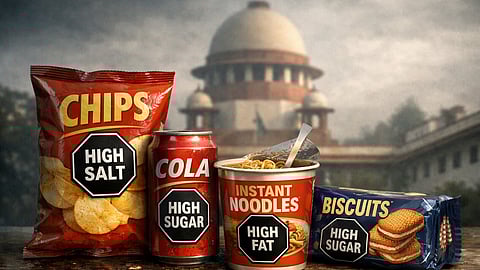
New Delhi, 15 February, 2026: The Supreme Court of India has asked the Food Safety and Standards Authority of India (FSSAI) to consider introducing clear front-of-pack warning labels on packaged foods that contain high levels of sugar, salt, and saturated fat. The direction came while the Court reviewed compliance in a public interest litigation focused on improving nutrition labelling and protecting public health. The Court’s direction reflects growing judicial attention to preventive public health measures aimed at reducing diet-related disease.
A Bench of Justice J.B. Pardiwala and Justice K.V. Viswanathan reviewed a compliance affidavit submitted by FSSAI and expressed dissatisfaction with the lack of concrete progress toward implementing front-of-package nutrition labelling. The Court noted that the issue directly relates to the right to health of citizens and requires urgent attention.
The case originated from a public interest litigation filed by the organization 3S and Our Health Society, which sought mandatory warning labels on packaged foods to clearly indicate high levels of sugar, salt, and saturated fat. The Supreme Court had earlier disposed of the main petition in April 2025 after FSSAI informed the Court that it had initiated steps toward implementing front-of-pack nutrition labelling through proposed amendments to existing food labelling regulations.
However, during the latest hearing, the Court observed that despite earlier directions, no effective implementation had taken place. The Bench stated that the efforts undertaken so far had not produced meaningful results and emphasized the importance of addressing public health risks associated with unhealthy diets.
In its affidavit dated January 30, 2026, FSSAI informed the Court that its expert committee had reviewed the proposed Indian Nutrition Rating system but found no consensus among stakeholders regarding its format and applicability. The authority stated that further research, stakeholder consultations, and analysis of global labelling practices would be conducted before finalizing any system.
FSSAI also referred to draft amendments notified in February 2025 that proposed displaying nutrition information more prominently, including bold labelling requirements. However, the matter was deferred during a meeting of the Food Authority in November 2025 and remains under consideration.
The Supreme Court took note of suggestions that packaged foods should carry visible warnings on the front of the packet, indicating high levels of sugar, salt, or saturated fat. The Court observed that such front-of-pack labelling is internationally prevalent and helps consumers make informed decisions quickly without needing to read detailed nutrition information printed elsewhere on the package. These labels typically use symbols, colour codes, or warning icons placed prominently on the front of packaging to alert consumers about high levels of unhealthy nutrients.
The Bench directed FSSAI to consider this approach and submit a fresh response within four weeks, outlining the steps it plans to take.
See also: FSSAI Launches Nationwide Crackdown on Adulteration of Milk, Paneer and Khoya
Front-of-pack warning labels are designed to alert consumers when foods contain excessive amounts of nutrients linked to health risks. Diets high in sugar, salt, and saturated fats are associated with increased risk of obesity, hypertension, heart disease, and diabetes. Clear warning labels allow consumers to identify unhealthy foods quickly and make better dietary choices.
India faces a rapidly growing burden of non-communicable diseases, with conditions such as cardiovascular disease, diabetes, and hypertension accounting for nearly two-thirds of all deaths in the country, according to the World Health Organization. ¹
The World Health Organization recommends front-of-pack nutrition labelling as an effective public health strategy to help consumers identify foods high in sugar, salt, and unhealthy fats and reduce dietary risk factors for chronic disease. ²
Public health experts consider such labelling an important tool to reduce the burden of non-communicable diseases, which account for a significant proportion of deaths globally and in India.
If implemented, front-of-pack warning labels could lead to changes in how food manufacturers present nutrition information and may encourage reformulation of products to reduce harmful ingredients. Countries such as Chile, Mexico, and the United Kingdom have implemented front-of-pack warning or traffic-light labelling systems, which have been associated with improved consumer awareness and changes in food purchasing behaviour. ²
The Supreme Court is expected to review FSSAI’s response in the coming weeks after the authority submits its updated plan.
References:
World Health Organization. Noncommunicable Diseases Country Profiles 2023: India. Geneva: World Health Organization, 2023. https://www.who.int/publications/i/item/noncommunicable-diseases-country-profiles-2023
World Health Organization. Guiding Principles and Framework Manual for Front-of-Pack Labelling for Promoting Healthy Diet. Geneva: World Health Organization, 2019. https://www.who.int/publications/i/item/9789241515770
Food Safety and Standards Authority of India. Food Safety and Standards (Labelling and Display) Regulations and Draft Amendments. New Delhi: FSSAI, 2025. https://www.fssai.gov.in
Supreme Court of India. Compliance proceedings in Public Interest Litigation regarding nutrition labelling and food safety, reviewed February 2026.
(Rh/MSM)