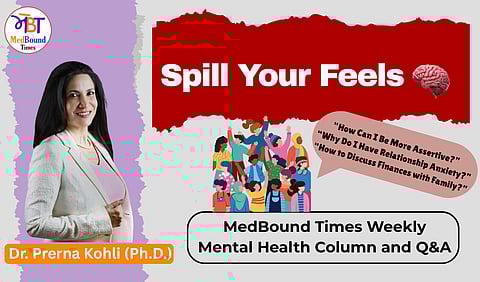
Welcome to Spill Your Feels – a special weekly column on MedBound Times where readers can send in their queries on mental health, emotional wellbeing, relationships, marriage, and sex. Each week, Dr. Prerna Kohli shares her insights and practical advice to help you navigate challenges and live a healthier life. From stress and parenting to work-life balance and relationships, this column sheds light on the everyday pressures of life with compassion and expertise.
Dr. Prerna Kohli is an eminent clinical psychologist with a Ph.D. in Clinical Psychology from Aligarh Muslim University, UP, India. Awarded among the 100 Women Achievers of India by the President of India, she is a public speaker, researcher, and social worker. With decades of experience, Dr. Kohli specializes in issues such as substance abuse, parental and marital counselling, relationship challenges, eating disorders, depression, and more.
PRM: I am quite agreeable by personality. As a senior, it becomes difficult to enforce authority. My team manipulates me and I fail to get important work done. I am also high in neuroticism, so I feel intense negative emotions when this happens. How can I be more assertive?
Dr. Prerna Kohli: Let’s slow this down. Neuroticism simply means you experience emotions more intensely than average. You may worry more, replay conversations, feel criticism deeply, and take longer to calm down. It is a personality trait, not a disorder. But I do want to ask, was this identified by a mental health professional, or is this your own conclusion after reading about personality traits? And if it was professionally assessed, are you receiving any support for it?
Now, about assertiveness. Your agreeableness is not the villain here. Lack of structure is. Teams do not manipulate kind leaders. They test unclear ones. If instructions are verbal and flexible, people negotiate them. If expectations are written and time bound, they comply.
Start small. Send follow up emails summarizing decisions. Set deadlines and ask for updates before they’re missed. When someone pushes back, do not justify your authority. Just restate the expectation calmly. Consistency builds authority more than personality ever will.
Your emotional pain after these incidents is real, but feelings are not proof that you are wrong. They simply show that you dislike conflict. Counselling can help you strengthen emotional regulation and assertiveness without changing who you are. You do not need to become harsher. You need to become firmer.
Anonymous: Imagine your relationship going well but then you start feeling anxious and restless, needing constant assurance. How to tackle that?
Dr. Prerna Kohli: That anxiety usually has little to do with your partner and everything to do with fear of loss. When things feel good, your mind panics and thinks something might go wrong. So, you seek reassurance to calm the feeling. The problem is reassurance works only briefly.
Instead of asking your partner to fix the fear every time, sit with it for a moment. Ask yourself what exactly you are afraid of. Abandonment? Rejection? Being replaced? Calm your body first. Slow breathing works better than repeated texts.
A secure relationship grows when you learn to soothe yourself, not when your partner becomes your emotional regulator.
Potato Fry: How to discuss your finances with your family? Should you hide or tell them? How to avoid that topic in family discussions?
Dr. Prerna Kohli: Money in families is rarely just money. It carries expectations, comparison, and control. You are not obligated to disclose every financial detail. Privacy is not dishonesty.
If sharing numbers creates pressure or interference, keep your responses general. You can say you are managing things well without giving specifics. If the topic keeps coming up, repeat calmly that you prefer not to discuss details.
Avoiding the topic through lies creates stress. Clear boundaries create less. Financial independence includes emotional independence. You can love your family and still keep your bank balance private.
This is your space to ask, share, and reflect. Write to Spill Your Feels with your queries on relationships, mental health, marriage, or personal struggles. Selected questions will be answered in upcoming editions of this column on MedBound Times.
Submit your question here!