Wearable neurotechnology is rapidly entering mainstream use, with transcranial direct current stimulation (tDCS) headsets being marketed for everything from improving focus to treating depression. Once confined to laboratories, these devices are now available to consumers, raising an important question:
Do tDCS headsets truly work, or are they driven more by hype than science?
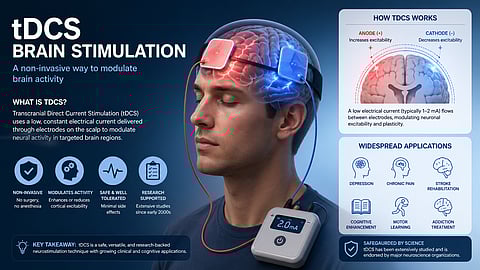
tDCS is a non-invasive brain stimulation technique that delivers low-intensity electrical currents (typically 1–2 mA) via electrodes placed on the scalp. Rather than directly triggering neuronal firing, it alters cortical excitability, making neurons more or less likely to activate.1,2
This mechanism positions tDCS as a neuromodulatory tool, capable of influencing ongoing brain activity rather than creating new activity.
One of the most studied applications of tDCS is in major depressive disorder. Research suggests that stimulation of the dorsolateral prefrontal cortex may help regulate mood and reduce depressive symptoms.3,4
Notably, tDCS is most effective when used as an adjunct to conventional therapies, rather than as a standalone treatment.
tDCS has also been investigated in stroke recovery and motor rehabilitation, where it may enhance neuroplasticity and support functional improvement when combined with therapy.1
These findings highlight its potential as a supportive intervention in clinical neurorehabilitation.
Across studies, a consistent theme emerges: tDCS works best when integrated into a broader therapeutic framework, rather than used in isolation.3
Much of the commercial appeal of tDCS lies in its potential to enhance:
Memory
Attention
Learning
However, evidence in healthy individuals remains inconsistent:
Some studies report modest improvements in specific tasks
Others show no significant difference compared to sham stimulation.5
These mixed findings suggest that outcomes depend heavily on variables such as stimulation parameters, brain region targeted, and individual differences.
tDCS is widely considered safe when used within recommended limits, with minimal side effects such as:
Tingling sensations
Mild skin irritation
Temporary redness
These effects are typically transient.1
However, concerns remain regarding:
Long-term use
Repeated unsupervised application
Variability in device quality
Thus, while relatively safe, tDCS is not entirely risk-free, particularly in home-use settings.
Commercial devices, such as those developed by Halo Neuroscience, have expanded the reach of tDCS beyond clinical settings. These products are marketed for:
Cognitive enhancement
Athletic performance
Mental wellness
While some are backed by preliminary research, the translation from controlled trials to consumer use remains uncertain.6
Marketing often portrays tDCS as a quick solution for brain enhancement, which is not consistently supported by scientific evidence.4
The effectiveness of tDCS depends on precise parameters such as:
Electrode placement
Current intensity
Duration of stimulation
Small variations can lead to significantly different outcomes, making generalized claims unreliable.2
Studies in brain stimulation are particularly susceptible to placebo responses, which can inflate perceived benefits.5
Even well-designed trials show variable and sometimes contradictory results, especially in cognitive enhancement studies.5
A noticeable gap exists between the scientific evidence on tDCS and its marketing claims.
Its clinical use shows promise in selected conditions like depression, but it is frequently marketed as a universal solution.3 Evidence for cognitive enhancement remains modest and inconsistent, despite claims of dramatic improvements in memory and focus.5
While generally safe within recommended limits, it is not entirely risk-free, and effectiveness varies significantly across individuals.4
tDCS is based on well-established neuroscience and has shown real potential in clinical and research settings. However, the way it is often marketed, as a tool that can universally boost cognition, is exaggerated.
Balanced perspective:
It is scientifically valid, but at the same time, it is often overhyped in consumer markets.
tDCS headsets are part of a rapidly developing space where neuroscience meets consumer technology. They do show promise, especially in areas like mental health and rehabilitation, but their ability to enhance everyday cognition is still not clear.
For now, it is better to approach them with awareness and a degree of caution, rather than assuming they will deliver dramatic results.
1. Nitsche, Michael A., Leonardo G. Cohen, Eric M. Wassermann, Alberto Priori, Nicolas Lang, Andrea Antal, Walter Paulus, Friedhelm Hummel, Paulo S. Boggio, Felipe Fregni, and Alvaro Pascual-Leone. 2008. “Transcranial Direct Current Stimulation: State of the Art 2008.” Brain Stimulation 1 (3): 206–23.
2. Neurolaunch. 2023. “TDCS Brain Stimulation: Exploring the Science and Potential of Direct Current Neuromodulation”.Accessed April 26, 2026.
3. Thair, H., A. L. Holloway, R. Newport, and A. D. Smith. 2017. “Transcranial Direct Current Stimulation (tDCS): A Beginner’s Guide for Design and Implementation.” Frontiers in Neuroscience 11 (November): 641.
4. Harvard Health Publishing. 2023. “Can Electrical Brain Stimulation Boost Attention, Memory, and More?” Harvard Medical School.
5. Kang, J., H. Lee, S. Yu, et al. 2024. “Effects and Safety of Transcranial Direct Current Stimulation on Multiple Health Outcomes: An Umbrella Review of Randomized Clinical Trials.” Molecular Psychiatry 29: 3789–3801.
6. Halo Neuroscience. 2024. “Neurostimulation Technology Overview.”