
- Home
- About Us
- Contact Us
- Biography
- Column
- MedBound Hub
- InternshipInternship
- Daily Pulse
- Medicine
- Physical Therapy
- InterviewInterview
- Pharmacy
- Biotechnology
- College/InstituteCollege/Institute
- Dentistry
- Blog
- Wellness & Nutrition
- Nursing
- Opinion

From checking messages and scrolling social media to attending online classes and work meetings, digital devices have become an essential part of modern life. However, the convenience of smartphones and tablets comes with an often-overlooked health consequence: Text Neck Syndrome or Tech neck.
Characterized by neck pain, stiffness, poor posture, and muscle strain, text neck is emerging as a common musculoskeletal problem among both adults and children. As screen time continues to rise worldwide, healthcare professionals are increasingly concerned about the long-term impact of prolonged device use on spinal health.¹–⁴
Text Neck Syndrome, often referred to as Tech Neck, describes the neck and upper back problems that develop when people repeatedly bend their heads forward to look at smartphones, tablets, or laptops.1,2
While occasional device use is unlikely to cause significant harm, spending hours each day in a head-down position places continuous stress on the cervical spine. Over time, this strain can trigger pain, muscle imbalance, reduced mobility, and postural changes.
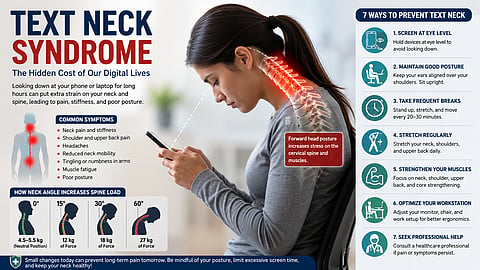
Common symptoms include:
Neck pain and stiffness
Shoulder and upper back discomfort
Frequent headaches
Reduced neck flexibility
Tingling or numbness in the arms and hands
Muscle fatigue
Poor posture and rounded shoulders
The human head weighs approximately 4.5–5.5 kilograms in a neutral position. When the head tilts forward, the force exerted on the cervical spine increases dramatically.2
Research shows that cervical loading progressively increases with neck flexion, reaching nearly five to six times the normal load at approximately 60 degrees of flexion.2 This extra pressure forces neck muscles and ligaments to work harder to support the head.
Over time, this repeated stress can contribute to:
Forward head posture
Tight neck and shoulder muscles
Weak deep neck stabilizers
Reduced cervical range of motion
Chronic pain and discomfort
Research suggests that text neck is becoming increasingly prevalent across all age groups. Prevalence estimates range from approximately 16.7% to 93.2%, depending on the population studied and the diagnostic criteria used. The wide variation reflects differences in study populations, definitions of text neck, and methods used to assess symptoms.3
A study reported that 46.3% of participants experienced symptoms of text neck syndrome, while more than 60% adopted severe neck flexion angles during smartphone use.4
One of the most concerning aspects of text neck is its growing impact on younger generations. Children and adolescents often spend between five and nine hours daily using smartphones and other digital devices.2,3
Research has shown that prolonged screen exposure in children is associated with neck pain, shoulder discomfort, poor posture, and reduced physical activity.2 Adolescents who spend more than three hours daily on smartphones appear to be at particularly high risk of developing musculoskeletal symptoms.3,4
Several habits and lifestyle factors can increase the likelihood of developing text neck syndrome:
Using smartphones, tablets, or computers for extended periods without breaks significantly increases cervical spine strain.
Forward head posture, rounded shoulders, and sustained neck flexion are consistently associated with greater symptom severity.
Frequent device checking and prolonged scrolling often result in sustained neck flexion throughout the day.
Weak postural muscles and sedentary behavior may worsen musculoskeletal stress and contribute to chronic symptoms.
Using devices below eye level or working at improperly arranged workstations can worsen symptoms.
Although text neck often begins with mild discomfort, persistent poor posture may eventually lead to more serious issues.2,3
Potential complications may include:
Chronic neck pain
Reduced spinal mobility
Muscle imbalances
Cervical disc degeneration
Disc herniation
Nerve irritation or compression
Recurrent headaches
Some experts suggest that prolonged forward head posture may contribute to accelerated mechanical stress on the cervical spine, although more long-term studies are needed to determine whether it directly causes early degenerative changes.3
See also: Smart Posture Trackers - The Future of Habit-Based Posture Correction
Healthcare professionals usually diagnose text neck syndrome based on a patient's symptoms, daily device use habits, and physical examination. Diagnosis typically includes:
Symptoms and medical history
Postural assessment
Physical examination
Evaluation of neck movement and muscle tenderness
Imaging studies such as X-rays or magnetic resonance imaging (MRI) are generally reserved for patients with severe symptoms, neurological deficits, trauma, or suspected structural abnormalities.²
Although mild symptoms often improve with posture correction and activity modification, medical evaluation is recommended if symptoms are accompanied by:
Persistent pain lasting several weeks
Arm numbness, tingling, or weakness
Loss of coordination or balance problems
Severe or worsening headaches
Pain that interferes with sleep or daily activities
These symptoms may indicate underlying nerve compression or other conditions requiring further evaluation.²
Research consistently supports conservative management as the first-line treatment for text neck syndrome.3,5
Improving head and neck alignment is one of the most effective ways to reduce stress on the cervical spine. Postural retraining has been shown to improve pain, function, and spinal alignment.
Targeted strengthening of the deep cervical flexors improves neck stability and helps restore proper posture.
Stretching the upper trapezius, levator scapulae, pectoral muscles, and cervical extensors may relieve tension and improve mobility.
These exercises improve muscular endurance and help restore normal neck function.
A recent scoping review found that physiotherapy interventions, including therapeutic exercise, postural correction, proprioceptive neuromuscular facilitation (PNF), Pilates, and manual therapy, have been reported to reduce pain and improve cervical function in several studies, although higher-quality research is needed.
Patients benefit from learning how to modify workstation setup, screen height, and daily habits to reduce cervical strain.
Experts recommend several simple but effective preventive strategies:5
Raise screens to eye level.
Maintain proper sitting posture.
Take movement breaks every 20–30 minutes.
Limit unnecessary recreational screen time.
Perform regular neck and shoulder stretches.
Strengthen postural muscles.
Stay physically active.
Text Neck Syndrome has become one of the most visible musculoskeletal consequences of our increasingly digital lifestyle. What begins as a simple habit of looking down at a phone can gradually lead to pain, stiffness, poor posture, and reduced quality of life.
Fortunately, evidence suggests that text neck is largely preventable through posture awareness, ergonomic modifications, regular exercise, and responsible screen use. As smartphones continue to dominate daily life, developing healthier technology habits may be one of the simplest ways to protect long-term spinal health.
1. Savoia, Andrew, Justin Streepy, Christopher Yuh, et al. “Tech Neck: The Silent Pandemic That Is Reshaping Our Spine.” European Spine Journal (2025). https://doi.org/10.1007/s00586-025-09444-1.
2. Piruta, Joanna, and Wojciech Kułak. 2025. "Physiotherapy in Text Neck Syndrome: A Scoping Review of Current Evidence and Future Directions" Journal of Clinical Medicine 14, no. 4: 1386. https://doi.org/10.3390/jcm14041386
3. Atakla, Hugues Ghislain, Maguette Mbaye, Thomas Kofi Dakurah, Marie Kisito Quenum, Lounceny Fatoumata Barry, Daouda Wague, Cyrus Igor Sossa, Dismand Stephan Houinato, Alioune Badara Thiam, and Momar Code Ba. “Tech Neck Syndrome: A Global Epidemic of the Modern Era Among Students at the University of Abomey Calavi in Benin.” Interdisciplinary Neurosurgery 34 (2023): 101812. https://doi.org/10.1016/j.inat.2023.101812.
4. Shinde, Sandeep, and Radha Bhende. “Evidence Based Treatment Strategies for ‘Text Neck Syndrome’: A Review.” International Journal of Occupational Safety and Health 13, no. 2 (2023): 245–257. https://doi.org/10.3126/ijosh.v13i2.48679.
5. Baylor Scott & White Health. “Tech Neck Is Real: 7 Steps to Stop It.” Baylor Scott & White Health. Accessed June 23, 2026. https://www.bswhealth.com/blog/tech-neck-is-real-7-steps-to-stop-it.
