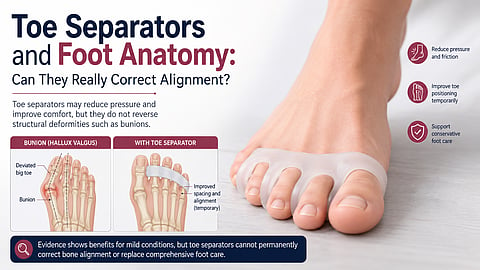
Toe separators have become one of the fastest-growing trends in conservative foot care. Frequently recommended for bunions, overlapping toes, and foot discomfort, they are marketed as an easy, non-invasive way to improve toe alignment.
However, from an anatomical perspective, correcting foot alignment involves far more than repositioning the toes. The bones, joints, ligaments, muscles, and arches of the foot function as an integrated load-bearing system, and any structural deformity reflects changes within this entire framework rather than in the toes alone.
Current research suggests that toe separators can improve comfort, reduce pressure between the toes, and provide temporary improvements in toe positioning, particularly in individuals with mild hallux valgus. However, there is little evidence to suggest that they can permanently reverse established structural deformities.1
To understand why, it is essential to first understand how the foot is built.
The human foot is far more complex than it appears. It is made up of 26 bones, 33 joints, and numerous muscles, ligaments, and tendons that work together to support body weight, absorb shock, maintain balance, and propel the body during walking and running.2
The bones are organized into three regions, the hindfoot, midfoot, and forefoot, with the forefoot containing the metatarsals, toe bones (phalanges), and the metatarsophalangeal (MTP) joints, where common conditions such as bunions develop.
The great toe, or hallux, also contains two small sesamoid bones beneath the first metatarsal that improve leverage during walking. Because the toes are connected to a complex network of bones, joints, ligaments, and muscles rather than functioning independently, changes in toe alignment often reflect alterations throughout the entire foot rather than the toes alone.2
Toe alignment is not determined by bones alone. A network of ligaments, the plantar fascia, and both intrinsic and extrinsic foot muscles works together to stabilize the foot, maintain its arches, and control toe movement during walking.2
Key muscles, such as the abductor hallucis, flexor hallucis brevis, lumbricals, and interossei, help guide and stabilize the toes, while ligaments and connective tissues provide structural support.
Over time, factors such as poorly fitting footwear, aging, or abnormal foot mechanics can stretch or weaken these soft tissues, contributing to toe deformities. Because toe separators only passively position the toes, they cannot replicate the active support provided by healthy muscles or reverse long-standing changes in ligaments and connective tissues.2
The human foot has three arches, the medial longitudinal, lateral longitudinal, and transverse arches. Together, they act as natural shock absorbers, cushioning impact when your foot touches the ground and providing stability as you push off during walking.
These arches are supported by bones, ligaments, muscles, and the plantar fascia, allowing the foot to distribute body weight efficiently. Because the toes are part of this interconnected system, changes in toe alignment can affect how forces are distributed across the entire foot.2
Dysfunction of these arches may alter the mechanical forces acting on the forefoot and contribute to the progression of certain toe deformities.
Toe separators, also known as toe spacers, are small devices placed between adjacent toes to gently increase the space between them and improve comfort in people with crowded toes or mild bunions. They are commonly made of silicone, gel, foam, or soft polymers and are available in a variety of designs, ranging from simple single-toe spacers to full-foot separators.
Although they are often marketed as a way to permanently correct foot alignment, current evidence suggests their effects are mainly temporary.1
From an anatomical perspective, toe separators do not move bones back into place. Instead, they gently hold the toes farther apart, gently separating adjacent toes, temporarily altering their position and reducing pressure between adjacent toes. This can temporarily improve toe positioning, redistribute pressure across the forefoot, and make walking more comfortable, particularly in people with early hallux valgus or toe crowding. However, once the spacer is removed, the toes usually return to their previous position because the underlying bones, joints, and ligaments remain unchanged.1
A bunion, or hallux valgus, is not simply a crooked toe, it is a structural deformity involving the bones, joints, ligaments, and surrounding soft tissues of the foot.4
Over time, the first metatarsal shifts out of position, the great toe deviates toward the smaller toes, and the joint gradually remodels. Because of these permanent structural changes, toe separators cannot reverse or "straighten" a bunion. However, they may reduce pressure between the toes, improve comfort, and temporarily improve toe alignment while they are being worn, especially in people with mild hallux valgus.1,3
Several studies suggest that toe separators can help relieve discomfort and temporarily improve toe alignment, especially in people with mild hallux valgus.5
Potential benefits include:
Reduced pressure between crowded toes.
Improved comfort during standing and walking.
Temporary improvement in toe alignment.
Pain relief in people with mild hallux valgus.
Better plantar pressure distribution.
Useful as an adjunct to physiotherapy and foot exercises.
Current limitations include:
No evidence of permanent correction of bunions or other structural deformities.
Limited benefit in advanced hallux valgus.
Should not be considered a replacement for surgery when severe deformity is present.
More high-quality, long-term clinical studies are needed.
Overall, current evidence suggests that toe separators can provide temporary symptom relief and support conservative foot care, but they are not a cure for structural foot deformities.1
Toe separators are not appropriate for every foot problem.
Medical evaluation is recommended if you have:
Severe or rapidly worsening bunions.
Persistent foot pain.
Difficulty walking.
Recurrent ulcers or wounds.
Peripheral neuropathy.
Progressive toe deformities.
Individuals with diabetes or reduced sensation in the feet should be particularly cautious because prolonged pressure from poorly fitted spacers may lead to skin injury without being noticed.3
Myth: Toe separators permanently straighten crooked toes.
Fact: They temporarily alter toe position while being worn.
Myth: They reverse bunions.
Fact: Bunions involve structural changes affecting bones, joints, ligaments, and soft tissues that cannot be reversed by spacers alone.
Myth: Everyone should wear toe separators daily.
Fact: Their usefulness depends on the individual's foot anatomy, symptoms, and underlying condition.
Myth: They eliminate the need for medical treatment.
Fact: They are supportive devices and should complement, not replace, professional assessment when indicated.
Toe separators have gained popularity as a simple, non-invasive option for improving foot comfort, but their effects are often misunderstood. Scientific evidence indicates that they can temporarily reduce pressure between the toes, improve comfort, and support conservative management of mild toe deformities.
However, they cannot reverse the structural changes seen in established bunions or permanently realign the bones of the foot. Used with realistic expectations, and combined with appropriate footwear, foot exercises, and professional advice when needed, toe separators can play a helpful role in maintaining foot health, but they should not be considered a substitute for evidence-based treatment
1. Krześniak, Hanna, and Aleksandra Truszczyńska-Baszak. 2024. "Toe Separators as a Therapeutic Tool in Physiotherapy—A Systematic Review" Journal of Clinical Medicine 13, no. 24: 7771. https://doi.org/10.3390/jcm13247771
2. Kenhub. 2025. Lower Extremity Anatomy. Accessed June 25, 2026. https://www.kenhub.com/en/library/anatomy/lower-extremity-anatomy
3. Cleveland Clinic. 2022. 3 Reasons to Try Toe Separators or Spacers. Accessed June 25, 2026. https://health.clevelandclinic.org/benefits-of-toe-separators-and-spacers
4. Chiong, Y., S. S. Tay, P. A. Lim, and D. M. Tan. 2013. "The Effects of Toe Spreader in People with Overactive Toe Flexors Post Stroke: A Randomized Controlled Pilot Study." Clinical Rehabilitation 27 (1): 90–95. https://doi.org/10.1177/0269215512446157.
5. Meh, Sara Gloria, Miha Pešič, and Žiga Kozinc. 2026. "Effects of Foot Strengthening Exercises With or Without a Toe Spacer on Hallux Alignment, Foot Mobility, and Balance: A Randomized Controlled Trial" Applied Sciences 16, no. 7: 3163. https://doi.org/10.3390/app16073163