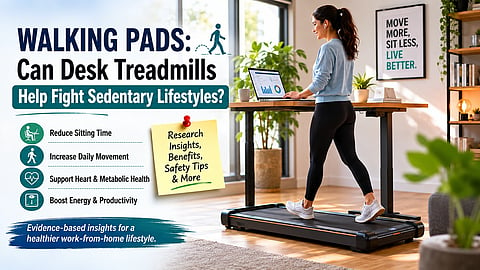
Walking pads, also known as under-desk treadmills or desk treadmills, are moving from social media trend to everyday home fitness product. For office workers, students, freelancers, and people working from home, the appeal is simple: walk slowly while answering emails, taking calls, watching a lecture, or breaking up long sitting hours.
The health idea behind walking pads is not new. Researchers have studied treadmill desks, walking workstations, and active workstations for years. The evidence suggests that these devices can help people sit less, increase light movement, and raise energy expenditure during the day. However, studies also show that walking pads should not be marketed as a cure for obesity, diabetes, heart disease, or poor fitness. They are best understood as one practical way to reduce sedentary behaviour in daily life.
A walking pad is a compact treadmill designed mainly for walking rather than running. Many models are slim, foldable, or easy to store under a bed, sofa, or standing desk. Unlike traditional treadmills, walking pads usually focus on low-speed walking and small-space convenience.
This makes them attractive for people who do not have space for large gym equipment at home. They are also popular among those who want to increase their daily step count without going outdoors, especially during extreme heat, rain, pollution, or busy workdays.
Walking pads fit into a broader shift in lifestyle health. Many people now want wellness products that blend into daily routines instead of requiring a separate gym session. The walking pad offers that promise: movement while working, studying, or watching television.
The trend also reflects a real health concern. Modern desk jobs and work-from-home routines can keep people seated for long stretches. Long sitting hours are often linked with lower daily movement, stiffness, weight gain risk, and poorer metabolic health patterns. Walking pads try to solve one part of that problem by making light activity easier to access.
For Indian urban users, the product may also feel practical because outdoor walking is not always easy. Air pollution, unsafe walking spaces, traffic, weather, and long work hours can make indoor walking more appealing.
The paper “A systematic review and meta-analysis of the effect of treadmill desks on energy expenditure, sitting time and cardiometabolic health in adults” reviewed treadmill-desk interventions in adults with sedentary occupations. The review found that treadmill desks were associated with increased energy expenditure and metabolic rate, and reduced sitting time. However, the authors also noted that evidence for cardiometabolic health outcomes remained limited and that more research was needed.
The paper “A systematic review of standing and treadmill desks in the workplace” looked at standing desks and treadmill desks as workplace interventions. The review concluded that both standing and treadmill desks showed some usefulness for breaking up sitting time and potentially improving selected health components.
“Effects of an ‘Active-Workstation’ Cluster RCT on Daily Waking Physical Behaviors” studied sit-to-stand and treadmill desks in office workers with overweight or obesity during a 12-month cluster-randomized intervention. The study concluded that active-workstation interventions may cause short-term improvements in daily standing and stepping. It also found that treadmill desk users engaged in fewer sedentary bouts, while sit-to-stand desks led to more frequent transitions to upright physical behaviours.
Walking pads may help users add light physical activity to the day. They may also help reduce long uninterrupted sitting time, which is a key concern in desk-based lifestyles.
Based on treadmill desk and active workstation research, walking pads may support:
higher daily step count
reduced sitting time
more light-intensity movement
increased energy expenditure during use
fewer long sedentary periods for some users
a more active work-from-home routine
indoor walking when outdoor walking is difficult
The safest evidence-based message is this: walking pads can help make movement more convenient. They are not a replacement for a complete fitness routine.
Many people search for walking pad for weight loss, but this claim needs caution. A walking pad can increase daily movement, and increased movement can support weight management when combined with nutrition, sleep, and overall activity. But a walking pad alone cannot guarantee weight loss.
The study “Treadmill Desks: A 1-Year Prospective Trial” reported average weight loss among participants, especially among those with obesity, but this should not be generalized to every user. Real-world results depend on how often the walking pad is used, walking speed, total daily calorie intake, medical conditions, and consistency.
The practical takeaway is simple: a walking pad may help if it replaces inactive time with light walking. It will not compensate for an otherwise inactive lifestyle or poor diet.
Walking pads may be useful for people who struggle to include movement in their day. This may include:
desk workers
remote employees
students
freelancers
people living in small homes
people trying to increase daily steps
people who avoid outdoor walking due to pollution, heat, rain, or safety concerns
beginners who want low-intensity movement
people who spend long hours on calls or online meetings
The product may be especially appealing to people who do not enjoy gyms or who find it difficult to schedule a separate workout.
A walking pad should be treated as exercise equipment, not just a home gadget. Safe use matters.
Start at a slow speed and increase gradually. Wear supportive footwear. Keep children and pets away while the machine is running. Place the walking pad on a stable surface and keep the area around it clear. Avoid multitasking heavily during the first few sessions. Users should first get comfortable walking before trying to type, read, or attend video calls.
People should also avoid using a walking pad when sleepy, dizzy, unwell, or distracted. If the device has a safety key or emergency stop feature, users should know how it works before starting.
Walking pads may be worth considering for people who sit for long hours and want a convenient way to add light movement at home. Research on treadmill desks and active workstations supports the idea that walking-based workstations can reduce sitting time and increase energy expenditure. However, the evidence does not support exaggerated claims that walking pads alone can transform health.
For many users, the real benefit may be behavioural. If the product makes walking easier, more frequent, and more consistent, it can become part of a healthier lifestyle.
Reference:
1. Arguello, Diego, Gabrielle Cloutier, Anne N. Thorndike, Carmen Castaneda Sceppa, Jennifer Griffith, and Dinesh John. “Impact of Sit-to-Stand and Treadmill Desks on Patterns of Daily Waking Physical Behaviors Among Overweight and Obese Seated Office Workers: Cluster Randomized Controlled Trial.” Journal of Medical Internet Research 25 (May 16, 2023): e43018.
https://pubmed.ncbi.nlm.nih.gov/37191995/
2. Ojo, Samson O., Daniel P. Bailey, Angel M. Chater, and David J. Hewson. “The Impact of Active Workstations on Workplace Productivity and Performance: A Systematic Review.” International Journal of Environmental Research and Public Health 15, no. 3 (February 27, 2018): 417. . PMCID: PMC5876962. PMID: 29495542.
https://pmc.ncbi.nlm.nih.gov/articles/PMC5876962/?
3. Arguello, Diego, Gabrielle Cloutier, Anne N. Thorndike, Carmen Castaneda Sceppa, Jennifer Griffith, and Dinesh John. “Effects of an ‘Active-Workstation’ Cluster RCT on Daily Waking Physical Behaviors.” Medicine & Science in Sports & Exercise 53, no. 7 (July 2021): 1437–47. PMID: 33449603.