
- Home
- About Us
- Contact Us
- Biography
- MedBound Hub
- InternshipInternship
- Daily Pulse
- Medicine
- Physical Therapy
- InterviewInterview
- Pharmacy
- Biotechnology
- College/InstituteCollege/Institute
- Dentistry
- Blog
- Wellness & Nutrition
- Nursing
- Opinion

White noise for sleep works by masking background noise and reducing sudden sound disturbances
White noise machines may help people fall asleep faster and experience fewer awakenings
These sleep devices are most effective in noisy environments such as urban homes and hospitals
Creating a consistent sound environment can support better sleep continuity and comfort
White noise is most useful as part of a healthy sleep routine, not a replacement for good sleep hygiene
Sleep disturbances are increasingly reported in urban environments, where background noise from traffic, shared living spaces, and electronic devices is common. Environmental noise is not only an annoyance but a documented factor that can interfere with sleep continuity and overall sleep quality.
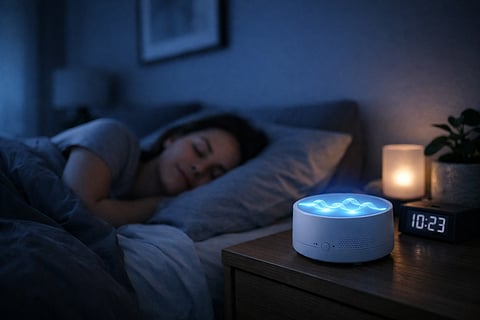
In response, many individuals turn to white noise machines or similar devices that generate constant ambient sound or background noise. These are often used as part of sleep routines, but the question remains whether they genuinely improve sleep quality or simply mask symptoms of disturbance. White noise machines are increasingly used as sleep devices to improve sleep comfort.
Sleep quality includes multiple dimensions:
Sleep onset latency
Sleep continuity
Time spent in restorative sleep stages
Subjective sense of restfulness
Sleep quality is generally defined by a combination of sleep duration, continuity, depth, and the feeling of restfulness upon waking.
Sleep cycles consist of non rapid eye movement and rapid eye movement stages. Non rapid eye movement sleep is further divided into stages N1, N2, and N3, each representing progressively deeper levels of sleep. Disruptions during these cycles, even if brief, can impair restoration, affect deep sleep, and reduce overall cognitive function.¹
Environmental noise can fragment sleep by causing brief arousals or shifts into lighter sleep stages. These disturbances may not always be remembered but can reduce overall sleep efficiency and overall sleep cycle stability.
The World Health Organization highlights that night-time noise exposure is associated with sleep disturbance, cardiovascular stress responses, and impaired daytime functioning.²
Noise that is intermittent or unpredictable is particularly disruptive because it exceeds the brain’s arousal threshold, meaning the level at which external stimuli can trigger a shift in sleep stage or brief awakening. Even low-level noise can lead to micro-arousals and fragmented sleep, which may not be consciously perceived but can still affect overall sleep quality. This makes sleep environment noise an important factor in overall sleep health.
White noise is a sound signal that contains a wide range of frequencies at relatively equal intensity. It produces a constant auditory background that does not fluctuate.
Other sound types include pink noise and brown noise, which differ in how sound energy is distributed across frequencies. White noise remains the most commonly used in sleep devices due to its uniform profile and ability to provide a consistent sound environment.
White noise works through sound masking, a process in which a constant background sound reduces the perception of sudden environmental noises. It works mainly by masking environmental noise and reducing the impact of sudden sound changes. Devices designed to generate steady ambient sound are commonly used to create this effect in home sleep environments.
This can:
Decrease the contrast between background and sudden sounds
Reduce the likelihood of sleep disruption
Stabilize sensory input during sleep
Continuous sounds are generally less disruptive to sleep than intermittent or unpredictable noise.
This consistent sound environment can help reduce sleep disruption caused by sudden noises.
Experimental research suggests that white noise may increase the threshold at which external sounds trigger arousal, helping maintain sleep continuity in noisy environments.³
Several studies indicate that white noise may help with sleep initiation and maintenance in specific conditions.
Clinical observations in hospital settings show that white noise can reduce sleep disruption caused by environmental noise.⁴
A systematic review found that noise masking interventions may improve sleep continuity, particularly in environments with fluctuating background noise.⁵
Research in adults has also suggested that white noise can help people fall asleep faster and reduce sleep onset latency under noisy conditions.⁶
These findings suggest potential benefits of white noise for sleep, particularly in noisy environments.
Some commonly observed white noise machine benefits include:
Helping individuals fall asleep faster
Reducing the number of awakenings
Blocking background disturbances
Modern white noise machines often provide adjustable sound settings and timers, allowing users to tailor the sound environment based on personal comfort and sleep needs.
White noise tends to be most useful in settings with significant background disturbance, including urban environments and hospital settings.
While benefits are reported, outcomes can vary depending on the environment and individual sensitivity to noise.
According to Harvard Health Publishing, white noise may be more useful in settings where background noise is inconsistent, rather than in already quiet environments.⁷
Some research also suggests that individual responses to continuous sound can differ, which highlights the importance of using such devices thoughtfully and at appropriate sound levels.⁸
Overall, white noise appears most beneficial in reducing sleep disruption caused by environmental noise.
White noise has been used to help infants fall asleep more quickly. Early studies demonstrated improved sleep onset in newborns exposed to white noise.9
However, appropriate volume and safe usage practices are important. Devices should be placed at a distance and not directed close to the infant’s ear.
Individuals who are sensitive to environmental noise or who live in noisy settings are more likely to benefit from white noise for sleep.
In contrast, those in quiet environments may experience limited additional benefit.
Sleep disruption is common in hospitals due to alarms, staff movement, and equipment noise. Sound masking strategies, including white noise, have been studied as part of environmental interventions to improve patient sleep.⁴
Despite its widespread use, certain considerations remain important:
Sound levels should be kept within safe limits
Devices should be placed at an appropriate distance, especially for infants
Individual comfort and response to continuous sound may vary
The American Academy of Pediatrics recommends cautious use in infant sleep environments, particularly regarding volume and proximity.
White noise should be considered a supportive measure rather than a primary treatment.
Effective sleep hygiene includes:
Maintaining consistent sleep and wake times
Reducing screen exposure before bedtime
Ensuring a comfortable and dark sleep environment
Ideal sleep environments are typically quiet, dark, and cool, with minimal sensory disturbance.
This contributes to creating an optimal sleep environment and supports circadian rhythm regulation.
White noise may be useful when environmental noise cannot be controlled and can help create the best environment for sleep in such settings. In such cases, using a dedicated white noise device can help maintain a stable and controlled sound environment throughout the night.
For individuals choosing to use white noise:
Keep volume at safe levels, generally below 50 decibels
Position the device at a distance from the bed
Use primarily in environments with variable noise
Avoid unnecessary use in quiet conditions
White noise machines may improve sleep quality in environments with disruptive or unpredictable noise by masking sudden sounds and reducing sleep interruptions.
Their effectiveness depends on context, with greater benefit seen in noise-prone settings. When used appropriately and as part of good sleep hygiene practices, they can serve as a practical tool for improving sleep comfort.
For many individuals, especially in urban settings, it offers a simple and practical way to improve sleep comfort.
National Institute of Neurological Disorders and Stroke.“Brain Basics: Understanding Sleep.” https://www.ninds.nih.gov/health-information/public-education/brain-basics/brain-basics-understanding-sleep
World Health Organization. Night Noise Guidelines for Europe. https://www.who.int/publications/i/item/9789289041737
Basner, Mathias, Wolfgang Babisch, Adrian Davis, Mark Brink, Charlotte Clark, Sabine Janssen, and Stephen Stansfeld. “Auditory and Non-Auditory Effects of Noise on Health.” The Lancet 383, no. 9925 (2014): 1325–1332. https://doi.org/10.1016/S0140-6736(13)61613-X
Stanchina, Michael L., Matthew Abu-Hijleh, Brigid Chaudhry, Paul Carlisle, and Atul Millman. “The Influence of White Noise on Sleep in Subjects Exposed to ICU Noise.” Sleep Medicine 6, no. 5 (2005): 423–428. https://pubmed.ncbi.nlm.nih.gov/16139769/
Ebben, Matthew R., and Sam J. Yan. “The Effects of White Noise on Sleep and Duration.” Sleep Medicine Reviews (2021). https://pubmed.ncbi.nlm.nih.gov/34049045/
Messineo, Ludovico, et al. “White Noise and Sleep Induction: A Randomized Controlled Trial.” https://pubmed.ncbi.nlm.nih.gov/28366374/
Harvard Health Publishing. “Can White Noise Really Help You Sleep Better?” https://www.health.harvard.edu/healthy-aging-and-longevity/can-white-noise-really-help-you-sleep-better
Frontiers in Psychology. “Effects of Continuous Noise on Sleep and Cognitive Performance.” https://www.frontiersin.org/articles/10.3389/fpsyg.2023.1301771/full
Spencer, J. A., D. Moran, A. Lee, and S. Talbert. “White Noise and Sleep Induction.” Archives of Disease in Childhood 65, no. 1 (1990): 135–137. https://pubmed.ncbi.nlm.nih.gov/2405804/
MSM
