Insights from Dr. Abhinaya K, MBBS, MD (Biochemistry) and Dr. Tabish, MBBS, MD (Physiology), Junior Resident, Department of Physiology, IGGMC, Nagpur
For many MBBS graduates, choosing a postgraduate specialty is one of the most important career decisions they will make. While clinical branches often receive the most attention, a significant number of students are drawn toward preclinical disciplines because of their passion for teaching, research, and the foundational sciences that underpin medicine.
Among the preclinical specialties, MD Anatomy, MD Physiology, and MD Biochemistry are the most common choices. Although these subjects are introduced together during the first year of MBBS, they differ considerably in terms of training, daily responsibilities, research opportunities, and long-term career prospects.
Anatomy focuses on the structure of the human body, Physiology explores how the body functions, and Biochemistry examines the molecular and chemical processes that sustain life. Each specialty offers unique opportunities for those interested in academics, medical education, scientific research, medical writing, healthcare innovation, and industry roles.
However, choosing between these branches is not simply a matter of selecting a subject you enjoyed during MBBS. It requires an understanding of your interests, strengths, preferred work environment, and future career goals.
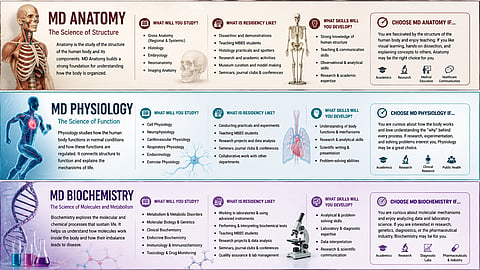
If you want a quick overview before exploring each specialty in detail, this comparison may help:
In general:
Choose MD Anatomy if you enjoy visual learning, cadaveric dissection, and understanding human structure.
Choose MD Physiology if you enjoy understanding how the body functions and solving scientific problems.
Choose MD Biochemistry if you enjoy laboratory medicine, molecular biology, and biochemical mechanisms.
Anatomy is the study of the structure of the human body and forms the foundation of medical education. An MD in Anatomy provides in-depth training in gross anatomy, histology, embryology, neuroanatomy, genetics, and clinical anatomy.
Residents spend considerable time in dissection halls, anatomy museums, histology laboratories, and teaching sessions. They learn not only the normal structure of the human body but also anatomical variations and their clinical significance. Modern anatomy education increasingly incorporates radiological anatomy, cross-sectional imaging, and surgical correlations, making the specialty highly relevant to contemporary medical practice.
For individuals who enjoy visual learning, cadaveric dissection, and teaching, Anatomy can be an intellectually rewarding career choice.
Some graduates may also pursue fellowship opportunities in areas such as clinical embryology, surgical anatomy, medical education, or anatomical sciences, depending on institutional offerings and evolving eligibility criteria.
While Anatomy focuses on structure, Physiology focuses on function. At its core, physiology is about understanding how the body's organs and systems function and work together to keep us healthy, adapt to changing conditions, and maintain normal bodily functions.
MD Physiology involves advanced study of cardiovascular, respiratory, endocrine, gastrointestinal, renal, reproductive, and nervous system physiology. Residents gain exposure to experimental techniques, human physiology laboratories, exercise physiology, neurophysiology, and clinical physiology.
The specialty appeals to individuals who enjoy understanding mechanisms, interpreting physiological responses, and conducting experimental research. Physiologists often bridge the gap between basic sciences and clinical medicine by explaining the functional basis of disease processes.
Some graduates may also pursue fellowships or advanced training in areas such as exercise physiology, clinical research, sleep medicine, or medical education, depending on institutional opportunities and eligibility requirements.
Biochemistry focuses on the molecular and chemical processes that keep the body functioning. During MD training, residents gain expertise in metabolism, molecular biology, genetics, enzymology, clinical biochemistry, and laboratory medicine.
Residency involves laboratory work, teaching undergraduate students, and understanding how biochemical pathways influence health and disease. Modern biochemistry departments also expose residents to emerging fields such as genomics, proteomics, and molecular diagnostics, which are becoming increasingly important in precision medicine.
The specialty is well suited for individuals who enjoy analytical thinking, laboratory-based work, and understanding diseases at the molecular level. In addition to academic and research careers, MD Biochemistry can also open doors to superspecialty training in areas such as hematology, medical genetics, and metabolic medicine.
Although Anatomy, Physiology, and Biochemistry are all classified as preclinical specialties, the training experience during residency differs significantly. Understanding what residents study, the responsibilities they undertake, and the skills they develop can help prospective candidates determine which branch aligns best with their interests and career aspirations.
Anatomy residency is centered on understanding the structure of the human body and its clinical relevance. The curriculum goes well beyond undergraduate anatomy, enabling residents to develop an in-depth understanding of human anatomy.
Residents receive extensive training in:
Gross anatomy, including regional and systemic anatomy
Histology and microscopic anatomy
Embryology and developmental anatomy
Neuroanatomy
Clinical and applied anatomy
Radiological and cross-sectional anatomy
Anatomical variations and their clinical significance
Modern anatomy departments increasingly integrate imaging modalities such as CT scans, MRI, and ultrasonography into teaching and research, allowing residents to correlate anatomical structures with clinical practice.
Cadaveric dissection remains a core component of anatomy residency, allowing residents to gain a detailed appreciation of anatomical structures and their relations. Teaching undergraduate medical students forms a major component of training, helping residents develop effective communication and presentation skills.
Additional responsibilities often include:
Conducting and supervising dissection sessions
Preparing museum specimens and anatomical models
Preservation and maintenance of cadaveric specimens
Histology slide preparation and interpretation
Participation in departmental academic activities
Undertaking research projects and scientific publications
These competencies prepare graduates for careers in medical education, anatomical research, surgical anatomy, radiological anatomy, and medical writing.
Physiology residency focuses on the mechanisms that govern normal bodily function and the physiological basis of disease. Rather than concentrating on structure, physiologists seek to understand how various organ systems interact to maintain homeostasis.
Training typically covers:
Cardiovascular physiology
Respiratory physiology
Neurophysiology
Endocrinology
Renal physiology
Gastrointestinal physiology
Reproductive physiology
Exercise and environmental physiology
Through their training, residents learn how the body functions in health, what changes occur during disease, and how these concepts apply to clinical situations.
Physiology residency often involves a combination of laboratory work, teaching, and research activities. Residents participate in practical demonstrations, physiological experiments, and data collection exercises that help translate theoretical concepts into measurable outcomes.
Common responsibilities include:
Conducting practical laboratory sessions
Performing physiological assessments and experiments
Teaching undergraduate students
Organizing academic discussions and journal clubs
Designing and conducting research projects
Presenting scientific work at conferences and meetings
Physiologists are well suited for careers in academia, biomedical research, clinical research, sports and exercise science, medical education, and scientific writing.
While Anatomy focuses on structure and Physiology focuses on function, Biochemistry explores the molecular processes that keep the body alive and healthy. It examines how cells produce energy, regulate metabolism, and respond to disease, providing a deeper understanding of the biochemical basis of health and illness.
During residency, trainees gain advanced knowledge in:
Metabolism and metabolic disorders
Molecular biology and gene regulation
Clinical biochemistry and laboratory diagnostics
Endocrine biochemistry
Genetics and molecular genetics
Immunology and immunochemistry
Toxicology and therapeutic drug monitoring
Modern biochemistry departments also expose residents to emerging fields such as genomics, proteomics, molecular diagnostics, and bioinformatics, reflecting the growing role of precision medicine in healthcare.
Biochemistry residency combines teaching, laboratory work, research, and clinical collaboration. Residents spend a significant amount of time working in laboratories, performing biochemical investigations, interpreting results, and understanding their clinical relevance.
Common responsibilities include:
Conducting practical sessions for undergraduate students
Performing and interpreting laboratory tests
Participating in journal clubs and academic discussions
Conducting research projects
Presenting scientific work at conferences
Contributing to laboratory quality assurance activities
The specialty is particularly appealing to individuals who enjoy analytical thinking and laboratory-based work.
Throughout training, biochemistry residents acquire:
Strong analytical and problem-solving skills
Expertise in laboratory diagnostics
Understanding of the molecular basis of disease
Research and scientific writing skills
Data interpretation and critical-thinking abilities
These skills prepare graduates for careers in academia, laboratory medicine, molecular diagnostics, biotechnology, research, medical writing, and the healthcare industry. Additionally, MD Biochemistry can serve as a pathway to superspecialty training in areas such as medical genetics, hematology, and metabolic medicine.
A common misconception is that preclinical specialists are limited to teaching careers. In reality, graduates of Anatomy, Physiology, and Biochemistry have a wide range of career opportunities both within and outside academia.
Many choose to work as faculty members in medical colleges, where they contribute to teaching, research, and curriculum development. Others pursue careers as research scientists, exploring areas ranging from anatomical variations and physiological mechanisms to molecular biology and genetics.
The growing demand for healthcare content has also created opportunities in medical writing, scientific communication, and continuing medical education. In addition, all three specialties can lead to roles in medical affairs, clinical research, and the pharmaceutical industry.
Biochemists often find additional opportunities in molecular diagnostics, laboratory medicine, and biotechnology, while physiologists may be involved in clinical research and exercise science. Anatomists can contribute to medical education technology, simulation-based learning, and anatomical research.
Ultimately, the scope of each specialty extends far beyond the classroom, and career growth largely depends on an individual's interests, skills, and professional goals.
Salary varies depending on where you work, whether in a government hospital or medical college, a private institution, a research organization, a biotechnology company, a pharmaceutical firm, or other industry roles.
For many students, work-life balance is an important factor when choosing a postgraduate specialty. One advantage of preclinical branches is that they generally offer a more predictable routine than most clinical specialties. Since the focus is primarily on teaching, academics, research, and laboratory work, emergency duties and frequent night shifts are usually less common.
However, no specialty guarantees a perfect work-life balance. Your experience will depend on your institution, workload, research commitments, and career goals. Someone deeply involved in research projects or scientific publications may have a busier schedule than someone focused mainly on teaching.
Overall, MD Anatomy, MD Physiology, and MD Biochemistry often provide a structured academic environment that allows many professionals to balance their careers with personal interests, family time, and activities outside medicine.
There is no universally "best" preclinical specialty. The right choice depends on what genuinely interests you and the kind of work you see yourself enjoying for years to come. A specialty that matches your personality and strengths is far more likely to bring long-term satisfaction than one chosen solely based on trends or other people's opinions.
You enjoy learning through diagrams, models, and hands-on experiences such as cadaveric dissection. Teaching excites you, and you find satisfaction in helping others understand complex concepts. If you can spend hours exploring anatomical details without getting bored, Anatomy could be the perfect fit.
MD Anatomy may not be the best fit if you prefer regular patient interaction, dislike cadaveric dissection, or are more interested in laboratory diagnostics than structural sciences.
You are curious about how the body works. Rather than memorizing facts, you enjoy understanding the mechanisms behind them. You like connecting concepts, analyzing information, and solving problems. If research, experimentation, and understanding the science behind health and disease appeal to you, Physiology may be a great choice.
MD Physiology may not suit you if you prefer procedural or hands-on clinical work, want frequent patient care, or are less interested in experimental and mechanism-based learning.
You have an innate curiosity about understanding how things work at the cellular and molecular level. You enjoy exploring why diseases occur, how biochemical pathways are altered, and how laboratory tests can provide clues about what is happening inside the body. If you enjoy analyzing data, interpreting results, and understanding the science behind laboratory medicine, Biochemistry may be a great fit for you.
The specialty is particularly suited to those interested in research, laboratory medicine, genetics, biotechnology, and the pharmaceutical industry. It may also appeal to individuals considering future training in fields such as Hematology, Medical Genetics, or Metabolic Medicine.
MD Biochemistry may not be the ideal choice if you are looking for regular bedside patient care, prefer anatomy-based learning, or have little interest in laboratory medicine and molecular sciences.
There is no universally best choice between MD Anatomy, MD Physiology, and MD Biochemistry. The right specialty is the one that matches your interests, strengths, and career goals.
If you are fascinated by the structure of the human body, Anatomy may be the right fit. If you enjoy understanding how the body works and love problem-solving, Physiology could be a better choice. If molecular science, genetics, and laboratory medicine interest you, Biochemistry may suit you best.
Ultimately, do not choose a branch based solely on trends or other people's opinions. Spend time speaking with current residents, explore departments if you have the opportunity, and think about the kind of work you would enjoy doing every day. Choosing a specialty that aligns with your interests, strengths, and long-term career goals is more likely to lead to lasting professional satisfaction than simply following popular choices.
Which is better: MD Anatomy or MD Physiology?
Neither specialty is universally better. MD Anatomy is ideal for those interested in human structure, dissection, and medical education, while MD Physiology is better suited to students who enjoy understanding body functions, research, and physiological mechanisms.
Is MD Biochemistry a good career choice?
Yes. MD Biochemistry offers opportunities in academia, laboratory medicine, molecular diagnostics, biotechnology, medical affairs, research, and the pharmaceutical industry. Career growth depends on your interests, expertise, and chosen workplace.
Can MD Biochemistry graduates work in laboratories?
Yes. Many MD Biochemistry graduates work in clinical biochemistry laboratories, molecular diagnostics, laboratory medicine, research institutions, and biotechnology settings, depending on their training and career goals.
Can MD Anatomy graduates pursue research careers?
Yes. Anatomy graduates can participate in anatomical research, medical education research, simulation-based learning, surgical anatomy, and related academic fields.
National Medical Commission. Postgraduate Medical Education Regulations, 2023. New Delhi: National Medical Commission, 2023. Accessed July 6, 2026. https://www.nmc.org.in/rules-regulations-nmc/
National Medical Commission. PG Curriculum. New Delhi: National Medical Commission. Accessed July 6, 2026. https://www.nmc.org.in/information-desk/for-colleges/pg-curricula-2/
National Medical Commission. Competency-Based Medical Education (CBME) Curriculum 2024. New Delhi: National Medical Commission, 2024. Accessed July 6, 2026. https://www.nmc.org.in/rules-regulations-nmc/