
- Home
- About Us
- Contact Us
- Biography
- MedBound Hub
- InternshipInternship
- Daily Pulse
- Medicine
- Physical Therapy
- InterviewInterview
- Pharmacy
- Biotechnology
- College/InstituteCollege/Institute
- Dentistry
- Blog
- Wellness & Nutrition
- Nursing
- Opinion

Imagine walking into a hospital emergency room with severe abdominal pain and getting an ultrasound scan within minutes, not in the radiology department, but right beside your bed.
Or picture a pregnant woman in a remote village receiving a prenatal ultrasound through a handheld device connected to a smartphone.
A few years ago, this would have sounded futuristic. Today, portable ultrasound systems are making it possible.
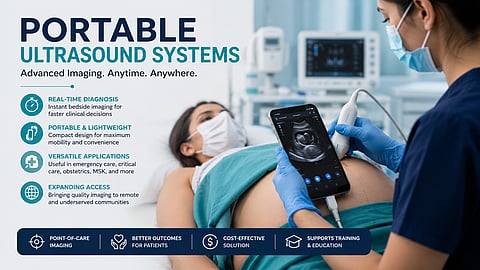
Ultrasound technology has quietly evolved from large, heavy machines confined to hospital imaging departments into compact handheld devices that fit inside a doctor’s pocket. These portable systems are transforming how clinicians diagnose diseases, monitor patients, and deliver care in real time.
From emergency medicine and intensive care to obstetrics and sports medicine, portable ultrasound is becoming one of the most valuable tools in modern healthcare.
Most people imagine an ultrasound as the large machine used during pregnancy scans. While those conventional systems still exist, newer portable ultrasound devices are much smaller and far more flexible.
Some portable systems are laptop-sized, while others are wireless probes that connect directly to smartphones or tablets. Despite their compact size, these devices can perform many of the same imaging functions as traditional ultrasound machines.
This means doctors can now carry ultrasound technology directly to the patient instead of transporting the patient to the imaging department.
And honestly, that small shift changes everything.
Healthcare today is moving toward faster, more accessible, and more patient-centered care. Portable ultrasound fits perfectly into that transition.
Instead of waiting hours for imaging appointments, clinicians can perform bedside scans immediately and make quicker decisions.
According to a study, point-of-care ultrasonography has fundamentally changed bedside diagnosis by allowing clinicians to integrate imaging directly into physical examination.1
In many ways, portable ultrasound is becoming the modern version of the stethoscope, except now doctors can actually see what is happening inside the body in real time.
POCUS, or point-of-care ultrasound, refers to ultrasound examinations performed directly by clinicians during patient evaluation. Instead of sending patients elsewhere for imaging, doctors can immediately scan the heart, lungs, abdomen, blood vessels, or even muscles at the bedside.
This approach has become especially important in emergency medicine and critical care settings.
For example:
A trauma patient can be scanned for internal bleeding within minutes.
A critically ill patient can have bedside cardiac assessment without leaving the ICU.
A patient with breathing difficulty can quickly be evaluated for fluid in the lungs.
During the COVID-19 pandemic, portable ultrasound systems became even more valuable because they minimized patient transport and reduced infection exposure risks.2
Portable ultrasound systems allow physicians to rapidly assess life-threatening conditions without delays. One of the most common examples is the FAST examination (Focused Assessment with Sonography for Trauma), which helps detect internal bleeding after trauma.
Emergency physicians also use handheld ultrasound devices to:
evaluate shock,
detect pneumothorax,
assess heart function,
guide emergency procedures,
and monitor critically ill patients.
What makes portable ultrasound remarkable is not just the technology itself, but the speed at which it brings answers.
One of the most exciting aspects of portable ultrasound technology is its ability to improve healthcare access in underserved areas.
In many rural or low-resource settings, advanced imaging facilities may be unavailable or located hours away. Portable ultrasound systems offer a practical solution because they are lightweight, relatively affordable, and easy to transport.
A healthcare worker carrying a handheld device can perform prenatal scans, abdominal assessments, or emergency evaluations in places where conventional imaging systems would never be feasible.
This has significant implications for maternal healthcare, early diagnosis, and preventive medicine.
Recent studies have highlighted how portable ultrasound can bridge healthcare gaps in remote communities and developing regions.3
Pregnancy monitoring often requires timely imaging, especially in high-risk cases. Handheld ultrasound devices now allow clinicians to perform bedside fetal assessments quickly and efficiently.
Recent research in obstetrics and gynecology has shown growing interest in portable ultrasound applications because they improve accessibility and support community-based maternal care.4
For many women in remote areas, portable ultrasound may become the first realistic opportunity for regular prenatal imaging.
While portable devices are incredibly useful, they still have limitations. High-end conventional ultrasound systems continue to provide superior image quality for complex diagnostic evaluations.
Portable ultrasound is best viewed as a complementary tool rather than a full replacement.
There are also challenges related to:
operator training,
image interpretation,
battery limitations,
and data security.
Ultrasound remains highly operator-dependent, meaning the accuracy of the scan often depends on the skill and experience of the person performing it.
Portable ultrasound systems are evolving far beyond simple handheld scanners.
Artificial intelligence is now being integrated into newer devices to assist with image acquisition and interpretation. Some systems can guide users during scanning, automatically identify anatomical structures, and generate measurements in real time.
Researchers are also exploring:
tele-ultrasound,
cloud-based imaging,
robotic-assisted scanning,
and wearable ultrasound devices.
It is entirely possible that in the near future, portable ultrasound could become as common in clinical practice as blood pressure monitors are today.
By bringing imaging directly to the bedside, these devices are improving diagnostic speed, expanding healthcare accessibility, and supporting faster clinical decision-making across multiple specialties.
From busy emergency rooms to remote rural clinics, portable ultrasound is helping medicine become more immediate, efficient, and connected.
As advancements in artificial intelligence, wireless connectivity, and point-of-care diagnostics continue to evolve, portable ultrasound systems are expected to play an even greater role in shaping the future of modern healthcare.
1. Moore, Christopher L., and Joshua A. Copel. “Point-of-Care Ultrasonography.” New England Journal of Medicine 364, no. 8 (2011): 749–757.
2. Kim, D. J., T. Jelic, M. Y. Woo, C. Heslop, and P. Olszynski. “Just the Facts: Recommendations on Point-of-Care Ultrasound Use and Machine Infection Control during the Coronavirus Disease 2019 Pandemic.” Canadian Journal of Emergency Medicine 22, no. 4 (2020): 445–449.
3. “Tang, C., D. Guss, M. J. Tanaka, and B. Lubberts. “Portable Ultrasound Devices: A Method to Improve Access to Medical Imaging, Barriers to Implementation, and the Need for Future Advancements.” Clinical Imaging 81 (2022)
4. Plöger, R., C. Behning, A. Walter, et al. “Evaluating the Accuracy and Reliability of Non-Piezo Portable Ultrasound Devices in Postpartum Care.” Archives of Gynecology and Obstetrics 311 (2025): 1039–1049.
