Anatomy and Medical Illustration: An Emerging Career Path in the Digital Era

How Anatomists Can Combine Science, Creativity, and Technology to Shape the Future of Medical Communication
A medical illustrator works at a digital workstation creating a detailed anatomical illustration of the head and neck on a drawing tablet. Surrounding the workspace are anatomy textbooks, anatomical models, sketches, and computer screens displaying 3D anatomical structures. An infographic highlights the role of medical illustration in education, healthcare, research, publication, and technology. The scene represents
A medical illustrator transforms complex anatomical concepts into accurate and engaging visual content, bridging the gap between science, education, and healthcare communication.AI Image
Published on
Updated on
Summary

Key Points

  • Medical illustration transforms complex anatomical and medical concepts into clear, engaging visual content.

  • Anatomists are well-positioned to enter this field because of their expertise in human anatomy and education.

  • Career opportunities exist in medical education, publishing, healthcare communication, biotechnology, and digital health.

  • Emerging technologies such as AI, VR, AR, and 3D visualization are reshaping the future of medical illustration.

  • Developing skills in illustration, digital design, and scientific visualization can help anatomists diversify their career options.

For decades, anatomy has been considered the cornerstone of medical education. Most anatomy graduates traditionally envision careers in teaching, research, or academia. However, the rapid evolution of digital healthcare, medical education technologies, and scientific communication is reshaping the opportunities available to anatomists today.

One of the most promising yet underexplored career paths is medical illustration. This multidisciplinary field combines anatomical knowledge, visual storytelling, artistic creativity, and modern technology to communicate complex medical concepts in a way that is accurate, engaging, and easy to understand.

As healthcare increasingly relies on visual learning tools, three-dimensional modeling, medical animations, and digital simulations, professionals who understand anatomy and can translate it into visual content are becoming increasingly valuable. For anatomists looking to diversify their careers, medical illustration represents a unique intersection of science, education, and innovation.

What Is Medical Illustration?

Medical illustration is the practice of creating scientifically accurate visual representations of anatomical structures, physiological processes, diseases, surgical procedures, and biomedical concepts. These visual resources are used across medical education, research, healthcare communication, publishing, and digital learning platforms.

Medical illustrations can take many forms, including:

  • Traditional anatomical drawings

  • Digital illustrations

  • Three-dimensional anatomical models

  • Surgical illustrations

  • Medical animations

  • Virtual reality (VR) simulations

  • Augmented reality (AR) educational tools

Unlike conventional artwork, medical illustration requires a strong scientific foundation. Every visual element must accurately reflect anatomical relationships and biological processes while remaining accessible to the intended audience.

Why Visual Learning Is Transforming Medical Education

Modern medical education is increasingly moving beyond textbooks and lectures toward interactive and technology-driven learning methods. Visual learning has become a critical component of this transformation because it allows learners to better understand spatial relationships and complex anatomical structures.

Modern anatomy education is increasingly embracing digital tools such as 3D models, virtual simulations, and immersive learning platforms. These technologies help students visualize anatomical structures more effectively, making complex concepts easier to understand and remember. In particular, three-dimensional visualization allows learners to appreciate spatial relationships within the human body far better than traditional two-dimensional images.1

The growing emphasis on visual education has created an increasing demand for professionals capable of producing scientifically accurate educational content. Medical illustrators play an essential role in meeting this need by transforming difficult concepts into meaningful visual experiences.

Why Anatomists Have a Natural Advantage in Medical Illustration

Among healthcare professionals, anatomists are uniquely positioned to succeed in medical illustration because of their extensive understanding of human structure and function.

Strong Foundation in Human Anatomy

Anatomists possess detailed knowledge of gross anatomy, neuroanatomy, embryology, histology, and clinical correlations. This expertise allows them to create visuals that are not only aesthetically appealing but also scientifically reliable.

Experience in Medical Education

Many anatomists spend years teaching medical students and healthcare professionals. This experience helps them understand how learners process information and where visual aids can improve comprehension.

Research and Scientific Communication Skills

Medical illustration frequently involves translating research findings into understandable visual formats. Anatomists already possess the analytical skills needed to interpret scientific information and communicate it effectively.

Attention to Accuracy

In medical illustration, even minor inaccuracies can lead to misunderstandings. Anatomists are trained to observe details carefully and maintain scientific precision, making them ideal contributors to this field.

The Role of Technology in Expanding Career Opportunities

Medical illustration is no longer limited to hand-drawn images found in anatomy textbooks. Technological advancements have significantly broadened the scope of the profession.

Three-Dimensional Anatomical Visualization

Three-dimensional models have become increasingly important in anatomy education, allowing students to interact with structures in ways that were previously impossible. Digital visualization technologies provide enhanced spatial understanding and support self-directed learning.1

Medical Animation and Interactive Learning

Animations are now widely used to explain disease mechanisms, physiological pathways, and surgical procedures. Compared to static images, animated content can simplify highly complex processes and improve audience engagement.

Virtual Reality and Augmented Reality

Immersive technologies such as VR and AR are rapidly transforming anatomy education. These tools allow users to explore anatomical structures in interactive environments, creating experiences that closely mimic real-life learning situations.1

Artificial Intelligence and Scientific Visualization

Artificial intelligence is beginning to influence healthcare visualization by supporting image generation, anatomical reconstruction, and educational content development. Recent advances suggest that AI can enhance scientific visualization workflows and improve accessibility to educational resources. However, expert oversight remains crucial to ensure anatomical accuracy and educational validity.2

Rather than replacing medical illustrators, AI is expected to function as a supportive tool that enhances productivity while preserving the need for scientific expertise.

Career Opportunities for Medical Illustrators

The growing integration of visual communication into healthcare has expanded employment opportunities across multiple sectors.

Medical and Health Sciences Education

Universities and medical colleges require visual educational resources for undergraduate and postgraduate training. Anatomists with illustration skills can contribute to textbooks, digital modules, and interactive learning platforms.

Scientific Publishing

Medical journals increasingly rely on graphical abstracts, scientific figures, and visual summaries to improve research dissemination. Medical illustrators help bridge the gap between scientific complexity and reader understanding.

Healthcare Communication

Hospitals and healthcare organizations use illustrations to educate patients about diseases, diagnostic procedures, and treatment options. Effective visuals improve communication and promote health literacy.

Pharmaceutical and Biotechnology Industries

Pharmaceutical companies utilize medical illustrations to explain mechanisms of action, disease pathways, and therapeutic innovations for both healthcare professionals and patients.

Digital Health and Educational Technology

The rapid growth of e-learning platforms, simulation-based education, and healthcare applications has created new opportunities for professionals skilled in anatomy-based visualization and content creation.3

Freelance and Entrepreneurial Practice

With increasing global demand for digital educational content, many medical illustrators work independently, collaborating with publishers, researchers, educational institutions, and healthcare companies worldwide.

Skills Needed Beyond Anatomy

Although anatomical expertise forms the foundation of medical illustration, additional competencies are necessary for long-term success.4

Artistic Skills

  • Sketching and drawing

  • Perspective and composition

  • Visual storytelling

  • Color theory

Digital Design Skills

  • Adobe Photoshop

  • Adobe Illustrator

  • Blender

  • ZBrush

  • Autodesk Maya

  • Three-dimensional modeling software

Communication Skills

Medical illustrators often collaborate with clinicians, researchers, educators, software developers, and publishers. Effective communication is therefore essential.

Adaptability and Lifelong Learning

The field continues to evolve alongside technological advancements. Professionals must remain updated on emerging visualization tools, software, and educational technologies.

Challenges in the Profession

Like any specialized field, medical illustration comes with its own challenges.

Professionals must continuously balance scientific accuracy with visual simplicity. Learning advanced software can be time-consuming, and building a competitive portfolio often requires significant dedication. Furthermore, the rapid pace of technological innovation demands ongoing skill development.

However, for individuals who enjoy both science and creativity, these challenges often become opportunities for growth and specialization.

The Future of Anatomy and Medical Illustration

Healthcare is becoming increasingly visual and technology-driven. From virtual anatomy labs and interactive 3D models to AI-powered educational tools, new innovations are changing the way medical information is taught and understood. As these technologies continue to evolve, there will be a growing demand for individuals who can accurately translate complex anatomical concepts into clear and engaging visual content.

As medical education becomes increasingly technology-driven, anatomists who embrace illustration, digital design, and scientific visualization may find themselves contributing not only to education but also to research, healthcare innovation, and global health communication.

Conclusion

Medical illustration is rapidly emerging as a valuable and innovative career pathway for anatomists. It combines the scientific rigor of anatomy with the creative power of visual communication, allowing professionals to contribute meaningfully to education, research, patient care, and technological advancement.

As the way we teach and communicate medicine continues to evolve, anatomists have the opportunity to move beyond the classroom and laboratory. With the right blend of scientific knowledge, creativity, and digital skills, they can play a key role in transforming complex medical concepts into meaningful visual experiences that educate, inform, and inspire.

References

1. Naicker, J. 2023. “Medical Illustration in Anatomy.” In Graphic Medicine, Humanizing Healthcare and Novel Approaches in Anatomical Education, edited by L. Shapiro, 57–71. Biomedical Visualization, vol. 3. Cham: Springer.

2. Smith, Christopher. 2025. “From Medical Illustration to Evolutionary Anatomy: Christopher Smith’s Artistic Approach to Science.” Communications Biology 8: 558.

3. Gajjar, Avi A., Shrey V. Patel, Raj Swaroop Lavadi, Rida Mitha, Rohit Prem Kumar, Tavis Taylor, Galal A. Elsayed, D. Kojo Hamilton, and Nitin Agarwal. 2024. “Art and Neurosurgery: The Importance of Medical Illustration.” World Neurosurgery 181: 82–89.

4. Miller, Mark M. 2024. “Medical Illustration State of the Art & Future Considerations: Illuminating Medicine & Science Part II.” Missouri Medicine 121 (1): 21–25.
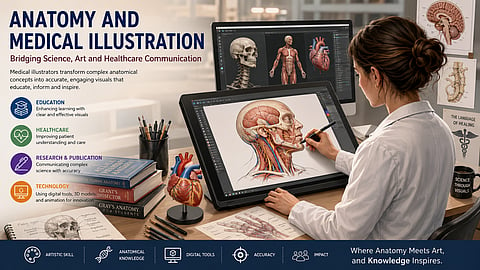

A medical illustrator works at a digital workstation creating a detailed anatomical illustration of the head and neck on a drawing tablet. Surrounding the workspace are anatomy textbooks, anatomical models, sketches, and computer screens displaying 3D anatomical structures. An infographic highlights the role of medical illustration in education, healthcare, research, publication, and technology. The scene represents
Top Medical Colleges in India with Advanced Anatomy Labs, Cadaver Training, and Research Facilities
logo
Medbound Times
www.medboundtimes.com