
Oral Health Beyond Clinics: Dr. Chintan Desai’s Practical Tips for Everyday Oral Care (Part-8)

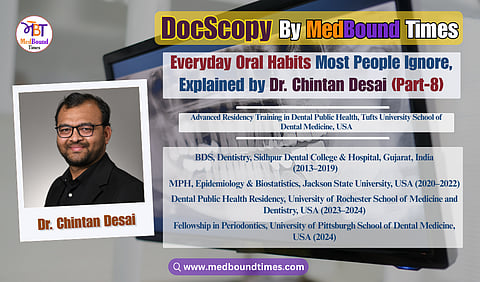
In this edition of MedBound Times, Himani Negi and Dr. Akriti Mishra speak with Dr. Chintan Desai, a Dental Public Health professional currently pursuing advanced residency training in Dental Public Health at the Tufts University School of Dental Medicine. With a strong foundation in clinical dentistry and a growing focus on population health, Dr. Desai represents a new generation of dentist–public health leaders working at the intersection of care delivery, research, and health equity.
A BDS graduate from Sidhpur Dental College, Gujarat, and holder of a Master of Public Health in Epidemiology and Biostatistics from Jackson State University, Dr. Desai has trained at renowned institutions including the University of Pittsburgh School of Dental Medicine and the Eastman Institute for Oral Health, University of Rochester. His work on NIH-funded projects and large public health initiatives has strengthened his expertise in data-driven research, program evaluation, and evidence-based dentistry.
Dr. Desai’s academic interests span oral–systemic health, periodontal disease, and epidemiological research using national health databases. He has co-authored peer-reviewed publications in journals such as Cureus and the Journal of Perinatology, presented at forums including AADOCR, NOHC, and the New York State Oral Health Summit, and serves as a peer reviewer for international dental and biomedical journals.
Beyond research, he is deeply committed to preventive care and health equity, contributing to school-based oral health programs, maternal and child initiatives, and community outreach addressing early childhood caries and access to care. His dedication to ethical, service-oriented dentistry has earned him selection as a Fellow of the International Pierre Fauchard Academy (India Section).
In the concluding part of this interview series at MedBound Times, conducted by Himani Negi and Dr. Akriti Mishra, Dr. Chintan Desai offers practical guidance for the general public, emphasizing the importance of regular dental checkups, consistent oral hygiene, proper brushing timing and technique, and simple everyday habits that support long-term oral health.
Himani Negi: For the general audience - what is that one advice they should definitely follow?
Dr. Chintan Desai: For the general public, my message is to avoid making health decisions on your own. Always take advice from a trained professional. Many people delay care because the problem does not seem serious at that moment, but small issues can become major problems later. It is like a car that needs regular service. If we skip it, the repair at the end of the year will be more difficult and more expensive. Oral health works the same way. Regular checkups and early treatment prevent pain, save money, and protect overall health. Listening to proper guidance leads to a healthier and more comfortable life.
Himani Negi: What are the three pieces of advice, that you want to give to the general public on oral health?
Dr. Chintan Desai: For the general public, my advice usually comes down to three simple points that have a very strong impact on oral health.
First, do not ignore early signs of a problem. If you notice pain, swelling, sensitivity, bleeding gums, or anything that feels unusual, visit a dentist as soon as possible. Many dental conditions start small and can be treated easily in the early stage, but they become more serious when they are left untreated.
Second, follow good daily oral hygiene. Brush twice a day with proper technique, and clean all surfaces of your teeth. Flossing is just as important because it removes plaque between the teeth where the brush cannot reach. Many people do not floss correctly, so learning the right method from a dentist or hygienist can prevent gum disease and protect the supporting tissues of the teeth.
Third, use mouthwash in the right way. Mouthwash can help reduce bacteria and freshen breath, but it should not replace brushing or flossing. Some medicated mouthwashes are meant for short term use only, while others can be used daily depending on the product. It is best to follow the advice of a dentist when choosing one, because each person has different needs based on their oral health condition.
These three habits are simple to follow and they make a major difference. When people take early action, follow good hygiene, and use products wisely, they protect both their oral health and their general well being.
Himani Negi: If a person is brushing their teeth twice a day, should they have their meal first and then brush their teeth, or the other way round? Also, what is the ideal time that you suggest, the waiting period, in between the meal and brushing your teeth? How long should one wait?
Dr. Chintan Desai: This is a very common question, and the timing does matter. When we eat foods or drinks that contain sugar or acids, the pH in the mouth drops for a short time, which makes the enamel slightly more vulnerable. If a person brushes immediately after eating, the enamel can slowly wear down over the years.
A safe and effective routine is to brush before breakfast. Brushing before eating removes the plaque that has formed overnight, and the fluoride from the toothpaste creates a protective layer on the teeth during the meal. This helps reduce the effect of acids on the enamel. After brushing, you can rinse your mouth with water if needed. If you prefer to use a tongue cleaner, that can also be done before breakfast. All of these steps help reduce the bacterial load in the mouth and improve both oral health and breath freshness. Flossing at any point in the day is important because it cleans the areas between the teeth where a brush cannot reach. Some people drink water before brushing, which is also fine. But brushing should still be done before eating, because it prepares the teeth for the meal.
If someone prefers brushing after breakfast, it is still fine, but they should wait at least thirty minutes. This is the amount of time the mouth usually needs to return to a normal pH level, especially after eating foods or drinking beverages that contain sugar or acids. These foods can temporarily soften the enamel. Brushing immediately during that period can slowly wear the enamel over time. Once the saliva brings the pH back to normal, brushing is safe again. So waiting at least thirty minutes is a good guideline.
So brushing before breakfast is a good everyday routine, and brushing after breakfast is acceptable if you wait for the mouth to recover.
There is another small but important habit related to sugar. It is better to eat sugary foods with your main meal rather than separately. If someone eats lunch and then eats something sweet ten minutes later, the pH drops again, and the teeth remain in an acidic environment for a longer period. When sugar is consumed with the meal, the mouth experiences fewer acidic episodes. It is also helpful to limit sugary foods at night.
Brushing technique matters as well. Using a soft bristle toothbrush is safer for the gums. Many people brush with a strong horizontal motion, and over time that can damage the gum line. A soft brush may feel gentle, but it cleans very well when used with the correct technique.
These simple steps protect both the enamel and the gums and make a meaningful difference in long term oral health.
In this MedBound Times interview, Dr. Chintan Desai reflects on his professional journey from clinical dentistry in India to advanced training in dental public health in the United States, offering a population level perspective on oral health challenges. He explains how his transition from BDS to MPH was driven by the realization that sustainable improvements in oral health require addressing systemic gaps such as access, awareness, and education, beyond chairside care. He also discusses how public health training strengthens research capacity and prepares dentists to engage with large scale community and policy driven initiatives. The conversation explores key oral health disparities observed across India and the United States, particularly in rural and underserved populations. Dr. Desai highlights that delayed care, reliance on non professional advice, and misconceptions, especially regarding the safety of dental treatment during pregnancy, remain common in both settings. He identifies dental caries, periodontal disease, and oral cancer as the major contributors to disease burden, with tobacco use significantly amplifying risks in certain communities. Drawing from his outreach experience, Dr. Desai emphasizes the effectiveness of mobile dental vans in overcoming transportation and access barriers by delivering preventive and basic restorative care directly to communities. He underscores the value of visual and practical education tools over purely verbal messaging, especially when addressing complex issues such as oral cancer prevention and the oral systemic health link. He also discusses the role of structured follow up, incentives in public health research, and continuity of care in building trust and sustaining community engagement. The interview further examines the growing role of technology in public health, with Dr. Desai describing how teledentistry and AI supported tools are expanding access to guidance, follow up, and data driven outreach in resource limited settings. He also stresses the importance of professional ethics, advocating mutual respect among dental practitioners and emphasizing patient safety as a shared responsibility within healthcare systems. Concluding the discussion, Dr. Desai offers guidance for dental students, young professionals, and the general public. He highlights communication, public health literacy, and community engagement as essential skills for aspiring public health dentists, while encouraging graduates to view community service as a foundation for long term professional growth. For the public, he reinforces the importance of early care seeking, consistent oral hygiene, and informed decision making, offering practical advice on brushing routines and preventive habits that support lifelong oral health.
