
Oral Health Systems in India vs the US: Dr. Chintan Desai on Patient Load, Access, and Communication (Part-2)

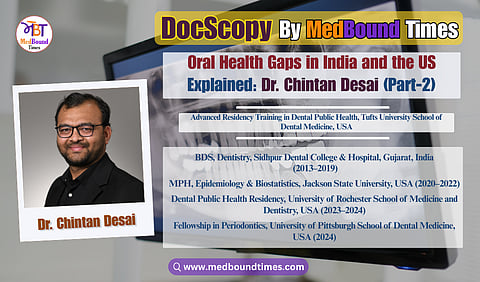
In this edition of MedBound Times, Himani Negi and Dr. Akriti Mishra speak with Dr. Chintan Desai, a Dental Public Health professional currently pursuing advanced residency training in Dental Public Health at the Tufts University School of Dental Medicine. With a strong foundation in clinical dentistry and a growing focus on population health, Dr. Desai represents a new generation of dentist–public health leaders working at the intersection of care delivery, research, and health equity.
A BDS graduate from Sidhpur Dental College, Gujarat, and holder of a Master of Public Health in Epidemiology and Biostatistics from Jackson State University, Dr. Desai has trained at renowned institutions including the University of Pittsburgh School of Dental Medicine and the Eastman Institute for Oral Health, University of Rochester. His work on NIH-funded projects and large public health initiatives has strengthened his expertise in data-driven research, program evaluation, and evidence-based dentistry.
Dr. Desai’s academic interests span oral–systemic health, periodontal disease, and epidemiological research using national health databases. He has co-authored peer-reviewed publications in journals such as Cureus and the Journal of Perinatology, presented at forums including AADOCR, NOHC, and the New York State Oral Health Summit, and serves as a peer reviewer for international dental and biomedical journals.
Beyond research, he is deeply committed to preventive care and health equity, contributing to school-based oral health programs, maternal and child initiatives, and community outreach addressing early childhood caries and access to care. His dedication to ethical, service-oriented dentistry has earned him selection as a Fellow of the International Pierre Fauchard Academy (India Section).
In the part 2 of this interview series at MedBound Times, conducted by Himani Negi and Dr. Akriti Mishra, Dr. Chintan Desai offers a comparative view of healthcare delivery, examining differences in patient burden, infrastructure, workforce allocation, and patterns of doctor–patient communication across two distinct healthcare systems.
Dr. Akriti Mishra: From your experiences of working in India and in the US, what are the major oral health gaps that you have observed? What stands out positively in India, and what stands out positively in the US?
Dr. Chintan Desai: Both India and the United States have significant differences in their healthcare systems, yet the oral health challenges seen in rural and underserved communities are surprisingly similar. In both countries, people often live far from dental clinics, face transportation difficulties, and rely on irregular visits rather than routine preventive care. Although the overall infrastructure in the United States is stronger, the basic barriers that limit access in rural regions are quite comparable to what we see in rural India.
A major gap in both settings is limited awareness about the importance of oral health and its connection to general health. In many communities, dental pain is considered normal or something that only needs attention when it becomes severe. Parents may not know how early childhood oral health affects long-term development, and there is often limited understanding of the role of fluoride, nutrition, and tobacco cessation. These knowledge gaps increase the burden of disease and delay treatment.
During my MPH internship at the State Department of Health in Mississippi, I worked on a project involving oral health in pregnant women. Many women avoided dental care because they believed treatment during pregnancy was unsafe. This misconception exists in both India and the United States. When dental care is delayed during pregnancy, even a minor cavity can progress and affect the mother’s comfort, nutrition, and overall health, which can also influence the child’s health.
Urban areas in both countries present a very different picture. People generally have better access to clinics, reliable transportation, and higher health literacy. This leads to more consistent preventive visits and healthier oral outcomes. Access, rather than geography alone, is often the deciding factor.
Regarding India, I have been away for the last five years, so my direct experience with the current system is limited. However, from my colleagues, batchmates, and friends, I hear that India has made considerable progress in recent years. There is more emphasis on preventive care, greater availability of dental services, and increased public awareness compared to the past. These improvements are encouraging, although rural India still faces notable gaps.
Overall, both countries have strengths. The United States benefits from stronger infrastructure and organized referral systems, while India has made impressive progress in expanding dental education and outreach programs. The biggest ongoing challenges in both nations involve improving access to care, strengthening community-based education, and ensuring that preventive services reach those who need them most.
Himani Negi: Since you have experience working in both India and the US, you can provide valuable insights, particularly regarding India. Take Delhi, for example, which is a metropolitan state with a very high patient load in government healthcare settings. As pharmacists, we are trained to explain medication dosages and usage when dispensing medications. Sometimes, we even prepare separate sachets to prevent patients from mixing their medications. However, there are times when patients are uninterested in what we have to say. They might respond with comments like, "You’re wasting our time." If I spend too long with one patient, the long line of waiting individuals may become impatient and voice their frustration, sometimes even directing their anger at the pharmacist, leaving the doctors out of the situation.
This question isn't exclusive to dentistry. In such scenarios, how do you handle patients as a doctor or an individual? When faced with a high patient load and limited time, it is challenging to provide thorough explanations. This issue is especially pronounced in rural areas. To address the shortage of doctors, India has implemented a bond system requiring medical graduates to serve for two to three years after completing their education.
In high-pressure situations with significant patient volumes and limited consultation time, how do you manage to communicate effectively as a doctor? Additionally, what is the patient load like in the US healthcare system? Is there a sufficient number of doctors, or how does the situation differ there?
Dr. Chintan Desai: Working in both India and the United States has helped me understand how different systems shape patient care. In India, especially in large cities like Delhi, the patient load in government hospitals is extremely high. Doctors, pharmacists, and nurses want to explain medications and treatment plans in detail, but the long lines and limited time often make this difficult. Many patients are tired or frustrated, and some do not want to listen because they feel rushed. The pressure on the staff can be intense, and at times the crowd may even become aggressive.
In those situations, the most practical approach is to stay calm and focus on the most essential instructions. We cannot give long explanations to every person, but we can still communicate the key points in simple language. Even a short and clear message can prevent mistakes. I also remind myself that the patient is reacting to the stress of the system and not to me as an individual. Patience and empathy help both sides.
The system in the United States works differently. Clinics usually have structured appointment schedules, and electronic systems help organize the flow of patients. When a new patient calls, their information is entered into the system, and the appointment is confirmed through text or email. This reduces waiting times and gives the doctor a chance to prepare before the visit. This does not mean there are plenty of doctors everywhere, as the country still has shortages in many rural areas, but clinics try to manage patient volume through planned scheduling.
Even here, patient behavior can sometimes be challenging. People become upset when there are delays or insurance issues. They may argue with the receptionist or the doctor. The difference is that the system has clear steps for staff safety. If any staff member feels threatened, they can call the police number, which is 911, and officers will handle the situation. This support allows the staff to focus on patient care.
In both countries, the main responsibility remains the same. We try to give each patient the attention they need while also respecting the time and safety of everyone in the clinic. The settings are different, but the goals of clear communication, empathy, and patient education remain the same.
Himani Negi: How effective is this system in urgent situations? Although I hope no one ever has to experience such circumstances, it raises the question: if you feel uncomfortable with a patient and need to call the police (911), how prompt and effective will the response be? I don't want to focus solely on India, but there are significant challenges in government healthcare settings. The patient load is often high, and many individuals lack proper information about their situations. Sometimes, patients contribute to the problems themselves. In these environments, doctors face their own limitations and can only do so much. Even if they call the police, there are instances when the response is not very effective.
Dr. Chintan Desai: The safety system here is quite effective. If a staff member feels threatened and calls the police, officers usually arrive quickly and take control of the situation. Their presence often calms things down, and the staff does not have to manage the issue alone. It may not solve every problem instantly, but it provides strong support and clear protection for everyone involved.
There are also strict rules for the protection of children and older adults. If I notice any injury on a child that does not appear accidental, I inform my assistant quietly, and Child Protective Services is contacted. They come to the clinic and guide the next steps. This allows the doctor to focus on care while the protective team manages the safety concern. With adults, we speak with them privately first. If they say they feel unsafe or need help, we follow the reporting process and contact the services that can support them. This respects the patient while ensuring they receive help if needed.
Overall, the system works well because there are clear procedures and strong support from outside agencies. It helps us provide safe and respectful care in difficult situations. I believe this responsibility is very important. If I see something concerning and choose not to act, it can lead to serious legal and professional consequences. As a doctor, I am expected to protect my patients’ safety and follow reporting rules when something does not look right. It is part of my duty to care for the patient in every possible way and to ensure that appropriate steps are taken whenever there is a sign of risk.
These structural differences directly influence how oral health awareness is delivered on the ground, thus bringing us to the crucial question of community education and outreach, which will be discussed in Part 3.
