
- Home
- About Us
- Contact Us
- Biography
- MedBound Hub
- InternshipInternship
- Daily Pulse
- Medicine
- Physical Therapy
- InterviewInterview
- Pharmacy
- Biotechnology
- College/InstituteCollege/Institute
- Dentistry
- Blog
- Wellness & Nutrition
- Nursing
- Opinion

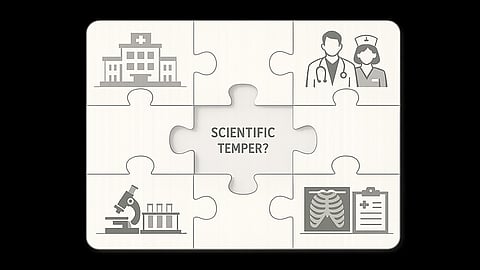
April 7, observed as World Health Day under the leadership of the World Health Organization, carries the 2026 theme: “Together for Health, Stand with Science.” It is a simple statement, but one that highlights a deeper and uncomfortable reality.
We are living in a time of rapid scientific advancement. Diagnostics are more precise, treatments more effective, and access to medical knowledge wider than ever before. Yet, there remains a clear disconnect between scientific knowledge and its application in society. Progress in science has not translated into progress in scientific temper.
In India, this gap is particularly evident. The Constitution places a responsibility on every citizen to develop scientific temper. However, in practice, unscientific beliefs, superstitions, and unverified health practices continue to persist, often even among the educated.
The issue is not merely philosophical. It has direct clinical consequences. Delayed diagnosis, inappropriate treatment, and avoidable complications continue to contribute to increased morbidity and mortality. These are not failures of science, but failures in applying it at the right time.
Quackery does not exist in isolation. It feeds on ignorance and survives on silence. The relationship is straightforward: the greater the ignorance in a society, the stronger the hold of unscientific practices.
Addressing this requires more than periodic awareness. Scientific education must extend beyond academic learning into everyday decision-making. Public health communication must actively challenge misinformation. Healthcare professionals, educators, and policymakers must consistently reinforce trust in evidence-based medicine.
“Standing with science” cannot remain a theme for a single day. It must become a sustained societal approach.
Because science, if not applied, does not save lives.
